Family Caregiver stress peaks during the holiday season
With the holiday season upon us, many Canadians are scrambling to fit a host of extra errands and activities into their already jam-packed lives. For most of us, stress levels can rise during the holidays, but new data from Elizz shows this time of year can be especially challenging for the millions of Canadians who act as family caregivers.
Elizz, Canada's go-to place for all things caregiving, has spent the last year connecting with and helping family caregivers and those who depend on them. Launched in October 2015 by Saint Elizabeth, a national health care provider, Elizz has received close to 600,000 visitors to its caregiver website, Elizz.com. Among its many online resources is a simple self-assessment presented to caregivers when they enter the site: 'How are you feeling today?'
This tool takes a daily temperature of Canadian caregivers and the results during key holidays are telling.
37% of caregivers were 'feeling stressed' or 'in crisis' in December 2015, a 10% bump over the monthly average reported.
Easter and Thanksgiving also showed peak stress with 34% and 37% reporting stress or crisis in the respective periods.
A recent poll on Elizz.com revealed that 45% of family caregivers find juggling extra holiday errands with work and caregiving duties is a key factor in their rising stress.
The same poll found that 15% of caregivers stress about how to include aging parents with health issues in holiday celebrations.
"'How are you feeling today' is a cornerstone of the Elizz brand," said Allyson Kinsley, Senior Vice President of Brand Experience and Strategy for Elizz and Saint Elizabeth. "So often people only ask about the health of an aging parent or relative, forgetting that family caregivers can also be under tremendous pressure and dealing with high levels of stress and anxiety."
What do caregivers ask for most? In a word – help. Help managing the health needs of their family members, with 25% of caregivers asking for professional in-home assistance.
Having mom or dad visit during the holidays can mean helping them get washed, dressed and fed or tending to other personal needs and medical care. This can be time-consuming on the best of days, making quality time during busy family gatherings especially difficult. When an aging parent or relative has complex health needs, or is in hospital or long-term care, bringing them home for any length of visit may seem virtually unmanageable.
The phone lines at Elizz are already lighting up with requests from families looking for home health care assistance over the holidays, whether it's help with personal care, medications or specialty nursing services such as dementia and palliative care. Virtual services such as the Caregiver Coach are also available to help guide families through the health care system based on their own unique situation.
Five holiday tips for caregivers of seniors
1.
Try to spend as much time as possible with the elderly person you're caring for before, during, and after the holidays. The holiday season can be a lonely time for seniors, especially if they are living in a long-term care facility, and can bring back memories of family and friends who are no longer here.
2.
Involve your elderly parent in your plans for holiday festivities. For example, asking someone their opinion on the menu for Christmas dinner may seem trivial to you, but it could mean the world to a senior who may be feeling a bit neglected.
3.
Try creating a new holiday memory or tradition with them. Try to find senior-friendly activities in which they are easily able to participate, such as window shopping at the mall during an off-peak time, or visiting their old friends.
4.
If possible, suggest having a small holiday gathering of your parents' friends at your home or facility where they live. Make this a family activity by enlisting the help of other family members, especially any older children or teenagers, to help in the preparations, serving, and clean-up.
5.
Encourage the elders in your care to stay active with light exercise for at least 30 minutes every day. If 30 minutes is too much, try starting with five minutes of easy stretches or walking around the house, and gradually adding more minutes as they build up their stamina.
New Study Confirms That
Mercury Is Linked to Autism
Researchers found strong relationship between mercury toxicity levels and autism severity.
By Robert. F. Kennedy, Jr.
Two new studies by international teams, including Egyptian scientists, have validated the link between autism and mercury.
In an article published in the journal Metabolic Brain Disease, a team of nine scientists from leading Egyptian universities and medical schools confirmed the causal role of mercury in the onset of autism.
The scientists determined the extent of mercury poisoning in children by measuring urinary excretion of organic compounds called porphyrins, which act as biomarkers for mercury toxicity. The researchers also measured blood levels of mercury and lead. The researchers found a strong relationship between mercury toxicity and the presence of autism and a direct correlation between levels of mercury toxicity and the severity of autism symptoms.
The scientists studied 100 children; 40 with autism spectrum disorder (ASD), 40 healthy individuals and 20 healthy siblings of ASD children. The results showed that the children with ASD had significantly higher mercury levels than healthy children and healthy siblings. Children with the highest mercury levels had the most severe autism symptoms.
At least six American studies have linked autism presence or severity to mercury exposure as determined by measuring urinary porphyrins. The first study, completed by Heyer et al. in 2012 (Autism Res 5:84) showed a correlation between the presence of autism and specific urinary porphyrins associated with mercury toxicity. This affirmed an earlier study by Kern et al. (2011, Pediatr Int 53:147) where specific porphyrins associated with mercury toxicity were significantly higher in ASD children as compared to non-autistic controls. Woods et al. (2010, Environ Health Perspect 118:1450) also saw disordered porphyrin metabolism in autistic kids which was not observed in non-autistic control children. This again suggested increased mercury toxicity associated with autism and autism spectrum disorder.
Autism severity has also been correlated to levels of specific porphyrins associated with mercury toxicity. Kern et al. in 2010 (Biometals 23:1043) showed a strong relationship between the level of autism severity as measured by the Autism Treatment Evaluation Checklist (ATEC) instrument and the amount of urinary porphyrins observed in ASD children. Geier et al. (2009, J Toxicol Environ Health A 72:1585) also correlated urinary porphyrins to autism severity in a blind study using the childhood autism rating scale (CARS). This study was further elucidated by Geier et al. (2009, J Neurol Sci 15:280) where children with severe autism showed significantly higher urinary porphyrins associated with mercury toxicity as compared to those children with mild autism and non-autistic controls. Other biomarkers measured in this study correlating mercury toxicity with autism severity include the presence of glutathione, cysteine and sulfate metabolites in plasma.
In a second study, by Mostafa et al., published in Metabolic Brain Disease in June 2016, an international team of Egyptian, Norwegian, Saudi Arabian and Chilean physicians and scientists used a different set of measurement protocols to find a direct correlation between mercury levels and autism diagnosis. The reasearchers measured levels of neurokinin A and B - pro-inflammatory neuro peptides that indicate the presence of mercury in the blood – in 84 children with ASD and 84 controls. The results showed a positive linear relationship between mercury levels and the severity of autism symptoms.
Many of the mothers of children in the first 2016 Egyptian study (Khaled et al.)had multiple dental amalgams which may have contributed to the children's body levels of mercury. The study does not examine the potential link between autism and the vaccine preservative, thimerosal, which is 50 percent ethyl mercury by weight. However, other studies indicate that the ethyl mercury in thimerosal is 50 times as toxic to human tissue as the methylmercury in amalgams and fish (Guzzi et al. 2012, Interdiscipl Toxicol 5:159) and at least twice as persistent in the brain (Burbacher et al. 2005, Environ Health Perspect 113:1015).
The 2016 Metabolic Brain Disease studies are only the latest in a series of important studies by leading Egyptian doctors and scientists linking mercury exposure to autism. A September 2015 paper published in Behavioral Neurology (Mohamed et al. 2015, PMID 26508811) by a group of researchers from the faculty of Cairo's Ain Shams University and the National Institute of Standards studied 100 autistic children and 100 healthy children. The researchers found significantly high levels of mercury, lead and aluminum in the autistic children (probably from maternal fish consumptions, living near gas stations and usage of aluminum paints) and concluded that "environmental exposure to these toxic metals at key times in development may play a causal role in autism."
A November 2014 study published in Environmental Toxicology and Pharmacology (38:1016) by Heba Yassa of the Assuit University Medical School's Department of Forensic Medicine and Clinical Toxicology, looked at 45 children with autism and 45 controls. Using blood and hair samples, Dr. Yassa also found high levels of lead and mercury among the children with autism and not the controls. Using dimercaptosuccinic acid or DMSA as a chelating agent, Dr. Yassa was able to reduce blood mercury and lead levels in the autistic children. His study documents significant declines in autism symptoms with the decrease of metals in the children's blood. The study's concluded: "Lead and mercury are considered as one of the main causes of autism. Environmental exposure as well as genetic inability of certain individuals to excrete metals is responsible for the high levels of heavy metals. Detoxification by chelating agents had a great role in improving those kids."
Dr. Yassa's 2014 study supported earlier findings by a team of German and Egyptian government and university medical school scientists, which reported in a 2012 study published in Maedica, a Journal of Clinical Medicine (Blaucok-Busch et al. 7:214). The scientists studied the efficacy of DMSA chelation therapy in a sample of Arab children with autism spectrum disorder. That study found that oral DMSA chelation in 44 children with autism ages 3 to 9 reduced body burden of three metals—sodium, mercury and lead—and that detoxification reduced their behavioral effects and neurological symptoms of autism.
These 2014 and 2012 Egyptian studies supported the findings of several other publications and case studies, suggesting that heavy metal chelation has a measurable therapeutic effect on autism. Other studies have reported significant improvement in the symptoms of autistic children following treatment with chelating drugs that remove metals from the body. In a 2002 study, 10 patients with autism were treated with a chelating agent. All but two of the patients showed improvement in their ATEC scores (Lonsdale et al., Neuro Endocrinol Lett 2002, 23:303). A study in 2003 by Jeff Bradstreet compared mercury excretion after three day treatment using the chelating agent, DMSA, and found that children with autism excreted three times the amount of mercury in their urine as the non-autistic control group (Bradstreet, et al., J Am Phys Surg 2003, 8:76).
These are only a sampling of the groundbreaking studies by Egyptian scientists, doctors and researchers on the etiology of autism. Impressive Egyptian studies beg a host of questions for public health officials and American citizens. Most prominently: why can a chaotic society in a war torn and relatively impoverished nation produce high quality science on the etiology and successful treatments of autism while the science on the environmental triggers of autism in the U.S. is stagnant despite the National Institutes of Health spending more than $1 billion on autism research since 2010?
MedReleaf continues to lead on scientific research: Landmark, peer-reviewed study shows medical cannabis dramatically improves lives of veterans with PTSD
MedReleaf, Canada's premium licensed producer of medical cannabis, today announced the findings from a landmark study on the effectiveness of medical cannabis on military veterans diagnosed with PTSD. The study found treatment with medical cannabis improved aggregate patient reported outcomes by 50-60% with a 77% decrease in suicidal thoughts as well as a 50% reduction in the consumption of related medications.
The study, being presented today in Vancouver at the 7th Annual Military and Veteran Health Research Forum, was conducted by Dr. Paul Smith, MD, using several of MedReleaf's proprietary strains of medical cannabis including AviDekel, Luminarium and Midnight.
From baseline to follow up, the study revealed a number of key insights on patient outcomes including:
Aggregate score of both PTSD symptoms and social impacts improved by 59%
Drug and alcohol overuse was reduced by 82%
Marital and relationship harmony improved 65% and
Severity of pain experienced by patients decreased 48%
Improvements in outcomes were also associated with a 50% reduction in the consumption of PTSD-related medications, including opioids. 36% of patients on PTSD related medications at baseline discontinued all such medications, for an estimated annual savings of $2,300 to $3,800 per patient.
"The evidence is overwhelming that cannabis is dramatically improving the lives of veterans with PTSD," noted Neil Closner, CEO of MedReleaf. "We're encouraged by Dr. Smith's work; it provides valuable insight and data that will assist the broader healthcare community in their quest to help veterans better manage their healthcare needs."
"In my practice, I see the worst of the worst in terms of PTSD; when all other treatment options fail, these patients come to me," noted the study's author, Dr, Paul Smith, adding "70% of veterans are dropping out of traditional PTSD programs in favour of a medical cannabis course of treatment and as the evidence overwhelmingly shows, it is remarkably effective."
Patients in the study required 9.4 grams of medical cannabis a day to achieve these results leading Dr. Smith to note, "There is no one-size-fits-all approach to effective cannabis dosing but I believe that when veterans get VAC coverage for cannabis oils and capsules, we'll see more veterans turn to this treatment and I think that with these new, accurate dosing methods of delivery we'll see a reduction in the amount of cannabis required for a course of treatment."
Following the presentation of the abstract at Forum 2016, Dr. Smith will submit the results for peer review with the goal of publication in the Journal of Veteran, Military and Family Health.
About the study
The study is based on chart audits of 100 patients with confirmed diagnosis of PTSD and who initiated a treatment of medical cannabis after January, 2014. Self-reported Patient-Related Outcomes (PRO) were captured at baseline and at a follow up visit between 3 and 18 months after initiation of a treatment of medical cannabis. The data review was conducted at a single medical practice with extensive treatment of medical cannabis and which serves a large number of military veterans.
The full abstract, including details on study background, methodology, epidemiology and detailed results can be found at www.medreleaf.com/research-overview.
About MedReleaf
MedReleaf is the leading, research-and-development driven, medical cannabis producer in Canada and the only ISO 9001 certified cannabis producer in North America. They offer the finest range of premium cannabis products sourced from around the globe and cultivated in their Ontario facility under the strictest guidelines and care. MedReleaf focuses on quality, safety, uniformity, and reliability, and they do it all to improve the quality of life for their patients. MedReleaf is setting The Medical Grade Standard™, because quality assurance is at the core of every product they produce. Through tireless clinical research in concert with the Canadian medical community, MedReleaf is consistently striving to unlock the immense potential of medical cannabis, and is dedicated to leading the way in the discovery of its medical and therapeutic benefits.
For more information on MedReleaf, its products and processes, please visit MedReleaf.com
SOURCE MedReleaf Corp.
Organic standards will exclude next generation of GMOs
The National Organic Standards Board voted unanimously on Friday to update U.S. organic standards to exclude ingredients derived from next generation genetic engineering and gene editing.
This recommendation to the US Department of Agriculture’s National Organic Program will ensure that ingredients derived from new genetic engineering techniques, including synthetic biology, will not be allowed in the production or final product of foods and beverages that are certified organic. Synthetic biology is a new set of genetic engineering techniques that include using synthetic DNA to re-engineer organisms to produce substances they would not normally produce or to edit DNA so as to silence the expression of certain traits.
“The Board’s hard-fought proactive stance on synthetic biology will both help preserve the integrity of organic standards and raise awareness about this virtually unregulated and unlabeled form of genetic engineering,” said Dana Perls, food and technology policy campaigner with Friends of the Earth. “It’s critical that organic standards treat new types of genetic engineering that are rapidly entering our food and consumer products as rigorously as the first generation of GMOs.”
Like “traditional” GMOs, synthetic biology ingredients are entering food and consumer products in absence of adequate health and environmental safety assessment, oversight and labeling. Many are being falsely marketed as “natural.” Products in development include synthetic biology stevia, saffron, coconut and cacao, meant to replace plant-based ingredients, many of which are currently produced by small farmers in the Global South. There is increasing concern that these farmers’ livelihoods may be displaced by synthetic biology ingredients. Other products include gene-silenced apples, CRISPR waxy corn and Cibus Canola oil, engineered with gene editing techniques.
“The National Organic Standards Board has made clear that all kinds of genetic engineering are to be excluded from ‘organic.’ The public expects that government to actually assess the new foods that it is permitting on the market,” said Jaydee Hanson, senior policy analyst, Center for Food Safety. “Unfortunately, the government has failed to update its regulations to adequately assess these new kinds of genetically engineering. When the USDA approves that NOSB recommendations, consumers who want to avoid GMOs will be able to use the Organic Seal to know that the product is not a GMO.”
The Board’s announcement follows a growing trend of companies stating that they will not use ingredients produced via synthetic biology. The Non-GMO Project, North America’s only third party verification program for non-GMO food and products, recently updated its standards so as to include synthetic biology and new gene editing techniques. Companies such as Ben and Jerry’s (BJICA: US), Three Twins Ice Cream, Straus Family Creamery, Luna & Larry's Coconut Bliss, Nestlé (NSRGY: OTC US), and General Mills (NYSE: GIS) have committed to “...not source vanilla flavor produced through synthetic biology,” a product that is designed to replace natural vanillin flavoring from vanilla beans. Synthetic biology vanilla flavoring, introduced by Evolva (SWX: EVE) and International Flavors and Fragrances (NYSE: IFF) in 2014, is the first major synthetic biology ingredient to enter food and beverages, marketed as “natural vanillin.” Other companies that have pledged to avoid synthetic biology ingredients entirely include Nutiva and Dr. Bronner’s.
Synthetic biology employs a new set of genetic engineering techniques that involve artificially constructing or “editing” genetic material such as DNA in order to create new forms of life, or to attempt to “reprogram” existing organisms. Despite growing concerns about the possible impacts of synthetic biology organisms on human health and the environment and a lack of independent safety assessment, the U.S. Food and Drug Administration has allowed synthetic biology vanilla, DuPont’s CRISPR waxy corn and other similarly created food and cosmetic ingredients to enter the market without regulation. Existing regulations that identify GE crops and food ingredients as “Generally Regarded As Safe” use an outdated process with minimal testing requirements that rely on companies to self-evaluate the safety of their products.
More information about synthetic biology can be found here.
Burnbrae Farms: EGG Creations – Recipes
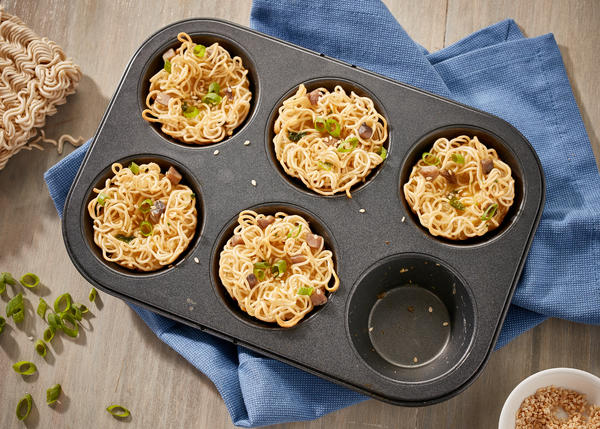
Ramen Egg Cups
PREP TIME: 10 min.
MAKES: 12
INGREDIENTS:
2 x 85g ramen noodles, cooked according to package directions
Egg Creations Whole Eggs Original Mushroom & Spinach
1 tbsp (15 mL) soy sauce
1 tsp (5 mL) hot sauce, plus extra to serve
¼ cup (60 mL) sliced green onions, plus extra to serve
DIRECTIONS:
1. Grease well a 12-cup muffin tin with cooking spray. Preheat oven to 350°F (180°C).
2. Place cooked ramen noodles in a large bowl. Pour over Egg Creations Whole Eggs Original Mushroom & Spinach. Stir to combine. Equally divide noodles into prepared muffin tin, letting excess egg drip back into bowl. Leave a dip in the middle of each noodle “nest” using your hands. Place in the oven and bake 5 min., to set noodles.
3. To remaining Egg Creations Original Mushroom & Spinach add soy sauce, hot sauce and green onions. Divide egg mixture between ramen “nests”. Continue to bake in oven until egg has completely set, 10 – 12 min. Remove egg cups from muffin tin, using a butter knife to loosen edges if necessary.
4. Top with extra hot sauce and a sprinkle of extra green onions, if using before serving.
TIPS:
* Use leftover spaghetti noodles instead of ramen noodles.
* Try adding a drop of sesame oil and a sprinkle of sesame seeds to ramen cups.
* Replace green onions with chopped cilantro or chopped fresh basil.
HoneyColony redefines nutritional energy with a new super superfood called Equilibrium. Our specially formulated raw honey-based blend consists of organic and wildcrafted ingredients—cultivated with the highest standards to bring you energy and superfood yumminess with every serving.
To create this blend, we teamed up with former Bee Panacea formulator, Gosia Reed. Equilibrium is similar to Bee Panacea, but with turbo-boosted ingredients and quality control. Only the finest and most organic ingredients are used for Equilibrium, which we believe is the finest superfood mix available in the market today.
At the core of Equilibrium is raw honey. Eleven other potent superfoods are added—each one organic or wildcrafted, boasting numerous health benefits. The total 12 ingredients bring harmony to a life that faces any stress, toxins, and negative energy.
Equilibirum Superfood is made in small batches to ensure high quality, exact measurements, and consistency in every jar. To ensure our product never loses integrity, we use high-quality Biophotonic jars that only let sunlight in to improve the substances in each formula.
Equilibrium comes in three different flavors and offers three different functions. The first one, Energy, was designed for athletes or anyone who lives an active lifestyle. By naturally stimulating the nervous system, enhancing brain function, supporting muscle relief, and providing anti-inflammation support, each jar will keep you in the active zone. For those of us who who seize life in its whirlwind of activity, Equilibrium Energy offers the support you need for a mental and physical edge.
Phytoplankton – Phyotplankton is rich in trace elements and micro-nutrients, making it one of the most nutrient-dense superfoods on the planet. This helps support cell regeneration, repair DNA, reduce inflammation,boost immune system response, combat free radicals, and support organ, muscle, and joint function.
Double- Directory Adaptogenic Herbs – Adaptogenic herbs rebalance our body when we’re faced with environmental stressors, toxins from the food we eat, or stress from toxic people. They help stimulate the nervous system for a boost of energy without negative stimulant side effects.
ORMUS – Ormus is an element-rich substance that was discovered in 1975. A few of it’s many suggested health benefits include boosting immune function, increasing energy and strength, supporting healthier sleep, enhancing mood, improving brain function and promoting healthy pH balance.
Suggested Use: You only need a teaspoon a day of this super potent superfood blend, preferably on an empty stomach. However you can add it to a smoothie and have a teaspoon pre-workout. One 12 ounce jar should last you a month with a teaspoon per day. Extremely POTENT.
Why We Love It:
Superfood formula comprised of 12 inidvidual superfoods
Provides long-lasting, cellular energy
Increases stamina and endurance
Improves oxygen utilization for enhanced performance
Supports physical adaptability
Boosts electrolytes
Boosts anti-oxidants
Supports DNA and cellular repair
Enhances brain function
Anti-inflammation, anti-bacterial, anti-viral support
All bee products come from family-owned California farms
High quality jar protects from negative influences of light
Each batch receives Certificate of Analysis to ensure highest quality
Non-GMO
All ingredients certified Organic or wild-crfafted
Free of added sugar, gluten, soy, nuts, wheat, herbicides, and pesticides
PACKAGING
To preserve the sublime quality of the our products, we choose the highest quality glass jars. Comparable to the packaging materials available on the market, these innovative jars sufficiently protect the sensitive products from the quality-lessening influences of light. The Biophotonic jars work like natural filters, only letting in the sunlight that protects and improves the substances in each formula, making our products a trustworthy and essential food supplement in every household.
CONSISTENCY
Please note that due to the fact that we work only with raw, wild-crafted bee products and different types of honey, the consistency of the product may vary ( from more liquid to more solid) from jar to jar. It is normal to see some small particles on the top of the jar, these are simply herbs and superfoods. We recommend mixing the product before first use.
CUPON CODE: CLEAN
Burnbrae Farms: EGG Creations – Recipes
French Toast On-The-Go
PREP TIME: 10 min.
MAKES: 2
INGREDIENTS:
1 cup (250 mL) ½-inch diced day-old bread cubes
½ (250 mL) pkg Egg Creations Whole Eggs Original
2 tbsp (30 mL) milk
½ tsp (2 mL) cinnamon
1 tbsp (15 mL) brown sugar
Maple syrup, sliced fruit and berries, whipped cream, to serve (optional)
DIRECTIONS:
1. Pack ½ cup (125 mL) bread cubes into two, 2-cup (500 mL) mason jars. In a bowl whisk together Egg Creations Whole Eggs Original, milk, cinnamon and brown sugar. Pour mixture evenly between jars. Let soak for 5 min.
2. Place mason jars in microwave on low heat. Microwave for 1 – 2 min., on 30 sec., increments until French toast is cooked and egg has set. Keep a close eye on jars as they might bubble up.
3. Top with maple syrup, sliced fruit, berries and whipped cream (if using). Close jars with lids for a breakfast on-the-go.
TIPS:
* Try using egg bread for a sweeter version of French toast on-the-go.
* Add different spices like a pinch of nutmeg or pumpkin pie spice.
* Let bread soak in French toast mixture overnight and microwave in the morning for breakfast.
Wait times down in emergency, but still long for some patients
Population growth and aging strain capacity of Ontario's emergency departments
TORONTO, Nov. 15, 2016 /CNW/ - People are seeing doctors more quickly when they arrive in Ontario's emergency departments (EDs) and overall their visits are shorter. This is despite an ever-increasing flow of patients who are becoming collectively older and sicker. Most Ontario residents are also satisfied with the care they receive in emergency.
But emergency departments are under a great deal of pressure. While progress has been made in overall performance, an emergency department could be strained by a bad flu season, or if a hospital nearby has to temporarily close its emergency department.
Those are the findings of Under Pressure: Emergency Department Performance in Ontario, a report released today by Health Quality Ontario, the provincial advisor on health care quality.
The good news includes a 10% drop over the last seven years in the maximum amount of time nine out of 10 patients spent in the ED – to 7.8 hours from 8.7 hours. There was also more than a 16% decrease in the maximum amount of time nine out of 10 patients waited in the emergency department to see a doctor – to 3 hours from 3.6.
However, the data also show that urban residents spend longer in the emergency department and wait longer to see a doctor in emergency than people living in rural areas. As well, many of the sickest patients in the province – those who need to be admitted to hospital – have to wait a long time in the emergency department for a bed in an inpatient ward. This is often because patients who should be receiving more appropriate care in other settings such as long term care remain in hospital. This is called alternate level of care and can impact the ability of hospital to move patients from the EDs to an inpatient ward.
"Patients may spend hours and sometimes even days lying on stretchers in emergency examination rooms or hallways," said Dr. Joshua Tepper, President and CEO of Health Quality Ontario.
Overcrowding can lead to poor quality of care, increased distress, illness and mortality among patients, and increased risk of medical errors by overworked staff. Under Pressure finds these stressors and others are likely to continue to affect emergency departments for many years to come as the province's population both grows in size and ages overall.
The report shows growth in emergency department visits is outpacing population growth. Over the past seven years, the number of annual visits to Ontario's emergency departments increased 13.4% – more than double the 6.2% increase in the province's population.
Patients are also sicker overall. Visits by more seriously ill or "high-acuity" patients who were not admitted to hospital increased by 44.1%, and visits by patients who were admitted rose 17.5%.
Some of this increase in patient acuity can be attributed to a rise in visits by older patients, who tend to require more complex care. There was a 29.1% increase in visits by people aged 65 and over.
The report also outlines some of the programs and strategies that have been implemented to relieve the pressure on emergency departments in the province. These include the Emergency Room Wait Time Strategylaunched in 2008, the Ministry of Health and Long-Term Care's Patients First action plan, and Health Quality Ontario's Emergency Department Return Visit Quality Program.
"Even with the demographic challenges the province is facing, the concerted efforts made by government, hospitals and others to improve the performance of Ontario's emergency departments have brought many positive changes," said Dr. Tepper. "But it's clear that much work still needs to be done to make emergency departments work better for all patients."
OTHER KEY REPORT FINDINGS:
More emergency visits are meeting overall provincial targets for length of stay and wait to see a doctor. Between 2008/09 and 2014/15:
The proportion of visits completed within the four-hour target for non-admitted low-acuity patients increased to 89.9% from 84.6%, and the proportion of visits completed within the eight-hour target for high-acuity patients and admitted patients taken together as a group rose to 85.7% from 79.8%
The majority of people in Ontario appear to be satisfied with the emergency care they receive. In a 2014/15 patient experience survey:
72.6% of respondents reported receiving excellent, very good or good care, with the other 27.4% rating their care as fair or poor
Some admitted patients spend a long time in emergency. In 2014/15:
The maximum amount of time nine out of 10 admitted patients spent in emergency – was 29.4 hours
Some patients who are more seriously ill wait longer to see a doctor than less seriously ill patients. In 2014/15:
The maximum amount of time nine out 10 patients waited in emergency to see a doctor was 3.1 hours for admitted patients and 3.2 hours for high-acuity discharged patients, compared to 2.7 hours for low-acuity discharged patients
Urban residents spend more time in emergency and wait longer to see a doctor. In 2014/15:
The maximum amount of time nine out of 10 urban residents spent in emergency was 8.3 hours, compared to 5.6 hours for rural residents
The maximum amount of time nine out of 10 urban residents waited in emergency to see a doctor was 3.1 hours overall for all acuity levels, and 2.6 hours for rural residents
Many patients visit the emergency department for less serious health issues. In 2013:
47% of adult Ontarians reported going to emergency for a condition they thought could have been treated by their primary care provider, if that doctor, nurse practitioner or other provider had been available. This rate was higher for Ontario than for its socioeconomically similar international counterparts, with Switzerland coming in at 36% and France lowest at 24%.
Health Quality Ontario (HQO) is the provincial advisor on the quality of health care. HQO reports to the public on the quality of the health care system, evaluates the effectiveness of new health care technologies and services, and supports quality improvement throughout the system. Visit www.hqontario.ca for more information.
Finding that perfect holiday gift for everyone on your list can add an unnecessary stress to the already hectic holidays. HelloFresh is delicious gift that can be delivered to everyone on your list, including:
- Parents, grandparents and in-laws who enjoy cooking and could use a new and refreshing recipe.
- Practical people who want a gift that has use, like ingredients to make a delicious dinner!
- Fit foodies who like delicious and satisfying meals that are also nutritious.
- Couples or significant other who you’re not sure what to give but cooking dinner together is a great way to bond.
- Friends you forgot who deserve a great gift and don’t want to show it was purchased last minute.
For everyone on your shopping list, HelloFresh offers the opportunity to enjoy healthy home-cooked meals without the hassle! Eliminating the need to plan or shop, HelloFresh delivers delicious and satisfying meals that are easy and fun to make in just about 30 minutes. Gift cards are available at HelloFresh.ca.
So much more than a gift, the benefits of cooking a HelloFresh meal at home are endless, from building healthy eating habits to learning new cooking techniques and bonding over creating a meal together.
ExamOne joins Manulife Vitality to provide free annual wellness checkup
"Vitality Check" provides another opportunity to earn Vitality Points
Manulife today announced that ExamOne has joined the Manulife Vitality program as a provider of Vitality Check, a physical fitness checkup for Manulife Vitality members. The goal of this free service is to give members an update on their general health and health risks. Manulife Vitality members who choose to participate in this optional service will also earn Vitality Points toward their Vitality Status, which can lead to rewards including discounts on their life insurance premiums.
Manulife Vitality members choosing to have a Vitality Check can do so through their preferred health provider (accredited medical practitioner/doctor) or by ExamOne, in a location of the member's choice.
"Vitality Check provides an additional level of insight into one's overall health," said Blake Hill, Head of the Manulife Vitality program. "Not all provincial health care systems cover the requirements and cost of a health review equivalent to Vitality Check so we have joined with ExamOne to provide it free of charge to Manulife Vitality members."
Vitality Check includes a collection and reporting of members' blood pressure, glucose, cholesterol and body mass index, and provides members with personal health information they can use to better understand their overall health and to make informed choices about their health care. Manulife Vitality rewards members with Vitality Points for simply choosing to complete a Vitality Check and learning about their health. Members can be further recognized with additional Vitality Points if their biometric measures are within healthy ranges.
Members connect with ExamOne through the Manulife Vitality secure member website, and will be connected with a local paramedical professional. The ExamOne representative will arrange for the checkup in a location of the member's choice, including their home or workplace. Results are only provided to the member and to The Vitality Group Inc., the administrator of the program in order to award the Vitality Points.
Manulife Vitality is a whole new approach to life insurance. It is a personalized wellness program that offers rewards when you make choices to live a healthier life. You can accumulate Vitality Points for routine activities you may already be doing to stay healthy. With Manulife Vitality, your life insurance has the potential to save you money and reward you for living a healthier life. Members of the Manulife Vitality program earn Vitality Points when they complete healthy living activities, such as health education courses, exercising, getting an annual health checkup, or even a flu shot. The number of Vitality Points a member accumulates over the course of a year determines their Vitality Status level. The greater the status that the member attains in the Manulife Vitality program the more they can enjoy the program rewards and benefits.
About Manulife Manulife Financial Corporation is a leading international financial services group providing forward-thinking solutions to help people with their big financial decisions. We operate as John Hancock in the United States, and Manulife elsewhere. We provide financial advice, insurance and wealth and asset management solutions for individuals, groups and institutions. At the end of 2015, we had approximately 34,000 employees, 63,000 agents, and thousands of distribution partners, serving 20 million customers. At the end of September 2016, we had $966 billion (US$736 billion) in assets under management and administration, and in the previous 12 months we made more than $24.4 billion in benefits, interest and other payments to our customers. Our principal operations are in Asia, Canada and the United States where we have served customers for more than 100 years. With our global headquarters in Toronto, Canada, we trade as 'MFC' on the Toronto, New York, and the Philippine stock exchanges and under '945' in Hong Kong. Follow Manulife on Twitter @ManulifeNews or visit manulife.com or johnhancock.com.
About Vitality The Vitality Group is a member of Discovery Ltd., a global financial services organization offering an incentive-based health and well-being program to employers, as part of their benefits program, and to insurers. With a foundation based on actuarial science and behavioral economic theory, Vitality encourages changes in lifestyle that reduce healthcare costs, both in the short run and long term, by rewarding members for addressing their specific health issues. Vitality well-being programs serve companies in a wide range of sizes and industries, improving individuals' health and wellbeing as well as employers' bottom lines.
Vitality brings a global perspective through successful partnerships with large employers and best-in-class insurers around the world, in countries including the United States, United Kingdom, South Africa, China, Singapore, Australia, Hong Kong, and the Philippines. Additional information can be found at thevitalitygroup.com.
TRAIN IT RIGHT NEWSLETTER
Sign Up and get a free 7 day Train it Right HIIT Program!