How Exercising Incorrectly Can Cause Serious Damage to Your Limbs
Finding new ways to exercise daily has become increasingly easier thanks to modern technology. Staying in shape has positive impacts on both the body and mind, but it is important to consider how you are getting the exercise you need. Many avenues for fitness might not teach the proper techniques. Exercising incorrectly could cause you an injury you didn't expect. Here are a few of the ways using improper movements could damage you.
Inflammation
Swinging heavy objects is one of the quickest ways you can build up strength. However, it is also one of the most dangerous in terms of the kinds of damage it can do to your limbs. This risk level comes partly from the fact that you'll use your arms to swing objects, but it is your lower limbs that provide the power you need to complete the rotation. In short, all of your limbs could be at risk for inflammation if you aren't careful. Make sure you use hamstrings and gluteus muscles to reduce strain on your shoulders here.
Cuff Tears
There are different exercises you can do to flex those upper limb muscles and work on your arms. Even if you don't do a lot of manual labor, it makes sense to keep your arms in shape for the everyday lifting or grabbing that you need to perform. However, exercises like a lateral pull-down normally place a great deal of stress on your rotator cuffs. You may even risk a cuff tear if you're not careful. If something feels off, stop these exercises and meet with asports medicine doctor who can offer you practical advice on how to move forward.
Imbalances and Strain
Many physical therapists actively avoid recommending leg extensions. Some circles agree that there is no natural position in life where the leg is extended fully with a lot of pressure working against it. Consequently, it is an exercise that could create a muscle imbalance or put great strain on areas that are already naturally tight, such as the toes and hip flexors.
Joint Issues
These exercises are designed to help your chest muscles, but they could pose a risk to your upper limbs. Many people start these exercises with lats that are underused at first. As a result, parts of the chest and arms work to compensate and help you do the moves. This effect can result in shoulder problems at the joints if left unchecked.
Various resources have ways of inspiring people to get moving and stay active in different ways. The wealth of information at your disposal means that you can tailor a workout routine to fit any goal, style, or schedule you prefer. The trick is to make sure that you aren't just copying the text, videos, or diagrams you might see. Knowing how to perform an exercise safely could mitigate the risk of an injury or hospital visit. It's important to understand that while any exercise you do incorrectly could be problematic, some of them are more likely than others to cause injury.
Broken and Beautiful: Let God Turn Your Mess into a Masterpiece
Seattle, WA, March 19, 2021 — If you have a past of brokenness—abuse, dysfunction, addiction or other trauma—it doesn’t have to define your future. There is hope for a brighter path forward if we let God lead the way.
“We’re going to fail. The truth is, that’s exactly where God wants us to be so that He can grow us,” writes Christine Soule in her inspirational story, Broken and Beautiful. “The key is discovering who you are in Christ — your true identify. And that’s especially significant if you, like me, have a past of brokenness.”
Soule’s life was a jumbled pile of broken pieces. Her father was married seven times; her mother four times. Between her parents’ divorce when she was 5 years old and the day she allowed the power and presence of God into her heart, she watched her sister have an affair with her adoptive father; met 15 siblings she never knew at her biological father’s funeral; turned to drugs and alcohol; got pregnant at 17; had twins less than two years later; and became a victim of human trafficking. She had to break the cycle for the sake of her children. With nowhere else to turn, she dropped to her knees and prayed. And that’s when everything changed.
Broken and Beautiful is Soule’s remarkable story of how God took the pieces of her broken, astonishingly dysfunctional life and transformed it all into a breathtaking mosaic of joy and purpose.
“The places where you feel hopeless are exactly what He wants to redeem and fill with beauty, dignity and strength. He has a plan for your pain. A wonderful intention for your failures. A purpose for your hardest, darkest stories,” Soule writes.
Told with honesty and surprising touches of humor, Soule shares her journey from drug-addicted stripper to exuberant Jesus lover with a passion for helping others embrace God’s love. Broken and Beautiful is a raw, authentic story of hope, from a place of experience.
Author Christine Soule lives with the love of her life, Mitch Soule, in Seattle. They have five kids and three wonderful grandchildren. She is the founder and CEO of Providence Heights (www.providenceheights.org), a nonprofit created to house women and children in need and to provide counseling, education and jobs.
Biblical vs. Eastern Meditation: Brain Expert Explains the Benefits and the Differences
Chattanooga, TN, March 19, 2021 ― Meditation offers a drug-free way to lower your blood pressure and heart rate, and achieve better focus and concentration. But are all forms of meditation equally beneficial?
From psychiatrist and author of The God-Shaped Brain Timothy R. Jennings, M.D., comes a helpful guide that explains the differences between Eastern and biblical meditation—in both practice and outcome on brain and mind.
Meditation: Biblical Method Versus Eastern Method,A Guide to a Bible-based Experience with God documents the differences between biblical and Eastern meditation; describes divergent meditation methods and their impact on brain function and character outcomes; and demonstrates how readers can engage in healthy biblical meditation. Also included is a simple test to help readers determine which form of meditation they’re practicing.
Dr. Jennings describes Eastern meditation as a form of self-anesthesia that relieves transient emotional distress (like pain medication for an injury) without providing an actual cure for the problem.
Alternatively, biblical meditation is like surgery for the soul, he explains. It takes one through the valley of the shadow of death, removes the cause of the emotional distress and cures the problem, resulting in genuine peace for the soul.
The Bible tells us to meditate upon God’s word and God’s wonders in creation, and Meditation can help readers understand the practice of biblical meditation so they can heal their hearts and minds, and return to their oneness with God and with each other.
Author Timothy R. Jennings, M.D., is a board-certified psychiatrist, international speaker and founder of Come and Reason Ministries. He operates a private practice in Chattanooga and has successfully treated thousands of patients. He is a Distinguished Fellow of the American Psychiatric Association and Life-Fellow of the Southern Psychiatric Association.
Dr. Jennings is also a prolific author whose books include The God-Shaped Brain: How Changing Your View of God Transforms Your Life; Could It Be This Simple? A Biblical Model for Healing the Mind; The Aging Brain: Proven Steps to Prevent Dementia and Sharpen Your Mind; and The God-Shaped Heart: How Correctly Understanding God’s Love Transforms Us.
To order your free copy (while supplies last) of Meditation: Biblical Method Versus Eastern Method, or to learn more about Dr. Timothy R. Jennings and his approach to brain and body health, please visit: www.comeandreason.com.
###
Biblical vs. Eastern Meditation: Brain Expert Explains the Benefits and the Differences
Chattanooga, TN, March 19, 2021 ― Meditation offers a drug-free way to lower your blood pressure and heart rate, and achieve better focus and concentration. But are all forms of meditation equally beneficial?
From psychiatrist and author of The God-Shaped Brain Timothy R. Jennings, M.D., comes a helpful guide that explains the differences between Eastern and biblical meditation—in both practice and outcome on brain and mind.
Meditation: Biblical Method Versus Eastern Method,A Guide to a Bible-based Experience with God documents the differences between biblical and Eastern meditation; describes divergent meditation methods and their impact on brain function and character outcomes; and demonstrates how readers can engage in healthy biblical meditation. Also included is a simple test to help readers determine which form of meditation they’re practicing.
Dr. Jennings describes Eastern meditation as a form of self-anesthesia that relieves transient emotional distress (like pain medication for an injury) without providing an actual cure for the problem.
Alternatively, biblical meditation is like surgery for the soul, he explains. It takes one through the valley of the shadow of death, removes the cause of the emotional distress and cures the problem, resulting in genuine peace for the soul.
The Bible tells us to meditate upon God’s word and God’s wonders in creation, and Meditation can help readers understand the practice of biblical meditation so they can heal their hearts and minds, and return to their oneness with God and with each other.
Author Timothy R. Jennings, M.D., is a board-certified psychiatrist, international speaker and founder of Come and Reason Ministries. He operates a private practice in Chattanooga and has successfully treated thousands of patients. He is a Distinguished Fellow of the American Psychiatric Association and Life-Fellow of the Southern Psychiatric Association.
Dr. Jennings is also a prolific author whose books include The God-Shaped Brain: How Changing Your View of God Transforms Your Life; Could It Be This Simple? A Biblical Model for Healing the Mind; The Aging Brain: Proven Steps to Prevent Dementia and Sharpen Your Mind; and The God-Shaped Heart: How Correctly Understanding God’s Love Transforms Us.
To order your free copy (while supplies last) of Meditation: Biblical Method Versus Eastern Method, or to learn more about Dr. Timothy R. Jennings and his approach to brain and body health, please visit: www.comeandreason.com.
###
Dismantle Social Constructs and Discover the Life You Were Meant to Live
Las Vegas, NV, March 19, 2021 — What better way to tackle existential angst than with a pint of Ben & Jerry’s Cherry Garcia? Or perhaps a more constructive way might be to take an introspective deep-dive into the ideologies you hold as true and ask yourself, “Is this the life I chose, or the one chosen for me?”
Christina Dylag’s Tiny Little Boxes: How to Cope with Existential Dread by Way of Ice Cream and Other Means takes readers on a soul-searching journey peppered with humor, philosophical musings and plenty of ice-cream-flavored metaphors to help them uncover any preconditioned social constructs and learn to distinguish between personal fact and fiction.
“A life constructed for us by society can be satisfying for a while, but at a certain point, the tension between who we want to be and who we are becomes unbearable,” Christina writes. “We want to follow our dreams and find fulfillment. We settle instead for a destiny carved for someone else. When we search for answers in religion or romance, we are still left with a nagging sense of emptiness.”
Christina’s book delivers a vastly different approach to the world of self-help. It’s unique, funny and fresh, with a free-flowing narrative that mirrors the fluidity of a stream of consciousness. Much of the book centers on the topic of straying from the norm and carving out a new and highly individualized path.
The result is a mind-broadening nudge that gives readers permission to live, to explore, and to break the barriers of their own little boxes. This book was written to expose and unravel the ideologies that we as humans unconsciously hold as truth, Christina explains. Tiny Little Boxes delves into our predetermined belief systems and how we might reassess or re-approach our conditioned world. Beyond our inherited notions of success, the self and existence lies a more expansive sense of freedom.
Christina Dylag is a writer and co-owner of Velveteen Rabbit, an award-winning craft cocktail bar in Las Vegas which has been featured in Forbes, The New York Times, The Wall Street Journal, Bon Appetit, Saveur, Vice, Maxim, Playboy, and others. Christina is 70 percent water, roughly 30 percent sushi and a shy whisper of human form. She lives in Las Vegas and will likely be survived by her giant pet rabbit, Steve.
For more insights from the author, please visit www.Nihilisticecream.com, or follow the author on Instagram (@nihilisticecream) or on Facebook (@nihilisticecream).
Tiny Little Boxes: How to Cope with Existential Dread by Way of Ice Cream and Other Means
Post-Traumatic Thriving Shares Essential Elements for Authentic Healing
Los Angeles, CA, March 19, 2021 — Trauma has a way of showing up when we least expect it, and society sends many signals telling us that it’s admirable to put on a brave face and soldier on. But our grief is normal — even healthy, says world-renowned expert on disasters and trauma Dr. Randall Bell.
“The hallmark error is to continually dodge the pain. There is a time and place for avoidance. However, to heal and grow, we cannot doge the pain forever …,” he writes in his new book, Post-Traumatic Thriving: The Art, Science, & Stories of Resilience. “Suffering is our opportunity to stare our moral compass in the eye and deal with the problem in a dignified way.”
Dr. Bell undertook unprecedented research, and juxtaposes outcomes of scientific studies with stories of real people (many of them familiar) who have used their trauma as their fuel to thrive to reveal common denominators. He divides his remarkable insights into three sections: The Dive Stage, The Survive Stage and The Thrive Stage, and outlines a step-by-step process toward authentic healing.
To inspire and connect with readers who’ve experienced trauma, he shares stories of remarkable resilience, including the following:
• A deaf man with a glass eye invented the electric guitar and became a household name, remarkably wealthy and most importantly, happy.
• A convicted murderer took responsibility for the damage he caused, graduated with honors from college, became a minister and turned around the hearts of the most hardened criminals.
• A girl born with cerebral palsy landed the world’s first starring role on national television and spoke at the White House three times.
• A woman hid in a basement for years and lost her entire family in the Holocaust. She eventually found true love and paints stunning artwork.
• The sister of a murder victim helped millions of women in toxic domestic relationships.
• A woman’s car crash resulted in an addiction to prescription drugs, a divorce, a loss of her children and a cot in a homeless shelter. She has rebuilt it all back and more.
• A man set to go to the Olympics had his hopes dashed by Jimmy Carter and went on to build a worldwide business empire.
Ultimately, Dr. Bell documents the science of happiness, as well as the individual styles and common thread that all post-traumatic thrivers have to emerge with a fulfilling life. When trauma hits, your most significant decision will be to dive, survive or thrive. If you choose to thrive, this book is for you.
As an economist, Dr. Randall Bell has consulted on more disasters on earth than anyone in history and is widely considered the world’s top authority in the field of post-traumatic thriving. His clients include the Federal Government, State Governments, International Tribunals, major corporations and homeowners. Dr. Bell believes that “the problem is not the problem — the problem is how we react to the problem.”
Often called the “Master of Disaster,” Dr. Bell is squarely focused on authentic recovery and resilience. His research has been profiled on major television shows and featured in numerous magazines and the international media. More information can be found at www.posttraumaticthriving.com.
Post-Traumatic Thriving: The Art, Science, & Stories of Resilience
Survey: Half of Canadians aren't confident public spaces are being properly disinfected
Clorox On-The-Go Disinfecting Wipes allows Canadians to take matters into their own hands
TORONTO, March 19, 2021 /CNW/ - Despite Canadians' excitement to re-engage and be out in the world in the months ahead, there are still concerns that high-touch public areas aren't being disinfected properly according to a Leger Survey commissioned by Clorox Canada (NYSE: CLX).
Over half of Canadians say they are uncomfortable with how often public bathrooms (57%), door handles (54%), gas station pumps (51%), and elevator buttons (51%) are disinfected. And many would rather take matters into their own hands just to be on the safe side.
Half (51%) say they wish they were able to disinfect surfaces outside their homes, especially women, and those with younger children. Six-in-ten (62%) of those surveyed agree they would be more confident going out if they knew they had a disinfecting wipe or spray with them while on-the-go.
"Canadians are patiently waiting to get back to some semblance of normalcy," says Melanie Plaz Casado, Vice President of Marketing for Clorox Canada. "While there are no guarantees about how the world will look in the months ahead, the survey has shown the key to being confident is being cautious – and Clorox On-The-Go Disinfecting Wipes allow Canadians to disinfect the surfaces they come in contact with."
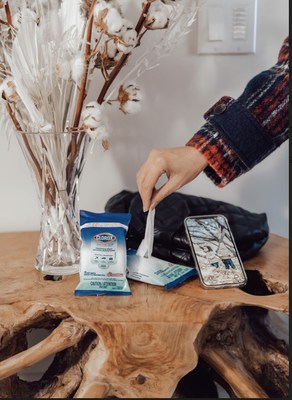
The disinfecting wipes are bleach-free and kill 99.99% of bacteria and viruses. Built for on-the-go, the wipes can support with a number of hard, non-porous surfaces such as cell phones*, door handles, credit or debit machines, elevator buttons, laptops*, gym equipment, light switches and certain children's toys.
"A lot of Canadians rely on public transportation, ridesharing and cabs, they need to drop their kids off at school and daycare, they're out running errands and grocery shopping," says Casado. "This gives them an option to carry disinfecting wipes in their cars, purses and bags so they can feel reassured as they re-engage."
The survey of over 1,500 Canadians was completed between February 19-21, 2021, using Leger's online panel and offers fresh insights on Canadians attitudes towards disinfecting while on-the-go.
Highlights include:
Six-in-ten say they disinfect at least one surface when they are outside their homes, with the average being nearly three surfaces, especially shopping cart handles (42%) and cell phones (33%).
Women are significantly more likely to disinfect most items when outside the home, and those with children under 18-years-old in the home more likely to disinfect many surfaces compared to those with no children.
Three-quarters keep disinfecting wipes in one or more locations outside the home; half keep some in two or more areas.
Clorox On-The-Go Disinfecting Wipes launched in January 2021. Suggested Retail Price 15 count- $1.99-$2.49 30 count - $2.99 - $3.29
Available at Walmart, Costco, Amazon, Loblaws, Sobeys, Metro, Save On Foods, London Drugs, Dollarama and Canadian Tire.
* For electronics check manufacturer guide for cleaning instructions
Note on Survey; No margin of error can be associated with a non-probability sample (i.e. a web panel in this case). For comparative purposes, though, a probability sample of 1,524 respondents would have a margin of error of ±2.5%, 19 times out of 20.
Leger's online panel has approximately 400,000 members nationally and has a retention rate of 90%.
SOURCE Clorox Canada
For further information:
For more information or high res images, please contact Adrienne Harry, Adrienne@devonconsulting.ca, 905-464-4167.
Improve Your Life and Career by Making the Most of Happy Accidents
San Diego, CA, March 19, 2021— Perhaps you were meant to read this article and it was meant to change your life. Serendipity is all around us, and it’s up to us to be aware of it, to explore its potential impact on our lives and to follow its gentle nudge toward positive outcomes whenever possible.
“Most people go through life believing that unexpected, fortuitous events that often bring fame and fortune happen to only a lucky few individuals,” says Neil J. Farber, MD. “The truth is that unexpected events frequently happen to all of us. They may not bring tremendous fame or fortune, but they can be recognized and utilized to significantly improve one’s professional and personal life.”
Dr. Farber’s new book, Serendipity: Utilizing Common Unexpected Events to Improve Your Life and Career, thoroughly explores the role that serendipity could play in our lives and explains that recognizing serendipitous events is better achieved with a certain set of skills.
“You have to have a mind-set that allows you to think that such events canhappen,” he explains, adding that by practicing self-awareness and cultivating keen visual and auditory observational skills, we are more likely to spot even the most subtle of serendipitous happenings.
Serendipity describes how to understand the different types of serendipitous events and how they are common to all of us; how to recognize these events when they do occur; how to acquire the skills necessary to become more aware of serendipity; how to “connect the dots” to bring the serendipitous event to a fortuitous conclusion (that is, what skills, assistance and resources may be necessary); and what to do with the end product or idea if it is profitable, or as sometimes happens, when it is not.
Dr. Farber uses events recorded in literature and the history books, as well as events that have occurred in his own personal and professional life to create a helpful guide for recognizing and turning common events into meaningful moments.
Author Neil J. Farber is a Professor Emeritus of Clinical Medicine at University of California, San Diego, and a docent at the San Diego Air & Space Museum. He has been an academic internal medicine physician for 40 years, teaching, researching and providing patient care in medical schools initially on the East Coast. For the past 12 years, he was Professor of Clinical Medicine at University of California, San Diego, retiring at the end of April 2019. He has received numerous awards, including Top Doctor of San Diego five times, and is a member of the FDA Non-Prescription Drug Advisory Committee. He has published over 60 research papers and has had a multitude of serendipitous events occur, which have significantly (and positively) influenced his career and his personal life.
Serendipity: Utilizing Common Unexpected Events to Improve Your Life and Career
Oldest Outdoor Group in US Challenges You to Spend 2 Hours Outside Each Week—6 Survival Tips
New York City, NY, March 19, 2021 — This winter, the Appalachian Mountain Club (www.outdoors.org), the oldest outdoor group in the United States, challenges you to spend two hours of outdoor exercise every week (social distancing, of course). Even though the entire country is experiencing two fewer weeks of snow cover compared to 100 years ago, wherever you live in America, getting outdoors regularly will provide mental benefits as well as physical ones. Despite the fact winter may be fundamentally shifting, AMC’s Colby Meehan, Leadership Training Manager, reveals six survival tips for thriving, surviving and basking in everything Mother Nature has to offer during winter 2021:
1. Plan your adventure: Avoid a 911 emergency by mapping out your exact route, choosing an alternate route for emergencies and calculating how long your roundtrip excursion will be. Make a trip plan and bring things like high-energy snacks and water for a more enjoyable day out.
2. Find the forecast:Check the forecast before you go by listening/watching/reading your favorite weather predictions in advance. This will help you prepare for the appropriate climate while you are out and about. Observe weather changes as they emerge and change your plan for the day as needed to avoid severe weather.
3. Dress appropriately: Carry the right gear based on the weather predictions to pack appropriately. Understanding how to layer for winter makes a world of difference. Avoiding fabrics like cotton and opting for ones like polyester or wool can turn a miserable, risky outing into a pleasant one. For good measure, take extra pairs of gloves, mittens and socks for especially cold temperatures.
4. Build a safe and protected outdoor living space: To guarantee a fun and safe small gathering under COVID conditions, you can create the perfect outdoor living space on a variety of different budgets. Fire pits are affordable, secure heat sources, and waterproof seating offers comfort while keeping you dry. Prep meals in advance so you can focus on fun and enjoy your time outside. Maintain social distancing guidelines (at least 6 feet apart) from other campsites when making your own.Finally, remember the Leave No Trace principles when you leave, which ask you to carry out anything that does not belong in nature.
5. Outdoor recreation and wellness: Winter brings a multitude of activities and sports. It can be as advanced as snowboarding and skiing; but you can also have a blast without snow by jogging, picnicking or hiking. Studies show that spending at least 120 minutes outdoors every week boosts your well-being.
6. Explore the city outdoors: City dwellers also have ways to revel outside during COVID. Whether you decide to walk around your neighborhood for 20 minutes a day, take up birdwatching in a local park for an afternoon or even study the surrounding architecture, time spent outside is good for you.
The mission of the Appalachian Mountain Club is to foster the protection, enjoyment and understanding of the outdoors. They envision a world where our natural resources are healthy, loved and always protected, and where the outdoors occupies a place of central importance in every person’s life. For more information, please visit www.outdoors.org.
Oldest Outdoor Group in US Challenges You to Spend 2 Hours Outside Each Week—6 Survival Tips
New York City, NY, March 19, 2021 — This winter, the Appalachian Mountain Club (www.outdoors.org), the oldest outdoor group in the United States, challenges you to spend two hours of outdoor exercise every week (social distancing, of course). Even though the entire country is experiencing two fewer weeks of snow cover compared to 100 years ago, wherever you live in America, getting outdoors regularly will provide mental benefits as well as physical ones. Despite the fact winter may be fundamentally shifting, AMC’s Colby Meehan, Leadership Training Manager, reveals six survival tips for thriving, surviving and basking in everything Mother Nature has to offer during winter 2021:
1. Plan your adventure: Avoid a 911 emergency by mapping out your exact route, choosing an alternate route for emergencies and calculating how long your roundtrip excursion will be. Make a trip plan and bring things like high-energy snacks and water for a more enjoyable day out.
2. Find the forecast:Check the forecast before you go by listening/watching/reading your favorite weather predictions in advance. This will help you prepare for the appropriate climate while you are out and about. Observe weather changes as they emerge and change your plan for the day as needed to avoid severe weather.
3. Dress appropriately: Carry the right gear based on the weather predictions to pack appropriately. Understanding how to layer for winter makes a world of difference. Avoiding fabrics like cotton and opting for ones like polyester or wool can turn a miserable, risky outing into a pleasant one. For good measure, take extra pairs of gloves, mittens and socks for especially cold temperatures.
4. Build a safe and protected outdoor living space: To guarantee a fun and safe small gathering under COVID conditions, you can create the perfect outdoor living space on a variety of different budgets. Fire pits are affordable, secure heat sources, and waterproof seating offers comfort while keeping you dry. Prep meals in advance so you can focus on fun and enjoy your time outside. Maintain social distancing guidelines (at least 6 feet apart) from other campsites when making your own.Finally, remember the Leave No Trace principles when you leave, which ask you to carry out anything that does not belong in nature.
5. Outdoor recreation and wellness: Winter brings a multitude of activities and sports. It can be as advanced as snowboarding and skiing; but you can also have a blast without snow by jogging, picnicking or hiking. Studies show that spending at least 120 minutes outdoors every week boosts your well-being.
6. Explore the city outdoors: City dwellers also have ways to revel outside during COVID. Whether you decide to walk around your neighborhood for 20 minutes a day, take up birdwatching in a local park for an afternoon or even study the surrounding architecture, time spent outside is good for you.
The mission of the Appalachian Mountain Club is to foster the protection, enjoyment and understanding of the outdoors. They envision a world where our natural resources are healthy, loved and always protected, and where the outdoors occupies a place of central importance in every person’s life. For more information, please visit www.outdoors.org.
TRAIN IT RIGHT NEWSLETTER
Sign Up and get a free 7 day Train it Right HIIT Program!