Sun Life donates $100,000 to support underrepresented researchers
Donation to Women's College Hospital establishes The Sun Life Awards for Excellence in Research
TORONTO, Feb. 24, 2021 /CNW/ - Sun Life is donating $100,000 to The Emily Stowe Society at Women's College Hospital Foundation to empower and support underrepresented communities. The donation will establish The Sun Life Awards for Excellence in Research. Preference will be given to researchers or scholars who identify as female or gender-diverse, are from the Black community and who specialize in diabetes or mental health research in the Black community.
This donation aligns with Sun Life's Diversity, Equity and Inclusion (DE&I) commitment to address health inequities in communities historically underrepresented from a funding and research perspective, and who see a greater risk of diabetes and mental health challenges.
"We continue to build on our DE&I commitments, ensuring everyone has equal access to opportunities and resources," said Jacques Goulet, President, Sun Life Canada. "Our purpose is to help Canadians live healthier lives, and we are actively working to remove systemic barriers that negatively affect the lives of Black, Indigenous and other underrepresented populations. Diabetes is Sun Life's global philanthropic cause, while the mental health crisis has been a growing concern for us in Canada. Establishing these awards will help future generations of researchers uncover new preventions, treatments and cures."
The Emily Stowe Society is named in honour of Dr. Emily Stowe, Canada's first woman doctor and the founder of Women's College Hospital. It is dedicated to breaking down barriers to careers in health sciences research. The Sun Life Awards for Excellence in Research will help increase the number of women and underrepresented scholars in health, research and leadership positions.
"It's with tremendous gratitude that we celebrate Sun Life's commitment to Women's College Hospital and the Emily Stowe Society," says Jennifer Bernard, President and CEO, Women's College Hospital Foundation. "In Canada today, women – and particularly women from diverse communities – continue to be underrepresented at all levels of the health sciences field. Without equity in the health research community, we simply cannot achieve equity in healthcare. The Sun Life Awards for Excellence in Research will help advance this mission for equity while attracting, advancing and retaining exceptional and deserving researchers at every stage of their career."
As a global industry leader committed to sustainability, Sun Life has a responsibility to help create lasting social change. Sun Life is taking actionable steps to remove systemic barriers for Clients, advisors, communities and employees.
Clients and the Community Sun Life is focused on creating an inclusive environment that reflects the diversity of our Clients and communities:
Signed on to the goals of the BlackNorth Initiative, led by the Canadian Council of Business Leaders Against Anti-Black Racism, to help remove systemic barriers that negatively affect Black Canadians.
Donated $60,000 to the Canadian Race Relations Foundation to support their effort in addressing discrimination, and an additional $40,000 to various charities supporting DE&I initiatives in Canada in 2020.
Signed the #DearEverybody agreement, a commitment to ensure our marketing is inclusive of people with disabilities and reflects everyone in our communities.
Employees Sun Life continues to build a culture where employees see themselves reflected at all levels of the company, and feel included and engaged:
Created numerous inclusion networks for colleagues to come together, share experiences and drive social change across the organization. The networks helped allocate donation funds to various Canadian charities.
Launched Inclusion Works, a peer-to-peer learning program, designed to train employees on unconscious bias, commit to conscious actions and enable acts of inclusion into their daily behaviours.
Reaffirmed our goal to have 25 per cent of underrepresented minorities at the vice-president level and above by 2025, with specific representation objectives for Black, Indigenous and People of Colour. Further, set a new goal to achieve gender parity at the vice-president level and above by 2025.
As outlined in Sun Life's 2019 Sustainability Report, our efforts in DE&I are directly aligned with our purpose, business strategy and ultimate success as a company.
Sun Life in the community At Sun Life, we are committed to building sustainable, healthier communities for life. Community wellness is an important part of our sustainability commitment and we believe that by actively supporting the communities in which we live and work, we can help build a positive environment for our Clients, employees, advisors and shareholders. Our philanthropic support focuses on health, with an emphasis on diabetes awareness, prevention, and care initiatives through our Team Up Against Diabetes™ platform; and mental health, supporting programs and organizations with a focus on building resilience and coping skills.
We also partner with sports properties in key markets to further our commitment to healthy and active living. Our employees and advisors take great pride in volunteering close to 12,000 hours each year and contribute to making life brighter for individuals and families across Canada.
About Sun Life Sun Life is a leading international financial services organization providing insurance, wealth and asset management solutions to individual and corporate Clients. Sun Life has operations in a number of markets worldwide, including Canada, the United States, the United Kingdom, Ireland, Hong Kong, the Philippines, Japan, Indonesia, India, China, Australia, Singapore, Vietnam, Malaysia and Bermuda. As of December 31, 2020, Sun Life had total assets under management of $1,247 billion. For more information please visit www.sunlife.com.
Sun Life Financial Inc. trades on the Toronto (TSX), New York (NYSE) and Philippine (PSE) stock exchanges under the ticker symbol SLF.
About Women's College Hospital Women's College Hospital is Canada's leader in advancing health for women and a global leader in conducting groundbreaking women's health research. As the first and only fully independent hospital focused on women, Women's is building on its 100+ year history as a trailblazer in identifying and addressing health gaps and delivering pioneering firsts for women, the vulnerable and the underserved.
Women's is also the only fully ambulatory, academic healthcare institution in Canada, with a provincial mandate to lead the way in improving the health system for all people. Women's achieves this by addressing the most pressing health system challenges facing Canadians today and proactively confronting the gender and social inequities that threaten people's health.
Women's College Hospital Foundation fuels the hospital's excellence in research and health care by connecting donors, partners, advocates and volunteers to its mission. We work to bring healthcare equity to the diverse communities in which we live and serve and, together, we are creating a healthier and more equitable world for women and for all.
Note to editors: All figures in Canadian dollars
Media Relations Contact: Meredith Mundick Manager, Corporate Communications T. 416-979-4048 meredith.mundick@sunlife.com
Laura Zarnke Senior Communications Officer Women's College Hospital Foundation 647-469-5136 Laura.zarnke@wchospital.ca
SOURCE Sun Life Financial Inc.
Pharmacists Gearing Up To Begin COVID-19 Vaccination
EDMONTON, AB, Feb. 24, 2021 /CNW/ - Alberta's community pharmacists are readying themselves to participate in Alberta's COVID-19 Immunization program. Today the province announced plans for expanding COVID-19 vaccination providers, which includes pharmacists working in community pharmacies able to offer vaccine to their patients Starting with a small group of Alberta pharmacies located in the Edmonton/Red Deer/Calgary corridor, vaccine will begin to be available starting in March, allowing seniors 75 and over an option to receive their COVID-19 vaccination from their trusted community pharmacist, with more pharmacies added as supply improves.
On February 16th, Alberta Health invited community pharmacists to begin applying to participate in Alberta's COVID-19 Immunization Program. By joining the program, community pharmacies were asked to confirm their readiness to meet provincial and public health expectations for the safe supply, storage, distribution, and administration of the vaccine. As the provincial vaccine supply increases, more pharmacies will be included to expand access to COVID-19 vaccine for Albertans across the province.
Community pharmacists in Alberta continue to play a vital role in supporting the health of Albertans throughout the pandemic, most recently having administered over 1 Million flu shots this season. Over the past 11 months, pharmacists have worked diligently to ensure that their patients continue to have access to needed medications, vaccinations, and trusted health information, despite the ongoing transmission of COVID-19 virus throughout the province. When other healthcare facilities temporarily closed, Alberta's community pharmacists rallied their efforts to ensure that pharmacies could remain open and available through increased safety and sanitization protocols.
As Alberta begins to see a glimpse of the light at the end of the pandemic tunnel, community pharmacists know that there is still much work to be done. Over the next several month's pharmacists will keep offering vaccinations for individuals according to the priority phasing approach described by the Alberta government and will once more be ready to meet the needs of Albertans at home in their communities.
The Alberta Pharmacists' Association (RxA) is tremendously proud of the continued efforts of all Alberta pharmacists who continue to play an integral role in the safe provision of medication therapy during these challenging times in our healthcare system. RxA recognizes and thanks Alberta Health for its commitment to engaging with our organization towards a collaborative approach to achieving public health goals through community pharmacists, for the benefit of all Albertans.
For two decades, the Alberta Pharmacists' Association (RxA) has been a champion for pharmacists in Alberta. We play an integral role in expanding pharmacists' practice, and we continue to advocate on their behalf towards excellence in patient care.
SOURCE Alberta Pharmacists' Association
Faith and Tenacity Continue to Drive 91-Year-Old Founder of Boston Area Homeless Shelter
Boston, MA, February 25, 2021 — Sylvia Anthony firmly believes that life is a gift from God, and she’s been using her gift to impact more than a thousand homeless women and children through her nonprofit, Sylvia’s Haven, which she launched in 1987. At 91 years young, Sylvia remains steadfastly involved with Sylvia’s Haven, and hopes to inspire others to overcome life’s challenges and pursue their passions.
“When we do the right thing with the right motives, there is no limit to how far we can go with the help of God,” she writes in her poignant memoir, Till the End of Time. “My advice to you is never give up, whatever comes your way; it is all worth it.”
Sylvia had endured a difficult childhood that included an abusive father and a disinterested mother. Sylvia married young and remained in an abusive marriage until a divorce that left her alone to support her three children. Through her ambition and strength of character, Sylvia persevered, building a life for herself and her kids. After raising her children, Sylvia remarried — still, there was a void. She felt a calling to help young women, and her husband, Rick, encouraged her to follow her heart. Initially designed for homeless pregnant women, her shelter opened on January 25, 1987. Sadly, her husband lost his battle with cancer on March 30 of the same year, telling Sylvia before he died to “go get the girls.” And she’s been giving new hope to young, homeless women ever since.
Hers has been a lifetime woven with tragedy and triumph, but at Sylvia’s core burns a powerful source of courage and tenacity. She shares her remarkable story in Till the End of Time, which chronicles her early days as an unwanted child, born at the onset of the Great Depression; through her turbulent first marriage, which blessed her with three children; to finding love and discovering her divine purpose later in life. The book includes a chapter with testimonials from women who have been helped by Sylvia’s Haven, underscoring the impact of her unwavering dedication to others. Till the End of Time is the ultimate love story, woven with heartwarming memories, inspirational anecdotes and life lessons that will inspire readers to share their own God-given gifts with others.
Author Sylvia Anthony was inducted into the National Women’s Hall of Fame on June 15, 2020. Invited to their museum in Seneca Falls, New York, she drove more than 350 miles for the appointment! Shortly thereafter, she received a Lifetime Achievement Award from Marquis Who's Who.
A woman of faith, courage, tenacity and love, Sylvia firmly believes that the “golden years” are a time to get busy. As the founder and president of Sylvia’s Haven, a shelter for women and children near Boston, she has helped transform over 1,100 lives in the past three decades. Sylvia refers to her organization as her “magnificent obsession.” Life hasn’t always been easy for Sylvia, but she believes that God not only gives her courage during times of hardship, but also keeps her healthy so that she may realize her dream to open up Sylvia’s Haven locations in all 50 states.
Till the End of Time rose to No.1 in four different categories when it was launched on Amazon and has received 5-star reviews.
Black Females More Likely Than Black Males to Exercise, Eat Healthy When Faced with Perceived Discrimination
Study Suggests Optimism Plays a Role
WASHINGTON — Black men and women, as well as adolescent boys and girls, may react differently to perceived racial discrimination, with Black women and girls engaging in more exercise and better eating habits than Black men and boys when faced with discrimination, according to research published by the American Psychological Association.
“In this study, Black women and girls didn’t just survive in the face of racism, they actually responded in a positive manner, in terms of their health behavior,” said lead researcher Frederick Gibbons, PhD, with the University of Connecticut. “This gives us some hope that despite the spike in racism across the country, some people are finding healthy ways to cope.”
For a paper published in the journal Health Psychology, researchers evaluated data collected over 14 years from an ongoing study on the impacts of racism on the physical and mental well-being of Black people. The analysis looked at 889 families living in Iowa and Georgia who have been participants in the Family and Community Health Study. The families consisted of an adolescent, the adolescent’s primary caregiver and in 289 cases, an older sibling. The first analysis examined the correlation between perceived racial discrimination and participants’ body mass index. Researchers then looked at how participants responded to survey questions on optimism and on eating and exercise habits.
The relationship between perceived racial discrimination and healthy habits in Black males was insignificant, the study found. Black women and adolescent girls, on the other hand, showed improvements in healthy eating and exercise as their perceptions of racism increased. And there was an even more significant increase in healthy behaviors for Black women who indicated they had an optimistic view of their lives and the future, according to the researchers. There was no correlation between racial discrimination and BMI in either Black males or Black females.
“The findings were surprising and suggest that adaptive coping strategies may lead to resiliency,” Gibbons said. “This contrasts with the avoidant coping strategies that we might see out of someone who is less optimistic.”
The findings should be placed in the context of the larger body of research on this issue, which has shown a correlation between perceived racial discrimination and unhealthy behaviors, including those leading to higher BMI, according to Gibbons.
“The question is why are these results different from the ones we’ve found in previous studies?” he said. “There are several possible explanations, including the fact that participants in previous studies may have conflated weight-based discrimination with perceived racial discrimination. It could also be that studies not finding a connection between perceived racial discrimination and poor health outcomes are less likely to be published.”
If the findings are confirmed in subsequent research, they could be used in resiliency programs targeting people of color and underserved populations, according to the researchers.
“There are programs already in place that work to instill a sense of resiliency and optimism in disenfranchised youth,” Gibbons said. “The findings from this study would suggest that these programs are on the right track, and that perhaps we should be developing more programs that focus on these types of coping skills.”
Article: “Perceived Racial Discrimination and Healthy Behavior Among African Americans,” by Frederick X. Gibbons, PhD, Meg Gerrard, PhD, and Mary E. Fleischli, PhD, University of Connecticut; Ronald L. Simons, PhD, University of Georgia; and John H. Kingsbury, PhD, Minnesota Department of Health. Health Psychology, published online Feb. 25, 2021.
New Year, New Outlook: Life Coach Shares Powerful Messages of Unity and Positivity
Stafford, TX, February 25, 2021 – Without question, 2020 was a difficult year on many levels. Life Coach Michael Taylor has a powerful call to action, intended to help readers focus on the factors that unite us as humans and view 2021 through a perspective of positivity.
“It is my belief that there has never been a better time to be alive on the planet than right now,” he says. “Obviously, I recognize all the challenges, but at the same time, I honestly believe that every human being has the capacity to be, to do and to have anything that they set their minds to.”
In his latest book, The Good News Is, The Future Is Brighter Than You Think!,the self-described “irrepressible optimist” uses science, spirituality and psychology to inform his insights into a range of topics, including:
•Being Human: Understanding what it means to be human, the role of trauma in our lives, how to move on from past trauma and taking 100 percent responsibility for our lives; •Divine Intelligence and Evolution: The Divine Intelligence as the creator of the universe, the driving force behind human evolution and how to use its power; •Spirituality: Recognition and acknowledgment of a connection to a power higher than oneself, the spiritual connection to the Divine Intelligence as a result of evolution; •Race: Realization that there is only one race and that is the human race — only through evolution will we heal our race relations and accept that we’re all the same; •Love: Accepting love as the highest power that can heal this universe and how to create meaningful connections and develop healthy intimate relationships; •Plus health, wealth, education, technology and everything in between!
“If you’ve been looking for a resource that inspires you and motivates you and lights you up, this is the book for you!” Taylor adds.
Author Michael Taylor is uniquely positioned to spread hope and optimism. A high school dropout, he overcamea divorce, bankruptcy, foreclosure, depression and being homeless for two years on his way to becoming a successful entrepreneur, motivational speaker, radio and TV host, and author of nine best-selling books. He has dedicated his life to empowering men and women to reach their full potential by transforming their lives from the inside out.
Taylor is President and CEO of Creation Publishing Group, a company that specializes in creating programs and products that empower men and women to live extraordinary lives,and Too Cool Club, a company that develops transformational education programs for youth. He has been featured in the Amazon.com bestselling book Motivational Speakers America and in USA Today magazine about the changing roles of manhood and masculinity in society. He has won numerous awards for his dynamic speaking style, and he is an Amazon.com bestselling author.
He is the host and producer of two TV Channels on the Roku Network, Joy Passion & Profit and Shatter The Stereotypes, and hosts two podcasts of the same names available on most podcast platforms like Spotify and iTunes.
Most importantly, he has been blissfully married for 18 years to the woman of his dreams and he is a proud father of three grown children.
New Year, New Outlook: Life Coach Shares Powerful Messages of Unity and Positivity
Stafford, TX, February 25, 2021 – Without question, 2020 was a difficult year on many levels. Life Coach Michael Taylor has a powerful call to action, intended to help readers focus on the factors that unite us as humans and view 2021 through a perspective of positivity.
“It is my belief that there has never been a better time to be alive on the planet than right now,” he says. “Obviously, I recognize all the challenges, but at the same time, I honestly believe that every human being has the capacity to be, to do and to have anything that they set their minds to.”
In his latest book, The Good News Is, The Future Is Brighter Than You Think!,the self-described “irrepressible optimist” uses science, spirituality and psychology to inform his insights into a range of topics, including:
•Being Human: Understanding what it means to be human, the role of trauma in our lives, how to move on from past trauma and taking 100 percent responsibility for our lives; •Divine Intelligence and Evolution: The Divine Intelligence as the creator of the universe, the driving force behind human evolution and how to use its power; •Spirituality: Recognition and acknowledgment of a connection to a power higher than oneself, the spiritual connection to the Divine Intelligence as a result of evolution; •Race: Realization that there is only one race and that is the human race — only through evolution will we heal our race relations and accept that we’re all the same; •Love: Accepting love as the highest power that can heal this universe and how to create meaningful connections and develop healthy intimate relationships; •Plus health, wealth, education, technology and everything in between!
“If you’ve been looking for a resource that inspires you and motivates you and lights you up, this is the book for you!” Taylor adds.
Author Michael Taylor is uniquely positioned to spread hope and optimism. A high school dropout, he overcamea divorce, bankruptcy, foreclosure, depression and being homeless for two years on his way to becoming a successful entrepreneur, motivational speaker, radio and TV host, and author of nine best-selling books. He has dedicated his life to empowering men and women to reach their full potential by transforming their lives from the inside out.
Taylor is President and CEO of Creation Publishing Group, a company that specializes in creating programs and products that empower men and women to live extraordinary lives,and Too Cool Club, a company that develops transformational education programs for youth. He has been featured in the Amazon.com bestselling book Motivational Speakers America and in USA Today magazine about the changing roles of manhood and masculinity in society. He has won numerous awards for his dynamic speaking style, and he is an Amazon.com bestselling author.
He is the host and producer of two TV Channels on the Roku Network, Joy Passion & Profit and Shatter The Stereotypes, and hosts two podcasts of the same names available on most podcast platforms like Spotify and iTunes.
Most importantly, he has been blissfully married for 18 years to the woman of his dreams and he is a proud father of three grown children.
Chip simplifies COVID-19 testing, delivers results on a phone Programmed magnetic nanobeads enable diagnostic device designed at Rice University
HOUSTON – (Feb. 25, 2021) – COVID-19 can be diagnosed in 55 minutes or less with the help of programmed magnetic nanobeads and a diagnostic tool that plugs into an off-the-shelf cell phone, according to Rice University engineers.
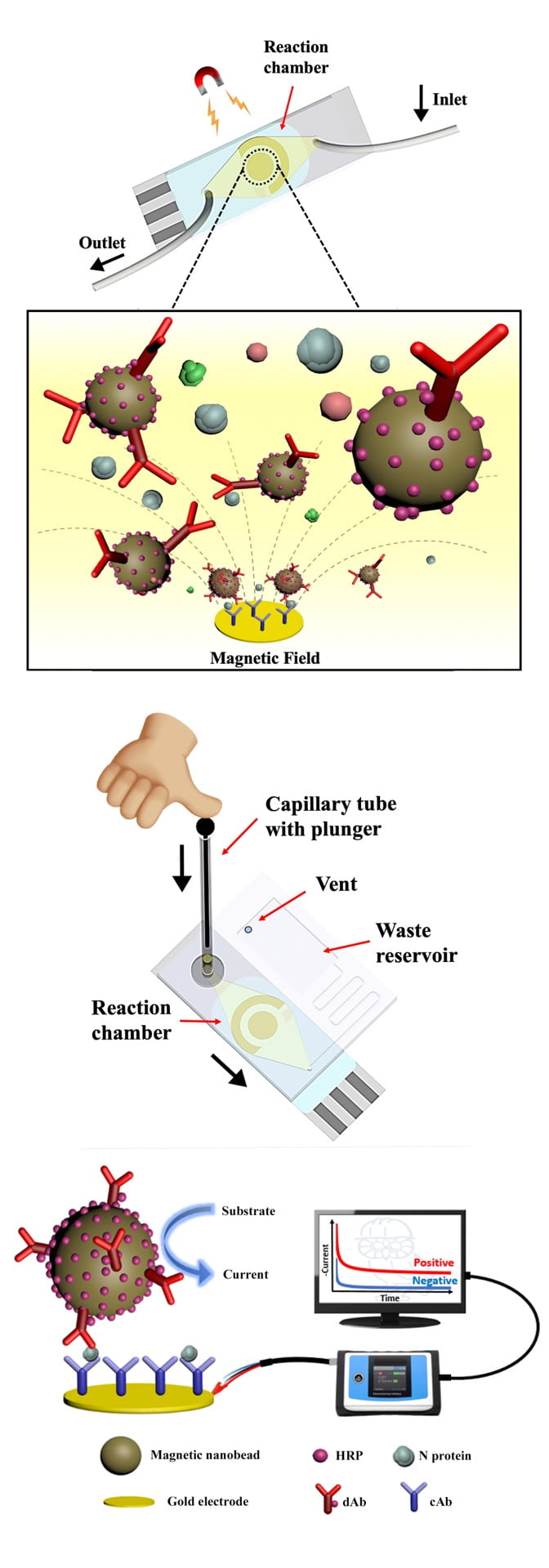
The Rice lab of mechanical engineer Peter Lillehoj has developed a stamp-sized microfluidic chip that measures the concentration of SARS-CoV-2 nucleocapsid (N) protein in blood serum from a standard finger prick. The nanobeads bind to SARS-CoV-2 N protein, a biomarker for COVID-19, in the chip and transport it to an electrochemical sensor that detects minute amounts of the biomarker.
The researchers argued their process simplifies sample handling compared to swab-based PCR tests that are widely used to diagnose COVID-19 and need to be analyzed in a laboratory.
“What’s great about this device is that doesn’t require a laboratory,” Lillehoj said. “You can perform the entire test and generate the results at the collection site, health clinic or even a pharmacy. The entire system is easily transportable and easy to use.”
The research appears in the American Chemical Society journal ACS Sensors.
Lillehoj and Rice graduate student and lead author Jiran Li took advantage of existing biosensing tools and combined them with their own experience in developing simple diagnostics, like a microneedle patch introduced last year to diagnose malaria.
The new tool relies on a slightly more complex detection scheme but delivers accurate, quantitative results in a short amount of time. To test the device, the lab relied on donated serum samples from people who were healthy and others who were COVID-19-positive.
Lillehoj said a longer incubation yields more accurate results when using whole serum. The lab found that 55 minutes was an optimum amount of time for the microchip to sense SARS-CoV-2 N protein at concentrations as low as 50 picograms (billionths of a gram) per milliliter in whole serum. The microchip could detect N protein in even lower concentrations, at 10 picograms per milliliter, in only 25 minutes by diluting the serum fivefold.
Paired with a Google Pixel 2 phone and a plug-in potentiostat, it was able to deliver a positive diagnosis with a concentration as low as 230 picograms for whole serum.
“There are standard procedures to modify the beads with an antibody that targets a particular biomarker,” Lillehoj said. “When you combine them with a sample containing the biomarker, in this case SARS-CoV-2 N protein, they bond together.”
A capillary tube is used to deliver the sample to the chip, which is then placed on a magnet that pulls the beads toward an electrochemical sensor coated with capture antibodies. The beads bind to the capture antibodies and generate a current proportional to the concentration of biomarker in the sample.
The potentiostat reads that current and sends a signal to its phone app. If there are no COVID-19 biomarkers, the beads do not bind to the sensor and get washed away inside the chip.
Lillehoj said it would not be difficult for industry to manufacture the microfluidic chips or to adapt them to new COVID-19 strains if and when that becomes necessary.
The National Institutes of Health, the National Science Foundation and the Rice University COVID-19 Research Fund supported the research.
A system developed by Rice University engineers employs a stamp-sized microfluidic chip that measures the concentration of SARS-CoV-2 nucleocapsid protein in blood serum to diagnose COVID-19 in less than an hour. The system uses an off-the-shelf cellphone and potentiostat to deliver the results. (Credit: Lillehoj Research Group/Rice University)
Programmed magnetic nanobeads paired with an off-the-shelf cellphone and plug-in diagnostic tool can diagnose COVID-19 in 55 minutes or less, according to Rice University engineers. (Credit: Jeff Fitlow/Rice University)
Rice University mechanical engineer Peter Lillehoj, left, and graduate student Jiran Li developed a system that uses programmable magnetic nanobeads, an off-the-shelf cellphone and a plug-in diagnostic tool to diagnose COVID-19 in 55 minutes or less. (Credit: Jeff Fitlow/Rice University)
Located on a 300-acre forested campus in Houston, Rice University is consistently ranked among the nation’s top 20 universities by U.S. News & World Report. Rice has highly respected schools of Architecture, Business, Continuing Studies, Engineering, Humanities, Music, Natural Sciences and Social Sciences and is home to the Baker Institute for Public Policy. With 3,978 undergraduates and 3,192 graduate students, Rice’s undergraduate student-to-faculty ratio is just under 6-to-1. Its residential college system builds close-knit communities and lifelong friendships, just one reason why Rice is ranked No. 1 for lots of race/class interaction and No. 1 for quality of life by the Princeton Review. Rice is also rated as a best value among private universities by Kiplinger’s Personal Finance.
Weak U.S. Dollar Benefits Some Agriculture Commodities, But Not All
Shifts in currency values boost export opportunities for many ag commodities, create headwinds for others
DENVER (February 25, 2021)—The value of the U.S. dollar weakened substantially since March 2020 and is expected to experience modest deflation in 2021. A weaker dollar generally makes U.S. agricultural products more competitive on the global export market. However, not all commodities are affected equally given the diversity in global export competition and foreign exchange rates.
Fundamental factors like tariffs and weather conditions in key agricultural producing regions often dominate market dynamics despite currency headwinds or tailwinds and should not be discounted, according to a new report from CoBank’s Knowledge Exchange.
“U.S. agricultural exports are largely expected to continue a faster pace in 2021 with help from weakness in the U.S. dollar,” said Tanner Ehmke, manager of CoBank’s Knowledge Exchange. “But our research indicates that some agricultural commodities like grains, oilseeds, and cotton will face a currency headwind.”
CoBank’s estimates on commodity-specific trade weighted balances reveals a nuanced view of currency implications for U.S. agricultural exports in 2021. Animal ProteinAfter a challenging currency environment in 2020, U.S. animal protein exports are expected to benefit from a modest tailwind fueled by a weaker U.S. dollar in 2021. The outlook for a stronger Australian dollar and euro should make U.S. beef and pork exports the largest beneficiaries in the coming year.
Beyond currency, other drivers signaling a good year for U.S. protein exports in 2021 include less disruption to U.S. meat processing capacity, the rebound in global foodservice demand, and the upward trend in China’s meat and poultry imports. Grain & OilseedsThe U.S. trade weighted grain and oilseed index stands out relative to other agriculture commodities. The index strengthened by 14% in 2020 and is expected to gain another 4%-5% in 2021. The further strengthening of the grain and oilseed index is driven by the U.S. dollar’s strength relative to the currencies of major exporters like Brazil, Argentina and Ukraine.
“A casual observer could argue that corn and soybean exports will face headwinds in 2021 since the index strength implies that U.S. exports become less price competitive,” said Kenneth Scott Zuckerberg, lead grain and farm supply economist with CoBank. “But this was not the case in 2020 nor is it expected to be in 2021 due to Chinese demand.”
China has been aggressively buying U.S. grain for feed as it rebuilds its hog herd, leveraging its strong currency relative to the U.S. dollar despite the dollar’s strength in relation to other currencies. DairyThe EU and New Zealand are dominant players in the global dairy trade, so their currencies factor heavily in the trade-weighted currency index for dairy. Both the euro and New Zealand dollar are projected to be stronger against the U.S. dollar in 2021, providing a tailwind for U.S. dairy exports. This creates enhanced opportunities for cheese exports into key markets like South Korea, Japan and Australia, non-fat dry milk exports to Southeast Asia and butter exports into South Korea. The strengthening euro will raise the cost to bring butter and cheese into the U.S., potentially supporting domestic demand for U.S. dairy products. Tree NutsThe U.S. is the dominant tree nut exporter in the world, leaving importers around the globe with limited options for alternative sources. The U.S. accounts for 87% of global almond exports, 65% of pistachio exports and 51% of walnut exports. Currency tailwinds may offer even greater export opportunities for U.S. tree nuts in 2021.
Australia, the second biggest almond exporter in the world with 9% of global exports, is forecast to experience its currency strengthening against the U.S. dollar, creating opportunities for the U.S., particularly into the Southeast Asian market. U.S. walnuts are also expected to benefit from advantages over major competitors. Currency weakness in Iran, however, will create headwinds for U.S. pistachio exports. CottonU.S. cotton is heavily dependent on exports with more than 80% of U.S. cotton moving into the export market. The U.S. also commands the top place in global exports with more than one-third of global market share. However, number-two Brazil, which claims 20% of global exports, is forecast to see continued weakness in the real in 2021, which will be a headwind for the U.S. cotton exports into markets like China, Vietnam and Pakistan.
The commodity indices created by CoBank’s Knowledge Exchange are intended to capture how changes in foreign exchange rates between the U.S. and their primary competitors in agriculture trade impact the price competitiveness of U.S. agricultural exports.
CoBank is a $159 billion cooperative bank serving vital industries across rural America. The bank provides loans, leases, export financing and other financial services to agribusinesses and rural power, water and communications providers in all 50 states. The bank also provides wholesale loans and other financial services to affiliated Farm Credit associations serving more than 75,000 farmers, ranchers and other rural borrowers in 23 states around the country.
CoBank is a member of the Farm Credit System, a nationwide network of banks and retail lending associations chartered to support the borrowing needs of U.S. agriculture, rural infrastructure and rural communities. Headquartered outside Denver, Colorado, CoBank serves customers from regional banking centers across the U.S. and also maintains an international representative office in Singapore.
Resilience Without Regrets: Acclaimed Physician on Finding Miracles and Facing Adversity
Denver, CO, February 25, 2021 — Many people reach the end of their lives wishing they could change the past. Turning back the clock is impossible, but Dr. Harley Rotbart’s new book, No Regrets Living, offers sage guidance to help us better appreciate what we have in our lives, and take greater pride in what we’ve done with our lives — without spending precious time and energy wishing things had turned out differently.
In No Regrets Living, Dr. Rotbart describes the seven keys to a life of wonder and contentment: Belief, Discovery, Healing, Appreciation, Acceptance, Seeking and Growth, and how to cultivate each in your life. Woven into the timeless message of the book are especially timely observations on the COVID-19 pandemic from Dr. Rotbart’s expert perspective as an infectious diseases physician, including coping mechanisms and paths for going forward as individuals and as a society.
Dr. Rotbart is a man of science who also believes in, and “collects,” miracles. No Regrets Living is the much-awaited follow-up to his previous book, Miracles We Have Seen – America’s Leading Physicians Share Stories They Can’t Forget. In this new work, Dr. Rotbart reconciles science and faith from his unique perspective as physician, scientist, heart surgery patient and child of a Holocaust survivor.
“I have a simple definition of a miracle,” Dr. Rotbart says. “Miracles are objects and events in nature and in our lives that cannot be fully explained or re-created. Yes, like the unimaginable true stories written by physicians in the Miracles We Have Seen book, but I believe the inside of the living human beings I have seen in the operating room and the tiniest of human cells I have seen under a microscope in my laboratory are equally miraculous and unexplainable. And you needn’t go to medical school or use a microscope to appreciate the ubiquity of miracles. They are all around us — we only need to open our eyes and hearts to recognize them.”
A nationally renowned infectious disease specialist, Dr. Rotbart is also a pediatrician, parenting expert, speaker and educator. He is Professor and Vice Chair Emeritus of Pediatrics at the University of Colorado School of Medicine and author of more than 175 medical and scientific publications, and five previous books for general audiences: Miracles We Have Seen; 940 Saturdays; No Regrets Parenting; Germ Proof Your Kids; and The On Deck Circle of Life.
To learn more, please visit www.harleyrotbart.com, or connect with the author on Facebook (HarleyRotbartMd) or Twitter (@HarleyRotbart).
No Regrets Living: 7 Keys to a Life of Wonder and Contentment
EDUCATION LEVEL, INTEREST IN ALTERNATIVE MEDICINE AMONG FACTORS ASSOCIATED WITH BELIEVING MISINFORMATION
Research looked at perceptions of three health care topics
WASHINGTON – While many people believe misinformation on Facebook and Twitter from time to time, people with lower education or health literacy levels, a tendency to use alternative medicine or a distrust of the health care system are more likely to believe inaccurate medical postings than others, according to research published by the American Psychological Association.
“Inaccurate information is a barrier to good health care because it can discourage people from taking preventive measures to head off illness and make them hesitant to seek care when they get sick,” said lead author Laura D. Scherer, PhD, with the University of Colorado School of Medicine. “Identifying who is most susceptible to misinformation might lend considerable insight into how such information spreads and provide us with new avenues for intervention.”
In the study, published in the journal Health Psychology, researchers surveyed 1,020 people in the U.S. between the ages of 40 and 80 about the accuracy of 24 recent Facebook and Twitter postings on HPV vaccines, statin medications and cancer treatment. Researchers shared with participants an equal number of true and false postings for all three medical issues. False claims included asserting that red yeast rice is more effective at lowering cholesterol than statins, that marijuana, ginger and dandelion roots can cure cancer and that HPV vaccines are dangerous.
Participants were asked to evaluate whether the postings were completely false, mostly false, mostly true or completely true. Researchers asked follow-up questions, including participants’ education level, interest in alternative treatments, understanding of health care issues, income and age.
Participants with lower education and health literacy levels were more likely to believe the misinformation, the researchers found. Those with a distrust for the health care system or who had positive attitudes toward alternative medicine also tended to believe the misinformation on the three health topics more often than others in the study. Also, participants who fell for misinformation on one health issue tended to be more susceptible to misinformation on the other two health topics.
The findings could help public health officials develop more targeted messaging and outreach for a range of health care issues, according to the researchers.
“People who were susceptible to misinformation tended to be susceptible to all three types we showed them, about a vaccine, statin medications and cancer treatment,” Scherer said. “One possible implication is that these individuals are susceptible to many different types of health misinformation, making these findings potentially relevant to other health care issues beyond the ones we studied here. This information could have implications for other public information efforts, such as those currently underway to address COVID-19.”
Still, more research needs to be done to fully understand how to interrupt misinformation cycles, Scherer said.
“We hope that researchers can build on these findings and develop novel and evidence-based interventions to reduce the influence and spread of health misinformation online. Such steps could save countless lives,” she said.
Article: “Who is Susceptible to Online Health Misinformation? A Test of Four Psychosocial Hypotheses,” by Laura D. Scherer, PhD, University of Colorado School of Medicine; Allison Kempe, MD, Larry A. Allen, MD, Christopher E. Knoepke, PhD, Channing E. Tate, MPH, and Daniel D. Matlock, MD, University of Colorado School of Medicine; Gordon Pennycook, PhD, University of Regina and Massachusetts Institute of Technology; and Jon McPhetres, PhD, University of Regina. Health Psychology, published online Feb. 25, 2021.
TRAIN IT RIGHT NEWSLETTER
Sign Up and get a free 7 day Train it Right HIIT Program!