Study could explain tuberculosis bacteria paradox TB-causing bacteria remember prior stress, react quickly to new stress
HOUSTON – (Feb 22, 2021) – Tuberculosis bacteria have evolved to remember stressful encounters and react quickly to future stress, according to a study by computational bioengineers at Rice University and infectious disease experts at Rutgers New Jersey Medical School (NJMS).
Published online in the open-access journal mSystems, the research identifies a genetic mechanism that allows the TB-causing bacterium, Mycobacterium tuberculosis, to respond to stress rapidly and in manner that is "history-dependent," said corresponding author Oleg Igoshin, a professor of bioengineering at Rice.
Researchers have long suspected that the ability of TB bacteria to remain dormant, sometimes for decades, stems from their ability to behave based upon past experience.
Latent TB is an enormous global problem. While TB kills about 1.5 million people each year, the World Health Organization estimatesthat 2-3 billion people are infected with a dormant form of the TB bacterium.
"There's some sort of peace treaty between the immune system and bacteria," Igoshin said. "The bacteria don't grow, and the immune system doesn't kill them. But if people get immunocompromised due to malnutrition or AIDS, the bacteria can be reactivated."
One of the most likely candidates for a genetic switch that can toggle TB bacteria into a dormant state is a regulatory network that is activated by the stress caused by immune cell attacks. The network responds by activating several dozen genes the bacteria use to survive the stress. Based on a Rice computational model, Igoshin and his longtime Rutgers NJMS collaborator Maria Laura Gennaro and colleagues predicted just such a switch in 2010. According to the theory, the switch contained an ultrasensitive control mechanism that worked in combination with multiple feedback loops to allow hysteresis, or history-dependent behavior.
"The idea is that if we expose cells to intermediate values of stress, starting from their happy state, they don't have that much of a response," Igoshin explained. "But if you stress them enough to stop their growth, and then reduce the stress level back to an intermediate level, they remain stressed. And even if you fully remove the stress, the gene expression pathway stays active, maintaining a base level of activity in case the stress comes back."
In later experiments, Gennaro's team found no evidence of the predicted control mechanism in Mycobacterium smegmatis, a close relative of the TB bacterium. Since both organisms use the same regulatory network, it looked like the prediction was wrong. Finding out why took years of follow-up studies. Gennaro and Igoshin's teams found that the TB bacterium, unlike their noninfectious cousins, had the hysteresis control mechanism, but it didn't behave as expected.
"Hysteretic switches are known to be very slow, and this wasn't," Igoshin said. "There was hysteresis, a history-dependent response, to intermediate levels of stress. But when stress went from low to high or from high to low, the response was relatively fast. For this paper, we were trying to understand these somewhat contradictory results. "
Igoshin and study co-author Satyajit Rao, a Rice doctoral student who graduated last year, revisited the 2010 model and considered how it might be modified to explain the paradox. Studies within the past decade had found a protein called DnaK played a role in activating the stress-response network. Based on what was known about DnaK, Igoshin and Rao added it to their model of the dormant-active switch.
"We didn't discover it, but we proposed a particular mechanism for it that could explain the rapid, history-dependent switching we'd observed," Igoshin said. "What happens is, when cells are stressed, their membranes get damaged, and they start accumulating unfolded proteins. Those unfolded proteins start competing for DnaK."
DnaK was known to play the role of chaperone in helping rid cells of unfolded proteins, but it plays an additional role in the stress-response network by keeping its sensor protein in an inactive state.
"When there are too many unfolded proteins, DnaK has to let go of the sensor protein, which is an activation input for our network," Igoshin said. "So once there are enough unfolded proteins to 'distract' DnaK, the organism responds to the stress."
Gennaro and co-author Pratik Datta conducted experiments at NJMS to confirm DnaK behaved as predicted. But Igoshin said it is not clear how the findings might impact TB treatment or control strategies. For example, the switch responds to short-term biochemical changes inside the cell, and it's unclear what connection, if any, it may have with long-term behaviors like TB latency, he said.
"The immediate first step is to really try and see whether this hysteresis is important during the infection," Igoshin said. "Is it just a peculiar thing we see in our experiments, or is it really important for patient outcomes? Given that it is not seen in the noninfectious cousin of the TB bacterium, it is tempting to speculate it is related to survival inside the host."
Gennaro is a professor of medicine and epidemiology at Rutgers Biomedical and Health Sciences. Igoshin is a senior investigator at Rice's Center for Theoretical Biological Physics.
The research was supported by the Welch Foundation (C-1995) and the National Institutes of Health (GM096189, AI122309, AI104615, HL149450).
-30-
Links and resources:
The DOI of the mSystems paper is: DOI# 10.1128/mSystems.00979-20
Follow Rice News and Media Relations via Twitter @RiceUNews.
Located on a 300-acre forested campus in Houston, Rice University is consistently ranked among the nation’s top 20 universities by U.S. News & World Report. Rice has highly respected schools of Architecture, Business, Continuing Studies, Engineering, Humanities, Music, Natural Sciences and Social Sciences and is home to the Baker Institute for Public Policy. With 3,978 undergraduates and 3,192 graduate students, Rice’s undergraduate student-to-faculty ratio is just under 6-to-1. Its residential college system builds close-knit communities and lifelong friendships, just one reason why Rice is ranked No. 1 for lots of race/class interaction and No. 1 for quality of life by the Princeton Review. Rice is also rated as a best value among private universities by Kiplinger’s Personal Finance.
Training Center for At-Risk Women Offers Hope for Independence
Seattle, WA, February 22, 2021 — Women and children are particularly vulnerable to the dangers of living on the streets or in unsafe environments. Drug dealers, pimps and human traffickers lie in wait for new victims. Seattle spends a staggering $1 billion per year on fragmented programs to support its homeless, according to Puget Sound Business Journal, yet the challenges continue to grow.It’s time for a new approach.
Providence Heights is a forward-thinking, Christian-based nonprofit designed to empower Seattle’s women in need through housing, employment opportunities and personal development programs. The organization’s business model is revolutionary: Providence Heights plans to reinvest revenues generated through real-estate, commercial and entrepreneurial enterprises to create a sustainable source of income, something founder Christine Soule calls Capitalism for the Poor. Additionally, “Our unique retail space integration will secure revenue as well as provide apprenticeship, jobs and entrepreneurial skills,” Soule explains.
Phase I will provide housing and resilient growth programs for over 88 women (and children) at risk of losing their homes, or who simply need opportunities to regroup and equip themselves to not just survive but to thrive. Also for those who have come out of a program such as the Union Gospel Mission and are fully prepared to commit to changing the trajectory of their lives.
Phase II aims to provide housing for more than 200 women, including those with children. Once the revenue stream is firmly established in this phase, Providence Heights will enter Phase III — the final phase — when the organization will replicate this model from city to city. They hope to also empower similar organizations to use its successful blueprint to help those they serve.
Providence Heights Founder and Chief Executive Officer Christine Soule is a lover of people and passionate about leading them toward a restored and dignified life. From her personal experience, she has great compassion for at-risk and abused women. She co-founded The Purpose and is a philanthropist, author and inventor. Her recently released book, Broken and Beautiful, chronicles her remarkable journey from trauma to triumph. Christine is also a mother of five and married to Mitch, the love of her life.
Plastic Surgeon, Dr. Adam J. Rubinstein Launches ‘NEW ME NOW”
The Latest in the #ItsNotAllTheSame Social Media Campaign
Miami, Fl –February 2021—Board-certified Miami plastic surgeon, Adam J. Rubinstein, MD, FACS announces the launch of the latest video NewMeNowas part of the ongoing #ItsNotAllTheSame Social Media Series on Monday February 22nd, on his YouTube and Instagram accounts @drrubinstein and @plasticsurgerytruths. View the new episode here: https://youtu.be/h-1k-2R08g8
The powerful tongue-in-cheek Instagram series discusses controversial topics in plastic surgery in a humorous yet truthful way to educate people on how to make informed decisions. The series is designed to make the point, with humor, that all plastic surgery is most definitely not the same. Through the series, Dr. Adam Rubinstein reminds patients to seek the appropriate doctors who are board certified and properly trained to ensure great results and safety.
The new episode looks at “fast and ‘inexpensive” procedures you can have done at home. Called NewMeNow, the story invites people to “get the procedure they have always wanted”, without the stress of entering a Board-certified plastic surgery center or doctor’s office. It advises to call 1 855 New Me Now and tell the operator the procedure you would like to have, and the warehouse will “ship this directly to your door”. It continues that you can “take your ‘package’ and enjoy a New Me Now – for just three installments of $19.95”, with a special offer of “if you call now, you get a free box of ‘injectables’ to use at home.”
Dr. Rubinstein says, “I understand and appreciate how important looking good and feeling good about your appearance can be; however, cheap fixes are not the right answer, and convenience and cost will never take priority over good patient care.” He adds, “This segment reminds us to slow down and remember always that healthcare starts with good health practices. That does not mean mail order facelifts or breast implants—obviously nobody would order a breast augmentation by mail. The point is, do your homework, check out your surgeon’s credentials and track record, and make safe choices. I launched the #ItsNotAllTheSame campaign because I am seeing too many people suffering after making questionable decisions when choosing their doctor, clinic, or procedure.”
The series is designed to use humor as warning on ‘fast and cheap’ plastic surgery. With the pandemic still looming large, it is understandable that people are seeking a fast and easy way to look and feel their best. The series #ItsNotAllTheSame forces people to slow down and with a sense of humor, guides them to make the right choices when choosing plastic surgery procedures.
Other episodes include “Drive Through Plastic Surgery”, whichjokingly asks the question “Do you want fries with that?” This episode demonstrates how the pandemic has changed the way we do many things, and often not always for the best. Dr. Rubinstein was inspired by other doctors doing drive through Botox. He says, “The idea of driving through a line to get injectables may sound convenient during the pandemic, but it is just not good medicine.”
In another episode, “Pilot This!”, Dr. Rubinstein demonstrates how some things seem obvious while others not so much. In this episode, a boat captain is asked to pilot more than a boat. From a boat to a plane, everyone knows #ItsNotAllTheSame. However, when it comes to plastic surgery, people sometimes need to be reminded. Dr. Rubinstein is committed to educating and keeping people safe.
“The COVID-19 epidemic has changed everyone’s life around the world, and it is challenging time” says Dr. Adam J Rubinstein. “We are trying to help people find a little humor, while learning about the importance of choosing properly when it comes to cosmetic surgery.”
Watch the new #ItsNotAllTheSame video on Youtube at https://youtu.be/h-1k-2R08g8. You can also learn more on his social channels including his YouTube and Instagram accounts, @DrRubinstein and @PlasticSurgeryTruths, SnapChat @DrRubinstein, and Facebook page @MiamiPlasticSurgeon. www.dr-rubinstein.com
About Dr. Adam J. Rubinstein
Dr Adam J. Rubinstein is a Board-certified and award-winning plastic surgeon. He has served as the Chief of Plastic Surgery and Chief of the Department of Surgery for Jackson North Medical Center in Miami; FL. Dr Rubinstein specializes in whole body surgical and non-surgical cosmetic treatments for both women and men. He can discuss the latest innovations and procedures to help people make proper and informed choices. Dr. Rubinstein is also a patient advocate and is passionate about sharing the good, the bad, and the ugly about common plastic surgery practices to help patients navigate the world of plastic surgery effectively and safely. His goal is to help people make their best choices about the latest and most innovative procedures. He is also an outspoken patient advocate and believes people have the right to know to make informed choices.
###
Feeling Forwards: Learn How to Harness the Infinite Energy of Your Emotions
"Feeling Forwards helps you find the power within to overcome unbelievable challenges and take a quantum leap forwards." — TONY ROBBINS
New York, NY, February 22, 2021 — Everything you need to transform your life is already within you, asserts bestselling author and personal reinvention coach Elizabeth Gould. Her empowering new book, Feeling Forwards: How to Become the Person Who Has the Life You Want, can help you say farewell to negative habits, release painful beliefs and tap into your full potential by harnessing the infinite energy generated by your emotions.
“Feeling Forwards is a thinking and feeling revolution. It’s not about writing to-do lists or visualizing every step toward a goal,” Elizabeth says. “Feeling Forwards is about living life as the complete person you’ve forgotten you already are and not as the person who’s just waiting to shine.”
The first half of Feeling Forwards is a fascinating deep-dive into the science proving the true power of our emotions, enabling them to travel forward and backward in time, influence pre-programmed computer outcomes, reverse aging, impact crime rates, fast-track personal reinvention and much more. After understanding the effects that our emotions can truly have on our lives, Elizabeth offers practical applications of the strategies in Feeling Forwardsusing real-life examples of those who’ve successfully integrated the principles into their lives.
Woven throughout are Elizabeth’s candid, personal stories of embracing these principles to thrive through several life-threatening events and dramatic personal upheavals.
The result is a refreshingly relatable, actionable guide to help you create the life you genuinely want to live. Feeling Forwards teaches you how to become the person who has the life you want … today. As Elizabeth reveals, “Today is the past of your future.”
About the Author
A bestselling author and founding member of Randi Zuckerberg’s global leadership school at the Zuckerberg Institute, Elizabeth Gould experiences the joy of working with people around the world to unlock their potential. She has spent decades interviewing thousands of successful professionals to understand how they behave to achieve what they want. Her work is endorsed by world-renowned life and business strategist, Tony Robbins. Feeling Forwards is her third book.
So-Called Normal Shares Gripping True Story of Suicide Attempt Survival and Resilience
New York NY, February 22, 2021 — By age 15, depression and anxiety had taken their toll on Mark Henick. Clinging to an outside girder on an overpass, a deeply troubled Henick made the only decision he thought he could. And he let go.
Henick’s newly released book, So-Called Normal: A Memoir of Family, Depression and Resilience, aims to break the relentless stigma of mental illness through his candid, intensely personal account of his youth, the events that led to that fateful night on the bridge, and the experiences and transformation that followed. Henick takes readers inside the mind of a boy who had to deal with the breakdown of his parents’ marriage, an abusive stepfather, bullying and trauma — all while trying to navigate his progressively worsening mental health. In the backdrop is a community that didn’t talk about mental illness, one where silence and maintaining the comforts of “normal” was paramount.
So-Called Normal is a vital, triumphant story of perseverance and recovery that has already touched the hearts of many, including television personality Rosie O’Donnell.
“Mark Henick is a powerful storyteller. His vivid account of his early years as a depressed, suicidal teenager is a page-turner. So-Called Normal is beautifully written, heart-wrenching, and hopeful. Necessary reading for anyone who wants a peek inside the mind of someone who journeyed through mental illness and found hope on the other side,” O’Donnell said.
Author Mark Henick’s TEDx talk, Why We Choose Suicide, is one of the most watched in the world and has been viewed millions of times. His search for “the man in the brown jacket” whose bravery and strong arms kept him from falling to his death went viral around the world (and was successful!). Henick has been on television and radio and has written many articles on mental health. He has hosted more than 60 intimate conversations about mental health with notable public figures and celebrities on his podcast, So-Called Normal, and has executive produced and hosted the Living Well podcast for Morneau Shepell. Henick has served on the board of directors for the Mental Health Commission of Canada, and was the president of a provincial division of the Canadian Mental Health Association — the youngest person in either role. He has worked as a frontline clinician, a program manager and the national director of strategic initiatives for CMHA. Currently the CEO and principal strategist for Strategic Mental Health Consulting, Mark Henick is in high demand as an international keynote speaker on mental health recovery.
Clinical Psychologist, Health Service Psychologist, a Board Certified Music Therapist, Dr. Bethany Cook emphasizes ways to take a mental break:
Buy yourself a nice, large, juicy orange and take it with you to the shower. Peel it, smell it, eat it. Squeeze the skin on your face and smell the beautiful scents.
Listen to a lush classical piece of music the entire way through with earphones on so there is nothing between you and the music. I suggest classical because we often don’t have strong associations or memories with these pieces of music. Allow yourself to sit or lay in a comfortable spot, close your eyes, and allow the music to take you on a mental journey. Obviously, if listening to classical music sets you off, pick anything you enjoy. Just set aside time to listen. Suggested songs:
Overwhelm your taste buds with a simple, easy treat. Take a small microwaveable bowl and add a few spoonfuls of peanut butter/almond butter/cashew butter, add 2-3 squares of dark chocolate throughout the bowl and lightly sprinkle some sea salt on top. Place the bowl in the microwave for 15-20 seconds just long enough to melt the chocolate. Slowly drag your spoon through peanut butter grabbing some chocolate on the way.
Surprise your Tongue: This one you will need a partner (or more than one). Have a “taste test” with shot-sized portions of a variety of beverages. Lemon juice, pickle juice, prune juice, Dr. Pepper, Sprite, cold coffee, vodka, Monster drink, etc. On a sheet of paper write the number of glasses. Cut them up, fold them over and put them in a bowl to draw from. Then do the same thing but this time don’t fold them but randomly place one in front of each glass. During your turn you wear a blindfold and pull a number from the bowl. The other person hands you the corresponding shot and you have to guess what it is. Person with the most correct identifications at the end wins.
Run yourself a nice hot bath and grab a bucket of ice cubes. Find your sore spots and hold an ice cube there until it melts. Not only is this a shock to your body and brain but it’s also going to help heal sore muscles. Play some calming music and burn some candles if needed.
KITS- Order a self-care kit for you or someone you love. Immerse yourself in another culture by ordering an assortment of foods from other countries or if you're more of a snacker get yourself some snacks!!! Or if you have some extra cash and wanna go lush try chocolate, Gems and affirmations from Vogue Chocolates. Or make up your own! This is about finding a way to make the ordinary “extra”.
Get in touch with a childhood hobby/activity or begin one. Youtube has made it easy to teach yourself skills. Hell, my wife just taught herself how to patch a huge crack in our 100+ old Victorian cedar beach house from watching Youtube. I’m gettin back to playing the piano for pleasure. What did you love? Model airplanes? Paper airplanes are “cheaper” so lookup some online origami and reconnect to a childhood dream.
At the end of the day I know we all could use a month’s vacation and mental break from the realities of life. Since most of us can’t take a month off from our lives, we need to learn how to harness the power of our minds and find ways to grab mini-mental vacations whenever possible. Taking 5-10 minutes doesn’t sound like a lot of time.
Ontario's doctors call for continued pandemic restrictions to ensure better spring
TORONTO, Feb. 19, 2021 /CNW/ - Ontario's doctors appealed to the government to continue pandemic restrictions for a while longer to avoid a Third Wave of COVID-19 cases caused by new variants of the virus.
Doctors also called on the government to adjust the colour-coded framework to be even stricter in view of how the variants are spreading.
The recent drop in new COVID-19 cases is good news. However, the new variants account for at least five to 10 per cent of confirmed cases and are doubling every seven to 10 days, meaning they will be the dominant strain of COVID in Ontario by mid-March. They are already present in many long-term care homes in Toronto. The government framework developed last fall was for the original strain, so it does not reflect the new variants, which are more infectious.
Given that it takes a while for an infected person to show symptoms, decisions are currently being made using case numbers that are several weeks old. The gap is even longer between the time tests are done for the variants and results are reported. This means we could well be into a Third Wave before the daily case counts start to rise.
"After projections of up to 40,000 new cases daily in the second wave, which would have resulted essentially in the collapse of health-care delivery as we know it, the current case count feels like nothing short of a miracle," said Dr. Samantha Hill, president of the Ontario Medical Association.
"The existence of an effective vaccine feels like another miracle. Perhaps our biggest miracle, though, is how during these horribly challenging times, the majority of Ontarians have rallied repeatedly, despite personal and fiscal losses, psychological distress, and mixed messaging on social media, to do the right thing. I know we are all weary, but the last year has proven that we can persevere, be steadfast and resolute in our adherence to public health guidelines. We can protect our most vulnerable for a short while longer while vaccines get distributed, we see our children back in school and we learn about the new variants. We can only get through this together, but together we can and we will."
The OMA urges pandemic-weary Ontarians to continue to stay home, socialize only with household members and strictly adhere to other public health restrictions as the fastest way to return to a "new normal." Spring is only weeks away, when we can open our windows and spend more time outdoors, where the risk of virus transmission is lower.
The OMA also recommends:
Banning indoor dining in regions in the "red zone" and other mask-less indoor activities with non-household members, and encouraging residents to support local businesses by ordering takeout
In regions where indoor dining is permitted, only household members should be allowed to sit together at dining tables
Encouraging retailers to offer curbside pickup rather than in-store shopping
Keeping a close eye on the spread of variants to determine whether to shorten the time people can socialize outdoors without masks to less than the current recommended 15 minutes
Watching whether the spread of variants overwhelms existing rapid testing arrangements and whether they need to be expanded to all schools and essential workplaces
Ensuring there are plans in place to expeditiously administer the vaccines expected to arrive in the next week or so
"Public health doctors are deeply concerned about new COVID-19 variants in Ontario," said OMA CEO Allan O'Dette. "These variants may have the ability to spread much more quickly and undo the hard work of 14 million Ontarians. Let's all continue to follow public health guidelines and keep the infection rate under control while we get everyone vaccinated."
About the OMA
The Ontario Medical Association represents Ontario's 43,000-plus physicians, medical students and retired physicians, advocating for and supporting doctors while strengthening the leadership role of doctors in caring for patients. Our vision is to be the trusted voice in transforming Ontario's health-care system.
SOURCE Ontario Medical Association
EOC Pharma well-positioned to bring innovative oncology drugs to China, says GlobalData
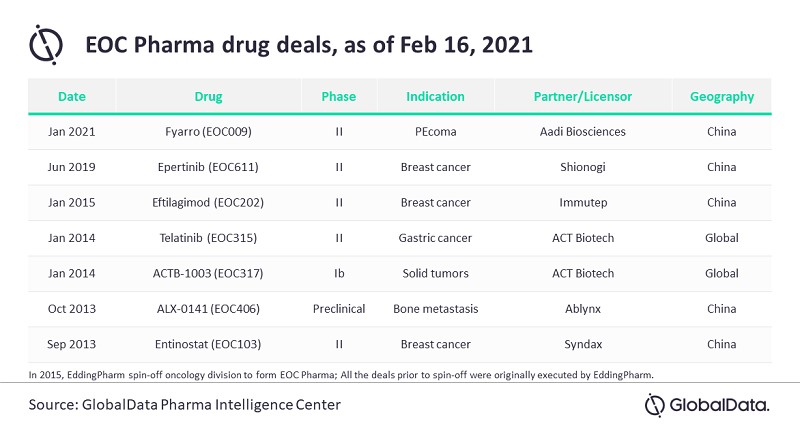
China-based EOC Pharma has recently entered an in-licensing partnership with US-based biopharmaceutical company Aadi Bioscience for the development and commercialization of ABI-009 (Fyarro). This deal, along with the previous in-licensing deals, clearly highlights EOC Pharma’s strategy to bring innovative oncology therapies for Chinese patients, says GlobalData, a leading data and analytics company.
Under the agreement, EOC Pharma will obtain exclusive rights for ABI-009 in Greater China including mainland China, Hong Kong, Macau and Taiwan. Aadi will receive an upfront payment, regulatory and sales-based milestone payments as well as tiered royalties based on annual net sales.
ABI-009 is a mTOR inhibitor for the treatment of advanced malignant PEComa, a rare type of sarcoma with no previous approved treatments. This deal reiterates EOC Pharma’s focus on indications still with high unmet need.
Bhavani Nelavelly, Pharma Analyst at GlobalData, comments: “EOC Pharma is selectively picking innovative products for in-licensing and has the candidates targeting potential oncology indications like breast cancer, gastric cancer and different types of solid tumors in its pipeline. To succeed in the Chinese market, local partnerships are very crucial for western companies and EOC is leveraging this through in-licensing deals. Moreover, EOC Pharma is well positioned to take advantage of the improved clinical and regulatory environment in China.”
According to GlobalData’s Pharma Intelligence Center, EOC Pharma currently has seven candidates in its clinical stage pipeline, with three of them targeted for breast cancer. All the pipeline candidates are in-licensed from small or global biopharmas outside China.
China has the largest number of cancer patients globally, with more than double the number of new cases per year compared to the US, which results in an urgent medical need and continued demand for better cancer treatment options in China.
Ms. Nelavelly concludes: “Western companies see significant opportunities within China’s oncology market and want to leverage local partnerships as a winning strategy. Unlike other China-based pure research and development (R&D) based companies, EOC Pharma’s business model is well differentiated to make it an integrated one-stop-shop for R&D and commercialization through in-licensing driven partnerships. The several in-licensing deals made over the past few years strengthened EOC’s product portfolio in oncology for the Chinese market and helps in gaining a foothold in the most lucrative market.”
INCREASING COVID-19 VACCINE CONFIDENCE
UNITED STATES OF CARE HOSTS WEBINAR WITH KAISER FAMILY FOUNDATION AND LEADING EXPERTS TO DISCUSS VACCINE CONFIDENCE, EQUITY AND INCREASING PUBLIC CONFIDENCE
(Washington, DC) – United States of Care hosted a webinar yesterday to discuss recent research on vaccine confidence and effective ways to communicate to the public about the vaccine, its distribution, and the need to get vaccinated. Presentations highlighted the “wait and see” populations unique concerns and motivations.
“During this critical phase of vaccine education and distribution, it’s especially important to help concerned people make their choice. Getting all the facts and weighing the information is truly what smart health decision-making looks like. We’re eager to help people along that path — and congratulate them when they make their choice,” said Natalie Davis, co-Founder, Managing Director, Public Engagement for United States of Care.
On the call, participants discussed recent data released by the Kaiser Family Foundation that examined adults who are considered “wait and see” for the vaccine, as well as how likely communities of color are to receive a vaccination.
Dr. Mollyann Brodie, Executive Vice President & Chief Operating Officer at the Henry J. Kaiser Family Foundation and Executive Director of KFF’s Public Opinion and Survey Research Program said, “The three in ten adults who put themselves in the ‘wait and see’ group have real concerns and questions about the vaccine. If trusted messengers such as health care providers are the ones answering their real information needs, that many more people are likely to conclude that getting vaccinated is the right choice for themselves and their families.”
The webinar also featured Dr. Rhonda Medows, President of Population Health Management at Providence, one of the largest nonprofit health systems in the United States, and CEO of Ayin Health Solutions. Also, Dr. Lisa Fitzpatrick, Founder and CEO of Grapevine Health, an Infectious disease physician, CDC-trained medical epidemiologist, and health activist. Medows and Fitzpatrick discussed the attitudes of communities of color toward the vaccine.
“Although, I may be a physician, I admit that even I started in the ‘hell no’ vaccine box and had to think long and hard about getting the COVID-19 vaccine. Ultimately what led me to take the shots and advocate for others to do the same was that I was able to learn all the facts behind the vaccines’ development and saw firsthand the devastating toll that the pandemic has taken on Black, Latinx, Indigenous, and Native communities,” said Dr. Rhonda Medows. “In my family alone, we’ve lost ten people to COVID-19, sadly that’s not at all unusual in communities of color.”
Dr. Lisa Fitzpatrick added, “To continue moving people along the vaccine acceptance continuum, trusted, credible information about the vaccine must be delivered by credible messengers in places where Black Americans are consuming health information. Rather than perpetuating narratives about vaccine hesitancy, we should be focusing our energy and resources into ensuring the Black community has answers to lingering questions about the vaccine.”
All participants stressed that people’s concerns about the vaccine are real and they deserve empathetic, straightforward answers as they consider whether the vaccine is right for them. Understanding and addressing these concerns now, early in the national vaccination process, is key for overall equitable vaccine uptake and protecting the most vulnerable. United States of Care assembled studies and research findings in a newly released memo.
"There is no one-size-fits-all approach to increasing COVID-19 vaccine uptake. Inclusion is key, both with respect to messages and their sources. In order to ensure the best vaccination rates, we need to make an effort to understand what makes people concerned in the first place,” concluded Dr. Matt Motta, Assistant Professor of Political Science, Oklahoma State University.
Organizations, experts address increased physical inactivity during pandemic
Change for Good Health seeks to make it easier for Canadians to access exercise for their health
Toronto, ON, February 18, 2021 -- A group of Canadian businesses, community organizations, non-governmental organizations, researchers and healthcare experts are working together to examine how the pandemic is contributing to unhealthy lifestyles and consider ways to make physical activity available to more people in Canada, especially marginalized communities and vulnerable populations.
Championed by David ‘Patch’ Patchell-Evans, a physical fitness pioneer in Canada and the founder and CEO of GoodLife Fitness and Fit4Less, the Change for Good Health project is intended to address the health impacts of inactivity, as well as longstanding inequities when it comes to accessing physical activity. Patch is working with Toronto-based social good consultants impakt, to convene a group of experts to co-create potential solutions to the heightened risks of inactivity exposed by the pandemic, leveraging existing research and programs.
“I believe that fitness should be a right for everyone living in Canada, but to make that a reality, we have to give everyone the opportunity to be physically active, particularly those who face significant barriers in the first place. It should just be part of living here, like going to school or seeing a doctor,” said Patchell-Evans. “We know most people aren’t active enough, and the pandemic has really brought this health issue to the forefront. It will take a comprehensive and forward-thinking approach to help more people get moving for their mental and physical health. We need diverse perspectives and expertise to find the best way forward.”
Before the pandemic, only about one in five Canadians (of any age) were getting the recommended 150 minutes of physical activity per week. Remote work, home-schooling, shelter in place measures and the closure of fitness, recreation and sport facilities and programs are contributing to more sedentary behaviour.
On top of that, anxiety and depression have risen dramatically. Canadians are reporting their highest levels of anxiety (23%) and depression (15%) – above the levels at the peak of COVID’s first wave.
There is mounting evidence that the lack of access to physical activity and recreation opportunities has put more people than ever at risk of lowered immunity, heart disease, obesity, substance abuse and increased stress and loneliness. Those risks can be even greater for people in vulnerable communities who may also be experiencing lower income, precarious home or work situations, marginalization or other conditions that threaten access to good health outcomes.
Change for Good Health will gather a diverse group of stakeholders from healthcare, academia, sport and recreation, and non-governmental organizations to take part in a series of roundtable discussions focusing on ways to collaborate and innovate to create more opportunities to be active, especially for people who need it most.
Other organizations taking part in Change for Good Health include Abilities Centre, Bootcamps for Change, Boys & Girls Clubs of Canada, Canadian Coalition for Seniors' Mental Health, Canadian Tire Jump Start Charities, Canadian Women & Sport, canfitpro, Diabetes Canada, Exercise is Medicine Canada, Global Wellness Institute, GoodLife Fitness, GoodLife Kids Foundation, Heart & Stroke Foundation, Jays Care Foundation, MLSE LaunchPad, Right To Play, Unsinkable and YMCA of Greater Toronto.
Academic and medical experts participating in the round tables include Dr. Gordon Asmundson (psychology, University of Regina), Dr. Paul Oh (cardiology, University Health Network), Dr. Nicole Culos-Reed (kinesiology, University of Calgary) and Dr. Iris Lesser, (kinesiology, University of Fraser Valley), Dr. Bruce Kidd (kinesiology, University of Toronto), among others.
Participants will share their expertise and ideas at three Change for Good Health online roundtable discussions this month.
Fitness as a right, health equity. Making the case for opportunities to be physically active as a basic right and necessity, during and after the pandemic.
The impact of physical inactivity on mental, emotional, and social health.
Addressing the health and wellness of children and families through physical activity.
Participant insights and ideas will inform a discussion document and recommendations, as well as a preliminary roadmap for the future to bring opportunities for physical activity to more people in Canada.
Click here to find out more about Change for Good Health.
###
TRAIN IT RIGHT NEWSLETTER
Sign Up and get a free 7 day Train it Right HIIT Program!