Find Therapeutics, a new drug development company dedicated to breakthrough therapies against rare diseases launches in Montreal
The new company raises initial capital to develop transmembrane peptides against GPCRs to address high unmet needs.
Canada – [June 8, 2020]: CTI Life Sciences, along with partners adMare BioInnovations, Domain Therapeutics and PeptiMimesis Pharma, have come together to establish a new Montreal-based drug discovery and development company, Find Therapeutics, dedicated to the development of the next generation of GPCR allosteric modulators to treat rare diseases.
Now being launched with seed funding from CTI Life Sciences, adMare BioInnovations and Domain Therapeutics, and with an initial focus on inflammatory and fibrotic diseases of the airways, liver and gastrointestinal systems, Find Therapeutics is based on a set of novel technologies that capitalize on deciphering disease-modifying GPCR pharmacology: modulation by transmembrane peptides, precise ligand signalling, disease-contextual cellular systems and advanced molecular design. GPCRs represent one of the most important druggable target classes, yet their full potential remains underexploited due to poor understanding of their cellular signalling.
“We are very excited about building this new company based on an innovative approach to discover transmembrane GPCR drugs. We believe this approach will enable the discovery of new therapies that we will first apply to rare disease indications,” said Dr. Laurence Rulleau Partner, CTI Life Sciences Fund, and President, Find Therapeutics. “We are also very proud of this partnership with members of the life science ecosystem bringing together multiple talents.”
Find Therapeutics sourced an original transmembrane peptide-based-technology developed by PeptiMimesis Pharma in France, and a first transmembrane peptide product discovered at the University of Illinois in Chicago. The company will also benefit from bioSens-AllTM, a proprietary GPCR technology platform of Domain Therapeutics, operated by its Montreal-based site, which revolves around the spatiotemporal monitoring of GPCR proximal events directly linked to GPCR activation. The result is a unique drug discovery engine that forms the foundation of Find Therapeutics.
Gordon C. McCauley, President and Chief Executive Officer of adMare BioInnovations, commented, “As Canada’s global life sciences venture, an essential part of adMare’s mission is to source therapeutically and commercially promising research from leading academic and biotech partners to create new companies of scale. This global partnership is an excellent example of how our model of collaboration is advancing new therapeutics and driving the growth of our Canadian life sciences industry.”
“We are extremely pleased by the creation and financing of Find Therapeutics, which will use two technologies, developed under the leadership of Domain Therapeutics in France and in Quebec, to discover a novel class of therapeutic agents for the benefit of the patients,” said Dr. Pascal Neuville, Chief Executive Officer of Domain Therapeutics. “As a major shareholder of PeptiMimesis Pharma, we are convinced that the transmembrane-peptide approach will be efficiently further developed in the rich biotech ecosystem of Montreal, a region which holds very valuable actors in the field –and the incorporation of Find Therapeutics is a nice illustration of this dynamic.”
Dr. Marjorie Sidhoum, Chief Executive Officer of PeptiMimesis added, “As the first developer of the GPCR transmembrane peptide technology, PeptiMimesis is glad to see the advancement of this innovative therapeutic approach pursued by Find Therapeutics. All PeptiMimesis stakeholders are very excited to join this endeavour.”
Dr. Youssef Bennani, Chief Scientific Officer of adMare BioInnovations, will also act as Find’s Interim Chief Executive Officer of the company. Dr. Bennani brings a solid experience in pharmaceutical R&D, as well as business acumen and corporate governance tenure (Chairman of the BOD at Domain Therapeutics, and Board member at Bellus Health). Trained as chemist, he most recently retired from Vertex Pharmaceuticals as Site Head and VP-R&D (Vertex Pharmaceuticals Canada), prior to which he had served as VP-Drug Innovation at Vertex Pharmaceuticals Inc. in Cambridge, MA. He also had tenures at Athersys, Abbott (now AbbVie) and Ligand Pharmaceuticals. He can be reached at ybennani@findtherapeutics.com.
Based in Montreal, CTI Life Sciences Fund L.P. was created in 2006. The firm makes venture capital investments mostly in innovative high-quality biotech companies at the pre-clinical and clinical development stages, in North America, and primarily in Canada. Since its second mandate in 2014, CTI Life Sciences Fund manages $245 million of assets. www.ctisciences.com
About Domain Therapeutics:
Domain Therapeutics is a biopharmaceutical company dedicated to the discovery and development of new drug candidates targeting G Protein-Coupled Receptors (GPCRs), one of the most important classes of drug targets. With teams at work in France and Canada, Domain operates multiple technologies aimed at validating targets and discovering first-in-class therapies (small molecules or antibodies), creates a pipeline of high-value programs in immuno-oncology, neurology and rare diseases which are developed as proprietary programs up to early clinical phases or in collaboration with pharma partners. www.domaintherapeutics.com
About adMare BioInnovations:
adMare BioInnovations is Canada’s Global Life Sciences Venture, building the Canadian life sciences industry from sea to sea. We do this by sourcing therapeutically and commercially promising research from leading academic and biotech partners to create new companies of scale, providing specialized expertise and infrastructure to help existing companies scale up, and driving the growth of those companies into Canadian anchors by training the next generation of highly-qualified personnel. www.adMarebio.com
About PeptiMimesis:
PeptiMimesis is a start-up company dedicated to the identification and development of peptide based therapeutic approach as allosteric modulators of membrane receptors such as RTK and GPCRs. Its proprietary technology acts via a cutting-edge mode of action and is originated from University of Strasbourg. PeptiMimesis made the demonstration of its added value particularly for the family of GPCR targets. www.peptimimesis.com
Majority of people expect government to make environment a priority in post COVID-19 recovery
Emerging markets top of the list when it comes to call for action and threat to health
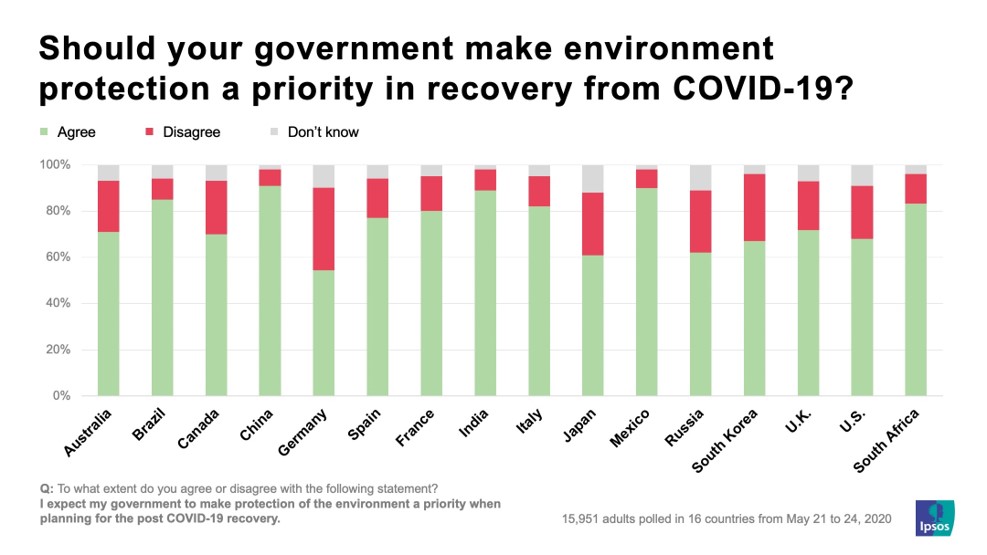
Paris, France June 5, 2020 — Three in four people in 16 major countries expect their government to make protection of the environment a priority when planning a recovery from the coronavirus pandemic, according to a global Ipsos poll conducted to mark World Environment Day.
In a survey of 16,000 people from May 21 to 24, a majority of people in all 16 countries agreed with this action with the highest support in emerging markets of China (91%), India and Mexico (89%), Brazil (85%), and South Africa (84%).
Disagreement over making the environment a government priority in a COVID-19 recovery is highest in Germany (36%), South Korea (29%), Japan and Russia ( 27%), the United States and Canada (23%).
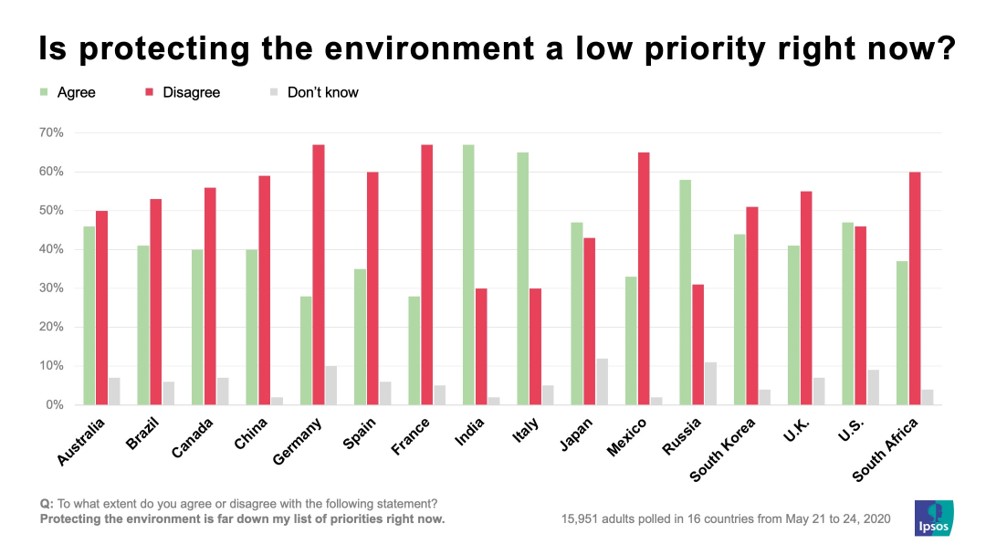
Added to this, there is a view the environment is a personal priority for people with half of the respondents disagreeing that protecting the environment is far down on their list of priorities right now. This sentiment is highest in many European countries including Germany and France (67%), Mexico (65%), Spain and South Africa (60%).
Those that believe protecting the environment is not a top priority right now are most likely in India (67%), Italy (65%) and Russia (58%). People most divided on this issue are in the U.S. with only 1 percentage point separating those that see it as a top priority from those that don’t, followed by Australia and Japan (4).
Environmental threat to health
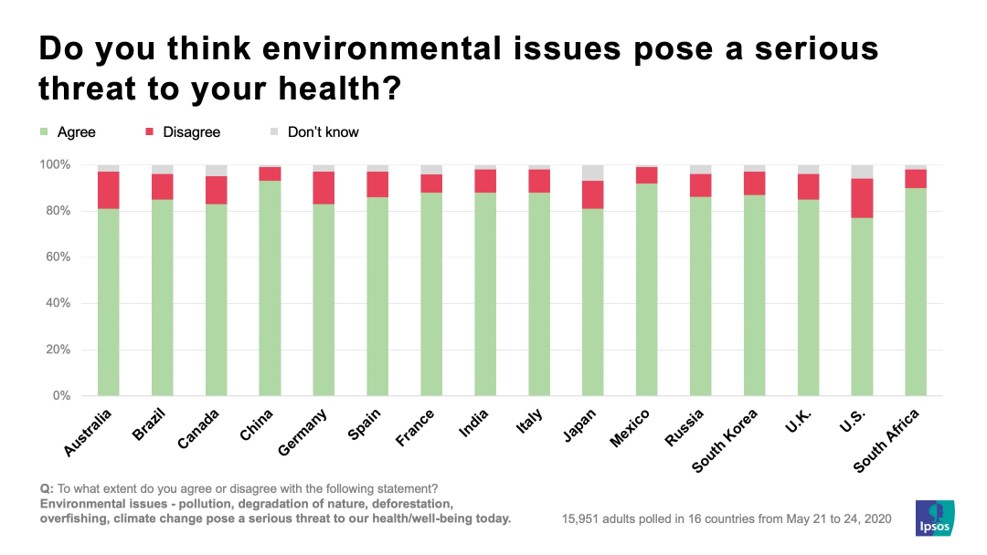
In terms of how seriously people view environmental issues, more than four in five respondents globally say issues such as pollution, degradation of nature, deforestation, overfishing and climate change pose a serious threat to our health and well-being today.
This sentiment is highest again in the developing countries of China (93%), Mexico (91%), South Africa (90%), India and Italy (88%). Meanwhile, the U.S. has the highest number of people that disagree with this threat at 17%, followed by Australia (16%).
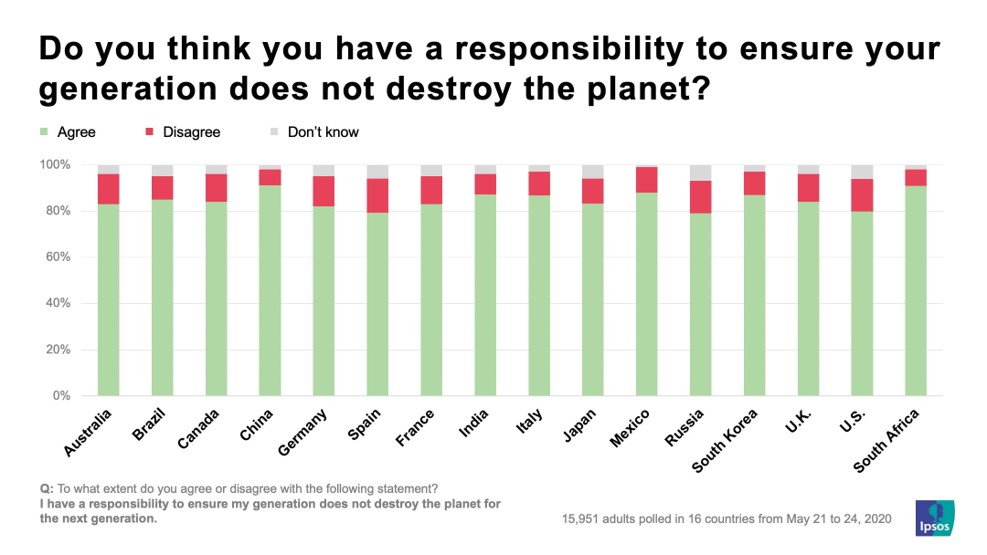
Overall, people feel a strong responsibility to ensure their generation does not destroy the planet for the next generation. Agreement with this sentiment is close to 80% and over in all of the countries with China (92%) and South Africa (91%) at the top.
These are the results of an Ipsos survey conducted May 21st to 24th, 2020 on the Global Advisor online platform among 15,951 adults aged 18-74 in Canada and the United States and 16-74 in Australia, Brazil, China, France, Germany, Italy, Spain, India, Japan, Mexico, Russia, South Africa, South Korea and the United Kingdom. Where available, tracking results from previous studies conducted through March and April, as well as selected results from February, are referenced by date.
The sample for this study consists of approximately 1,000 individuals in each country. The samples in Australia, Canada, France, Germany, Italy, Spain, Japan, South Korea, the U.K. and the U.S. can be taken as representative of these countries’ general adult population over age 16 or 18 (as above) and under the age of 75. The sample in Brazil, China, India, Mexico, Russia, and South Africa is more urban, more educated and/or more affluent than the general population and should be viewed as reflecting the views of the more “connected” segment of the population. The data is weighted so that each market’s sample composition best reflects the demographic profile of the adult population according to the most recent census data.
Where results do not sum up to 100 or the ‘difference’ appears to be +/-1 more/less than the actual, this may be due to rounding, multiple responses or the exclusion of don't knows or not stated responses. The precision of Ipsos online polls is calculated using a credibility interval with a poll of 1,000 accurate to +/- 3.5 percentage points. For more information on the Ipsos use of credibility intervals, please visit the Ipsos website (www.Ipsos.com).
Poor People’s Campaign calls for day of fasting & focus to mark upheaval in-country
The Poor People’s Campaign: A National Call for Moral Revival is calling for a National Day of Fasting and Focus on Monday to call Americans to repent of systemic racism and turn toward the work of building a more just and loving society for all people.
Bishop William J. Barber II, campaign co-chair and president of Repairers of the Breach, said the campaign seeks not merely a fasting from food, but also a national fasting from systemic racism, systemic poverty, the denial of health care and from other death-dealing policies.
"We must dedicate ourselves to breathing life into our Constitution and its promises and refuse to accept a civility that covers up injustice,” Bishop Barber said. “The very life of our democracy is at stake. Not the democracy that is, but the democracy that could be.”
The upheaval in the country has shown the power of social justice movements, said Rev. Dr. Liz Theoharis, director of the Kairos Center for Religions, Rights and Social Justice and co-chair of the Poor People’s Campaign.
“People across race, across geography, across age have seen that we cannot be silent anymore,” she said. “It is only when the people organize in radical and bold ways that we can build a society that actually takes care of the needs of the people.”
The campaign is asking people to stand still wherever they are at 5 p.m. Monday, June 7, and be still and focus for eight minutes and 46 seconds -- the amount of time that an officer held his knee on the neck of George Floyd, killing him on Memorial Day. They will then be asked to read a litany that the campaign will share on social media.
After that, Rev. Barber will speak to the nation from Greenleaf Christian Church in Goldsboro, North Carolina, where he is the minister. You can watch listen to his sermon here: https://www.facebook.com/anewppc/
People should also remember Ahmaud Abery, who was shot and killed by armed white men as he jogged in Georgia in February and Breonna Taylor, who died in March after she was shot eight times by police who used a battering ram to invade her apartment. As a sign that our collective repentance is real, people will also be invited to dedicate themselves to stay engaged, to vote, to hold elected officials accountable and to work for a moral agenda that addresses historic wrongs and policies that perpetuate inequality.
On Sunday, June 6, the campaign will hold a national interfaith service to recognize the more than 100,000 Americans who have died from COVID-19, especially poor and low-income workers. While President Trump wants to divert attention away from the pandemic and to his misinterpretation of protests in the streets, the Poor People’s Campaign will insist that the country doesn’t forget those who died.
The service will be co-led by Revs. Barber and Theoharis and Rabbi Jonah Pesner, Imam Omar Suleiman and Valerie Kaur. It can be viewed here: https://www.facebook.com/greenleaf.c.church/
The Poor People’s Campaign: A National Call for Moral Revival, is building a generationally transformative digital gathering called the Mass Poor People’s Assembly and Moral March on Washington, on June 20, 2020. At that assembly, we will demand that both major political parties address the interlocking injustices of systemic racism, poverty, ecological devastation, militarism and the distorted moral narrative of religious nationalism by implementing our Moral Agenda
Temporary Isolation Can Be TheOpportunity To Permanently Transform Your Weight And Health
Los Angeles, CA, June 5, 2020 ̶ Not sure how to eat and stay healthy this quarantine season without resorting to your familiar diet of spaghetti, bread, pizza, and sugar? Candice Rosen, R.N., MSW, and author of the upcoming book Forget Dieting: It’s All About Data-Driven Fueling! encourages "trophology," or "food combining," which is one of the foundations of Rosen's Data-Driven Fueling Plan. As you combine foods, Rosen adds that "monitoring blood glucose is the key to weight gain vs. weight loss; good health vs. poor health."
1. Make Wednesdays and Fridays Vegan Days. According to Rosen, avoid dairy! Try vegan yogurts, cheeses, and milks. Dairy is inflammatory and will deplete your bones of calcium (it’s true!). There are unsweetened milks of almond, hemp, cashew, etc., and all are available in grocery stores. A low blood glucose breakfast idea would be a sprouted grain English muffin, spread with a tofu or nut-based cream cheese, some sliced tomatoes, and topped off with sea salt or Trader Joe’s Everything But The Bagel Sesame Seasoning Blend.
2. Eat fruits that are high in fiber. Apples, bananas, oranges, berries ̶ the list goes on! You will still want to avoid sugary fruit juices, as well as very sweet fruits like pineapples and mangos while trying to lose weight. Fruit is always eaten alone with two exceptions: they can be added to a vegan smoothie and they can be eaten with a nut or seed butter. These healthy fats reduce the chance of a blood glucose spike.
3. Nothing white. To lower blood glucose, do not eat or combine animal proteins with any white potatoes, bread, rice, or pasta… EVER. Sorry!
4. Eat More Sweet Potatoes. Think wholesome, nutritious, responsibly grown, pancreatic-friendly foods (food that doesn’t raise your blood glucose) like sweet potatoes and yams, which are an incredibly nutritious carbohydrate that are low in sugar levels and provide fiber. They’re best consumed baked or steamed, but can also be cooked in a variety of other ways. A great lunch or dinner option (and it is inexpensive) is a baked sweet potato, split down the middle with a large spoonful of black beans, a tablespoon of tomatillo salsa, and a side salad. To lower blood sugar, eat them with veggies and plant-based protein together… NOT MEAT!
5. Try Fish. Give your body a break from animal protein. Red meats increase inflammation and provide poor sources of fat. However, if you crave protein, try fish! For those who aren’t allergic, fish is a fantastic source of protein that’s low in carbohydrates and contains high amounts of omega-3 fatty acids, one of the few consumable healthy fats! If consuming fish raw, remember only sashimi-style – no white rice! To lower blood sugar, combine fish with veggies, not starches or fruit.
About the author:
Candice P. Rosen, RN, MSW, CHC, is a registered nurse based in Los Angeles, CA. As the founding member of Gilda’s Club Chicago and its first executive director and program director, she created and coordinated a diverse array of wellness-related programs. She was appointed by Mayor Richard Daley to serve as Chair of Healthcare Initiatives for Chicago’s Sister Cities International Program (CSCIP). CSCIP provided an opportunity to advocate for preventive medicine, improve maternal and infant healthcare, stress disability access, promote nourishing diets, and bring awareness to the obesity and diabetes epidemics that now affect populations on a global level. She is married and the mother of four adult children and grandmother to a precious granddaughter. For more information on Candice, please visit https://candicerosenrn.com.
Experts Offer Insights Into the Mental Health Effects of COVID-19 at Virtual Conference
TORONTO, June 7, 2020 /CNW/ - Leading Canadian and U.S. experts in disaster psychiatry coached health-care providers and first responders on how to recognize and manage COVID-19-related mental health trauma, including in children and those who have lost loved ones.
More than 900 people from 19 countries attended the webinar organized by the Ontario Medical Association and Disaster Psychiatry Canada on Saturday.
"Disasters are usually local and sometimes regional, but COVID-19 is an unprecedented modern era disaster causing global mental trauma," OMA President Dr. Samantha Hill said. "The OMA is proud to host this international forum that examines the significant mental health effects of this terrible epidemic and how to provide assistance to those who are struggling."
This was the OMA's third annual Psychiatric Dimensions of Disaster conference. The concept was developed by Dr. Frank Sommers, a child survivor of the Holocaust from Hungary and former President of the Ontario District Branch of the American Psychiatric Association.
"As many participants here today said, getting through COVID-19 is like running a marathon. It is very important to pace ourselves and remember to stay connected on an emotional level. Social support will help us all to take care of each other, and ourselves," Dr. Sommers said.
Dr. Janet Ellis, Director of Psychosocial Care in Trauma at Sunnybrook Health Sciences Centre in Toronto, said that people who lost loved ones during COVID-19 are especially vulnerable to acute stress because of the lack of social supports and religious and social rituals. She said it takes about six months to process and mourn a death and stressed that people shouldn't be told to pull themselves together or think positively, or that their loved one wouldn't want them to grieve.
Dr. Frederick J. Stoddard, Jr., Chief of Psychiatry Emeritus at Shriners Hospitals in Boston, said that preschool children are attuned to and affected by their parents' emotions. "Try to stay calm around them," he urged. "Turn off the TV, computers and smart speakers when they are around. They will hear things or see images that are potentially scary. Try turning handwashing or wiping surfaces a playful game."
Children in Grades 1 to 6 can understand more about infectious diseases so parents can explain that the COVID-19 virus is like the cold or flu virus, and that by staying home from school or work, people are preventing the spread of COVID-19. This age group may also become clingy and demanding, which is a way of expressing fear. He suggested this is not a time to tell them to "grow up" even if the behaviour is frustrating. "They may need more time with you – reading to them, watching a TV show together, drawing or playing," said Dr. Stoddard.
The first Psychiatric Dimensions of Disaster conference took place on April 21, 2018, two days before the Toronto van attack that killed 10 people and injured 16. Several Toronto-based attendees used their newfound skills to help victims on the scene and in the aftermath.
About the OMA The Ontario Medical Association represents Ontario's 43,000 plus physicians, medical students and retired physicians, advocating for and supporting doctors while strengthening the leadership role of doctors in caring for patients. Our vision is to be the trusted voice in transforming Ontario's health-care system.
SOURCE Ontario Medical Association
Leaked Audio Recording Reveals Nothing has Changed at Sienna Senior Living Corporation
Union reiterates demand for real change and the end to for-profit delivery of long-term care in Ontario
RICHMOND HILL, ON, June 4, 2020 /CNW/ - SEIU Healthcare, the union that represents over 60,000 frontline healthcare workers in Ontario, joined with families and workers in Woodbridge who are demanding real change and an end to the for-profit delivery of long-term care after a leaked audio recording reveals the disdain that Sienna nursing home executives have for the pain and grief of resident families.
During a telephone town hall with resident families at the Woodbridge facility, Sienna Senior Living delivered prepared talking points in a transparent attempt to rebuild its corporate image after failing to keep workers and families safe during COVID-19. Before exiting the call, executives were overheard mocking and ridiculing the concerns of families.
Following the disturbing call, the long-term care corporation issued a press release that included no substantive change and no real action to address the underlying conditions that contribute poor nursing home conditions.
The failed experiment of for-profit delivery of long-term care must come to an end.
Statement from Anthony Manieri, whose 55-year-old sister Lucia lives at Sienna Woodbridge Vista Community Care with Multiple sclerosis (MS) and is now COVID-19 positive:
"I'm here today to speak for our family members and residents of Woodbridge Vista Care Community who can't speak for themselves. Shame on Sienna Living, its Board of Directors, and Joanne Dykeman the VP of Operations, who during a policed town hall meeting last night danced around questions from family members concerned about operations, only to realize once the town hall meeting was finished that Ms. Dykeman didn't fully end the session and referred to us as those "blood sucking class action lawsuit people," followed by personally ridiculing family members who asked questions."
Statement from SEIU Healthcare President, Sharleen Stewart:
"I would call on VP Dykeman to resign, but that wouldn't change the fact that at the end of the day companies like Sienna are simply not in the business of care.
Yesterday Sienna issued a meaningless press release that includes no financial resources to improve dangerously low staffing levels for better resident care.
Yet Sienna continued to pay out over $15,000,000 in dividends to shareholders during the first four months of the pandemic.
If Sienna is open to a real investigation and real change, they should call on Doug Ford for a full public inquiry and agree to testify in front of a judge."
SEIU Healthcare represents more than 60,000 healthcare and community service workers across Ontario. The union's members work in hospitals, homecare, nursing and retirement homes, and community services throughout the province. www.seiuhealthcare.ca
SOURCE SEIU Healthcare
For further information:
For media inquiries, contact: Corey Johnson, SEIU Healthcare, Head of Strategic Communication, 416-529-8909, c.johnson@seiuhealthcare.ca
4 Athletic Injuries You Shouldn't Try to Push Through on Your Own
Athletic injuries can range from mildly irritating to completely demobilizing. Training through certain injuries or leaving them untended can lead to chronic pain conditions, permanent nerve damage and even arthritis later in life. If you're an active individual, it's important to research common types of sports injuries and how to prevent them. While you may not be able to fully avoid every twist or sprain, you can learn about how to identify different injuries and know which ones require medical attention ASAP.
Stress Fractures
When you try to lift too much weight, muscle tears occur. Similarly, if you put too much pressure on one of your bones, a stress fracture happens. These are microscopic breaks that most often affect the legs. Commonly known as "shin splints," stress fractures in the lower leg are often caused by performing high-intensity exercises too quickly or without adequate endurance training. If you feel any pain touching the area or it worsens when you apply pressure or hop up and down, stop all physical activity and see a doctor. Failure to recover from stress fractures makes you more vulnerable to a full break, which requires casts, bedrest and possibly corrective surgery.
Runner's Knee
Patellofemoral pain syndrome, commonly known as "runner's knee", develops when the cartridge in the kneecap is damaged from overexertion and causes pain, typically by rubbing against the femur. Runner's knee can take up to five months to resolve with treatment; if you push through it and ignore knee pain, you could suffer lifelong pain and further wear away the cartilage. It's best to engage in physical therapy and get new exercise recommendations from your doctor until you recover.
Achilles Tendon Injuries
The Achilles tendon connects your calf muscles to your ankle. Many people mistakenly think that this type of injury always leads to crippling pain, so they could never possibly ignore it, but this isn't the case. Achilles injuries can also be mild, marked by tightness, swelling or a small bump on the heel. Working out with an achilles tendon can slightly alleviate the pain, which makes it tempting to keep training through it. Extended use can lead to a chronic condition called Achilles tendinosis or a full tear, which requires surgery. If you suspect you have anything wrong with your Achilles tendon, speak to your doctor right away. Most cases can be resolved easily through physical therapy at an injury rehab clinic.
Hamstring Strains
If you ever experience sudden spasms of pain in the upper leg or buttocks, you may be suffering from a muscle tear. The tears can be extremely small or large enough to sever attachment to the bone. Most tears are uncommon, but strains or pain in the upper legs should be addressed with a physician. Developing a strong core and engaging in exercises that don't put too much stress on your legs will help prevent hamstring injuries.
Just because your body can pull off an exercise does not mean it's prepared to perform or recover from it. Protecting yourself from sports injuries can be done with pre- and post-workout stretches, proper posture and endurance training. Always build up your routines, and never try to do more than you know your body can handle.
More think opening businesses puts too many people at risk of COVID-19 and we need to wait
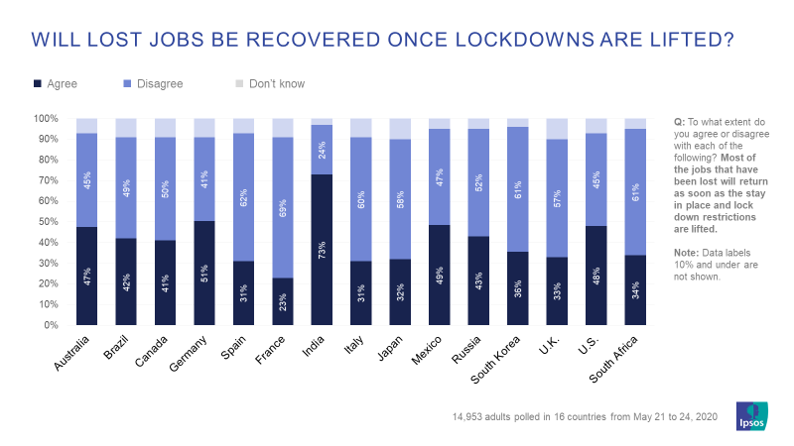
A majority of people in some hard-hit countries think jobs lost will not be recovered
A majority of people in nine out of 16 countries think opening businesses now puts too many people at risk of contracting COVID-19, according to the latest Ipsos suvey.
More people also say most jobs lost during the lockdown will not return, suggesting those that support reopening are doing so in spite of the risk rather than believing the risk is low.
In a poll of 16,000 people in 16 major countries conducted from May 21 to 24, people in Brazil (71%), India (69%), Mexico and South Korea (65%), Japan and the United Kingdom (62%) and the United States (60%) are most likely to say we need to wait at least a few more weeks before opening businesses, because opening now would put too many people at risk of contracting COVID-19.
But on the opposite end, those in hard hit countries of China (65%), Italy (64%), France (59%), Germany (57%) and Russia (55%) are most likely to say the health risk is minimal if people follow social distancing rules, and we need to get the economy moving again.
People most divided on taking this action are in Spain, Australia and South Africa with only 2 percentage points between those who think opening businesses now puts too many people at risk versus those who say the risk is minimal.
Added to this, a majority of people in France (69%), Spain (62%), South Korea and South Africa (61%), Italy (60%), Japan (58%), the U.K. (57%), and Russia (52%) don’t think most jobs lost during the pandemic will return as soon as the stay in place and lockdown restrictions are lifted.
A majority of respondents in India (73%) and Germany (51%) are the only ones out of 15 countries to believe most lost jobs will return once restrictions are eased.
A number of countries are divided on this question with only 2 points separating those who agree and disagree on whether jobs will be recovered in Australia and Mexico, followed by the U.S. (3), Brazil (7), Canada (9) and Germany (10).
About the Study
These are the results from Ipsos Essentials, a weekly global syndicated study examing the opinions and behaviours as countries move through the pandemic. These results were collected May 21st to 24th, 2020 using an online methodology 16,000 adults aged 18-74 in Canada and the United States and 16-74 in Australia, Brazil, China, France, Germany, Italy, Spain, India, Japan, Mexico, Russia, South Africa, South Korea and the United Kingdom.
The sample for this study consists of approximately 1,000 individuals in each country. The samples in Australia, Canada, France, Germany, Italy, Spain, Japan, South Korea, the U.K. and the U.S. can be taken as representative of these countries’ general adult population over age 16 or 18 (as above) and under the age of 75. The sample in Brazil, China, India, Mexico, Russia, and South Africa is more urban, more educated and/or more affluent than the general population and should be viewed as reflecting the views of the more “connected” segment of the population. The data is weighted so that each market’s sample composition best reflects the demographic profile of the adult population according to the most recent census data.
Where results do not sum up to 100 or the ‘difference’ appears to be +/-1 more/less than the actual, this may be due to rounding, multiple responses or the exclusion of don't knows or not stated responses. The precision of Ipsos online polls is calculated using a credibility interval with a poll of 1,000 accurate to +/- 3.5 percentage points. For more information on the Ipsos use of credibility intervals, please visit the Ipsos website (www.Ipsos.com).
Ipsos is the world’s third largest market research company, present in 90 markets and employing more than 18,000 people.
Our passionately curious research professionals, analysts and scientists have built unique multi-specialist capabilities that provide true understanding and powerful insights into the actions, opinions and motivations of citizens, consumers, patients, customers or employees. We serve more than 5000 clients across the world with 75 business solutions.
Founded in France in 1975, Ipsos is listed on the Euronext Paris since July 1st, 1999. The company is part of the SBF 120 and the Mid-60 index and is eligible for the Deferred Settlement Service (SRD).
Safeguard Your Emotional Health During Any Crisis With These 7 Practical Steps
Boulder, CO, June 4, 2020 — In our interconnected world, global events impact all of us in one way or another. Knowing how to help ourselves, our families and our organizations navigate a crisis can profoundly affect our emotional health and well-being.
7 Keys to Navigating a Crisis: A Practical Guide to Emotionally Dealing with Pandemics & Other Disasters is a must-read for anyone seeking to thrive during challenging times. Written by clinical psychologist Elia Gourgouris and change management expert Konstantinos Apostolopoulos, this easy-to-read book offers powerful, yet practical, insights to help minimize the negative emotional impact of pandemics, natural disasters, financial challenges and other major disruptions.
“Not only will individuals and families find the book helpful in a crisis, so will first responders, healthcare professionals, mental health counselors and wellness coaches,” said Dr. Gourgouris.
Drawing from their real-world experiences, Dr. Gourgouris and Apostolopoulos explain the following seven keys to navigating any crisis:
1. Start with self-care. Be aware of your physical, mental, emotional and spiritual needs.
2. Practice awareness. Listen to your intuition or inner wisdom.
3. Choose flexibility so you can adapt, pivot and avoid unnecessary pain.
4. Act now! Preparation is key to your survival.
5. Take initiative by moving into action. Become the navigator in your life’s journey!
6. Cultivate a positive attitude filled with faith and hope.
7. Show kindness to others.
“Each chapter has an end section including points to ponder, questions to consider and action steps to take, so the reader can move beyond just surviving to thriving in a crisis situation,” added Apostolopoulos.
Author Elia Gourgouris, PhD, is the Founder of The Happiness Center, an organization of world-leading experts in the field of positive psychology. Dr. Elia's previous book, 7 Paths to Lasting Happiness, became an Amazon #1 best-seller. He is an international keynote speaker and happiness expert focusing on corporate wellness and leadership training. He holds a PhD in Clinical Psychology and is a UCLA graduate. Dr. Elia is certified by the American Red Cross in Disaster Mental Health Services, having assisted in the 1994 Los Angeles and 2010 Haiti earthquakes, the 1999 Columbine High School shooting and other crises. He's the co-host of The Kindness Happiness Connection podcast and a Thrive Global contributor. Please visit: https://www.linkedin.com/in/thehappinessdoctor/, https://www.instagram.com/dr.eliag/ or https://www.facebook.com/DrElia.
Co-author Konstantinos Apostolopoulos is the Founder and CEO of Fresh Biz Solutions, a performance consulting and training provider. As an award-winning facilitator and coach, he has successfully delivered hundreds of custom learning events in the US, Canada and Europe for diverse audiences and industries. He is a regular contributor to Thrive Global and other industry publications. As a young man in Greece, he experienced firsthand the devastation left behind by natural and economic disasters. As an adult, he was fortunate to help play a small part in the rebuilding efforts in New Orleans after Hurricane Katrina. Today, he helps others navigate the challenges brought by major events in their lives. Please visit: https://www.linkedin.com/in/coachkon/.
Poor People’s Campaign calls for day of fasting & focus to mark upheaval in country
The Poor People’s Campaign: A National Call for Moral Revival is calling for a National Day of Fasting and Focus on Monday to call Americans to repent of systemic racism and turn toward the work of building a more just and loving society for all people.
Bishop William J. Barber II, campaign co-chair and president of Repairers of the Breach, said the campaign seeks not merely a fasting from food, but also a national fasting from systemic racism, systemic poverty, the denial of health care and from other death-dealing policies.
"We must dedicate ourselves to breathing life into our Constitution and its promises and refuse to accept a civility that covers up injustice,” Bishop Barber said. “The very life of our democracy is at stake. Not the democracy that is, but the democracy that could be.”
The upheaval in the country has shown the power of social justice movements, said Rev. Dr. Liz Theoharis, director of the Kairos Center for Religions, Rights and Social Justice and co-chair of the Poor People’s Campaign.
“People across race, across geography, across age have seen that we cannot be silent anymore,” she said. “It is only when the people organize in radical and bold ways that we can build a society that actually takes care of the needs of the people.”
The campaign is asking people to stand still wherever they are at 5 p.m. Monday, June 7, and be still and focus for eight minutes and 46 seconds -- the amount of time that an officer held his knee on the neck of George Floyd, killing him on Memorial Day. They will then be asked to read a litany that the campaign will share on social media.
After that, Rev. Barber will speak to the nation from Greenleaf Christian Church in Goldsboro, North Carolina, where he is the minister. You can watch listen to his sermon here: https://www.facebook.com/anewppc/
People should also remember Ahmaud Abery, who was shot and killed by armed white men as he jogged in Georgia in February and Breonna Taylor, who died in March after she was shot eight times by police who used a battering ram to invade her apartment. As a sign that our collective repentance is real, people will also be invited to dedicate themselves to stay engaged, to vote, to hold elected officials accountable and to work for a moral agenda that addresses historic wrongs and policies that perpetuate inequality.
On Sunday, June 6, the campaign will hold a national interfaith service to recognize the more than 100,000 Americans who have died from COVID-19, especially poor and low-income workers. While President Trump wants to divert attention away from the pandemic and to his misinterpretation of protests in the streets, the Poor People’s Campaign will insist that the country doesn’t forget those who died.
The service will be co-led by Revs. Barber and Theoharis and Rabbi Jonah Pesner, Imam Omar Suleiman and Valerie Kaur. It can be viewed here: https://www.facebook.com/greenleaf.c.church/
The Poor People’s Campaign: A National Call for Moral Revival, is building a generationally transformative digital gathering called the Mass Poor People’s Assembly and Moral March on Washington, on June 20, 2020. At that assembly, we will demand that both major political parties address the interlocking injustices of systemic racism, poverty, ecological devastation, militarism and the distorted moral narrative of religious nationalism by implementing our Moral Agenda
TRAIN IT RIGHT NEWSLETTER
Sign Up and get a free 7 day Train it Right HIIT Program!