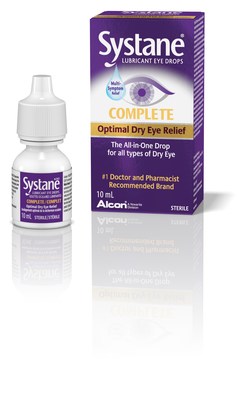
Alcon Canada introduces SYSTANE® COMPLETE Lubricant Eye Drops, the first all-in-one drop for all types of dry eye
TORONTO, Oct. 25, 2018 /CNW/ - Alcon, the global leader in eye care, introduces SYSTANE® COMPLETE, the first all-in-one drop for all types of dry eye that provides hydration and lasting protection for optimal dry eye relief. The new product joins the #1 doctor recommended1 SYSTANE® family of dry eye drops as the brand's most advanced solution to date.
Although there are three general types of dry eye, the majority of eye drops are only designed to treat one type. Featuring tiny, nano-sized lipid droplets that replenish and lock in moisture across the eye surface, SYSTANE® COMPLETE Lubricant Eye Drops are the ideal first-line treatment option for people who suffer from evaporative dry eye, aqueous tear deficient dry eye or mixed dry eye.
"As an optometrist, I understand first-hand the need to provide patients with dry eye solutions that not only work, but provide instant relief that lasts for hours," said Dr. Judy Parks of Ancaster Eye Clinic. "That's why I am particularly excited about the addition of SYSTANE® COMPLETE to the SYSTANE® portfolio, because it takes key ingredients from existing drops and elevates the technology to deliver real relief for patients for all major types of dry eye."
With increased screen time and longer workdays, dry eye is becoming one of the most common conditions seen by Canadian optometrists.
"Dry eye is a chronic issue for a large number of my patients, often making it a challenge to treat them and achieve optimal results," said Dr. Parks. "SYSTANE® COMPLETE represents a much-needed, over-the-counter dry eye solution. The technology is designed to deliver the active ingredient in a way that ensures effective coverage of the eye, so I can deliver the best outcome for my patients."
SYSTANE® COMPLETE joins the full line of SYSTANE® Lubricant eye drops, including SYSTANE® ULTRA Hydration and SYSTANE® BALANCE. SYSTANE® COMPLETE Lubricant Eye Drops is now available for over-the-counter purchase in Canada. Please view the SYSTANE® COMPLETE Method of Action video to learn more.
About SYSTANE® Lubricant Eye Drops
The SYSTANE® brand is the best-selling over-the-counter dry eye treatment in Canada with a full range of products for the comprehensive treatment of dry eye. The SYSTANE® family of products is the number one doctor and pharmacist-recommended brand for the treatment of dry eye disease. New SYSTANE® COMPLETE is the most advanced treatment option, to provide optimal relief for all types of dry eye.
About Alcon
Alcon, the global leader in eye care, provides innovative products that enhance quality of life by helping people worldwide see better. Alcon Surgical and Vision Care business franchises offer the widest spectrum of eye care products in the world. Headquartered in Fort Worth, Texas, USA, Alcon has operations in 75 countries and products available in 180 markets. For more information, visit www.alcon.ca.
© 2018 Novartis 10/18 GL-SYS-18-CANE-2282
SGS Introduces New In Vitro Toxicology Testing at its Mississauga Laboratory
MISSISSAUGA, ON, Oct. 25, 2018 /CNW/ - SGS, a leading bio/pharmaceutical, analytical and bioanalytical contract solutions provider, today announced that it is introducing new in vitro toxicology services at its Mississauga, Ontario laboratory.
The investment in instruments and expansion of the laboratory's capabilities will now allow SGS clients to establish the toxicological profiles of bio/pharmaceuticals, medical devices, cosmetics and chemicals.
The investment includes an expansion of existing cell/tissue culture capabilities, flow cytometry and mass spectrometry facilities, along with the introduction of high throughput screening, automation, and multiplexing technologies such as the MESO SECTOR S 600 for biomarker analysis. The suite of services being introduced covers over 50 analytical techniques including dermal and ocular toxicity, cytotoxicity, genotoxicity, carcinogenicity, phototoxicity, endocrine disruption, hepatotoxicity and cardiotoxicity. The new service offerings will be available under both R&D and Good Laboratory Practice (OECD, FDA Part 58) study conditions.
"Recent technical advancements and new government regulations have led to the rapid development of new, cost effective testing for the establishment of drug, device, chemical and cosmetic safety," commented Dr. Alex Perieteanu, Director of Biopharmaceutical Services at SGS Canada. "SGS is an organization with a strong global reputation for quality and integrity, and this investment aligns the laboratory with the three Rs – the principles of replacement, reduction and refinement – for more humane experimental research, and ensures patient safety and accelerating product development."
SGS's Mississauga facility has over 200 staff, and provides contract testing services within the biopharmaceutical, pharmaceutical, bioanalytical, and medical device segments. The facility is Health Canada and FDA registered and carries ISO 9001:2015 and ISO 13485:2016 (design and manufacture of medical devices) accreditations.
With 18 laboratories offering contract analytical and bioanalytical services, SGS leverages its wholly-owned global network, present in North America, Europe, and Asia, to deliver harmonized solutions to large pharmaceutical and biotechnology firms. In addition to testing services for the bio/pharmaceutical market, SGS also provides Phase I-IV clinical trial management, and services encompassing data management and statistics, PK/PD modeling and simulation, pharmacovigilance and regulatory consultancy.
SOURCE SGS Canada Inc.
Menarini Launches "Pills of Art"
Did you know that Botticelli's Birth of Venus was the first painting after the fall of the Roman Empire to feature a completely nude woman? And that when painting the Medusa, Caravaggio was most likely inspired by his own facial expressions?
All of this and much more is now available on the new "Pills of Art" section of the Menarini website; an area dedicated to the art world.
FLORENCE, Italy, Oct. 25, 2018 /CNW/ - This new initiative confirms the artistic vocation of the company which, on an annual basis for more than 60 years, has published bespoke monographs dedicated to the great masters of paintings and sculptures including Leonardo, Michelangelo, Raffaello, Caravaggio and Giotto. The curiosities of their works can now be found in video clips on the new section of the Menarini website, "Pills of Art", which is dedicated to the art world. Merely one click away; a journey which starts in Florence, the home of the Pharmaceutical Group, among the masterpieces of the Uffizi Gallery.
(Logo: https://mma.prnewswire.com/media/774837/Menarini_Pills_of_Art_Logo.jpg )
To widen the appreciation and knowledge of Italy's artistic heritage abroad, especially in the 136 countries where Menarini's products are available, the video clips have been produced in both Italian and English, and they will soon be translated into other languages including Chinese, Spanish, German and Russian.
"Menarini has a long-standing artistic tradition, one that endures with time and continues to evolve, today with the Pills of Art project," stated Valeria Speroni Cardi, Director of Menarini Group Press & Media Relations. "Menarini's art collections, characterised by their simple language, invite readers to not only look at the images, but to discover the details that so often remain unseen. With the publication of these video clips, the Pharmaceutical Group aims to involve those who are discovering the world of paintings and sculptures for the first time, revealing the anecdotes and stories behind the great masterpieces of Italian art. We are proud to have accomplished our mission under the exceptional guidance of EikeSchmidt, Director of the Uffizi Museum who, among many other things, showed us the technique used by Caravaggio to create the Medusa."
The Coronation of the Virgin by Fra' Angelico, Annunciation by Leonardo da Vinci, Judith Slaying Holofernes by Artemisia Gentileschi, Eleanor of Toledo by Bronzino,The Birth of Venus and Primavera by Botticelli are just some of the video clips you can find on the new section of the Menarini website.
http://www.menarinipillsofart.com
SOURCE Menarini I.F.R
Leukemia survivor Mai Duong keeps her promise and founds Swab The World
Fair fight for all. We're all created equal, until we have to fight cancer. It's time to give everyone an equal fighting chance. #ShareYourDNA
MONTREAL, Oct. 23, 2018 /CNW Telbec/ - Today, Mai Duong is proud to launch the Swab The World Foundation, to help those like herself who are fighting blood cancer. Her ultimate goal? To diversify and shake up the world stem cell donor registry. Nothing less.
Having gained prominence during the 2014 Save Mai Duong campaign, her story brought to light the cruel lack of ethnic stem cell donors in all national registries. The initiative was successful as three Asians in addition to Mai were able to find a compatible donor, and the percentage of Asian donors signed up to the Quebec registry increased from 0.9% to 4.3%. Mai Duong is now ready to take over the world and educate youth from all four corners of the earth about stem cell donation, with the aim of growing donation banks.
"I always promised myself that I'd do something when I was better, and that happens today. We're launching the Swab The World Foundation fully intent on giving all patients an equal chance of survival, regardless of their ethnicity," she said.
Cancer is a tough battle, even more so when the patient is of ethnic origin. To this day, 70% of registered stem cell donors are Caucasian, while 88% of the world is not. It's crucial to raise awareness about this issue among young people to change this statistic.
"Today, there are 18,000 people in the world waiting for a stem cell transplant. What I want is for young people to register so we can save more patient lives in their communities," she added.
Mai Duong also encourages young ethnic people aged 18 to 35 to join her new #ShareYourDNA campaign, and for patients or survivors to create a profile on the Foundation's website, www.swabtheworld.com. Other than donating stem cells, you can support the Swab The World Foundation through monetary donations, and especially by helping to spread the word about the Foundation.
Le courage de Bébé Lionne
In addition to launching her Foundation, Mai will publish her first book in November. When she was being treated for leukemia, she came up with a story to help her five-year-old daughter through this ordeal. Published by Éditions de la Bagnole, Le courage de Bébé Lionne ("Baby Lion's Courage") is a wonderful story about family, love and resilience. Written with love by a mother and wonderfully illustrated by Amélie Dubois, this book isn't just for children living with a sick parent – it's also for anyone having to face obstacles, big and small.
About Swab The World
Swab The World was born out of the desire to empower patients from all over the world through agility, technology and media. The Foundation was founded by Mai Duong, a leukemia survivor, who faced the grim reality of not finding her match because of her Vietnamese background. More than a simple recruitment platform to register donors, Swab The World aims to empower patients from all over by giving them the right tools and the right words to lead a successful recruitment campaign, be it locally or internationally. Through our platform, those looking for a match can get the word out on stem cells connect qualified donors to their country's registry and connect with others going through the same ordeal. Real people, real impact, real change.
SOURCE Swab The World Foundation
Boo! The Truth About How Halloween Candy Affects Your Children’s Heart

With October 31st approaching, kids and grownups are already planning their Halloween outfits, delicious candy and trick-or-treating strategies to scare every living soul out there. And, sure, ghosts, freaky clowns, Draculas and whatnot are all super scary. But what’s frightening about the whole thing is what all that Halloween candy is doing to us and our children’s cholesterol! No, no one’s trying to be a Debby Downer, we’re just telling it how it is. On that note, here are some facts you’ll want to know and hopefully include in your Halloween party planning.
What is This Scary Truth About Fats and Sugars You Want Us to Know?
We do understand Halloween isn’t the best time to talk about all the dangers of Halloween candy and other treats, but we have to – better safe than sorry, right?
Saturated Fats Are the Enemy
Saturated fats found in pastries, sweets, and similar store-purchased products cause bad cholesterol (LDL) to increase and therefore endanger our overall health. Plus, they are placing us at increased risk for heart disease, and that’s a chance you don’t want to take.
Hydrogenated Oils Are Unsafe
Hydrogenated oils replace trans-fats, causing LDL cholesterol to rise and HDL (good) cholesterol to decrease. When there are low levels of HDL in our bodies, our ability to remove excess cholesterol from the body decreases significantly. So, when you go shopping for your kids’ Halloween snacks, pay attention not to buy anything labeled “hydrogenated” or “partially hydrogenated.”
Sugars are Dangerous
The issue with sugars being fattening and consuming plenty of empty calories through the sweets we eat is more significant than what we look like: it’s about our health, and it’s serious.
Added sugar causes inflammation, and lead to weight gain which, as a result, can cause a number of health problems – from gynecological issues (in women and girls), skin conditions (acne, redness, blemishes, etc.), high blood pressure, and slower mobility, to fatigue, increased bad cholesterol levels, and even lower brain activity. All the empty calories your kids eat during Halloween and at other times take the place of valuable calories found in nutritious food.
Do your kids a favor, include a few lifestyle changes to limit their consumption of sweets as much as possible, especially during Halloween when candy is pervasive.
OVERVIEW: Cholesterol in Children
Children who have a healthy diet, are physically active, don’t have a family history of high cholesterol and aren’t overweight, are at a lower risk of having high cholesterol. However, despite these parameters, it is advised that you check your children’s cholesterol levels between ages 9 and 12, and then again between ages 17 and 21.
In case your kids are in the “higher risk factor” group, their cholesterol should be checked between ages 2 and 8 and again between ages 12 and 16.
Cholesterol chart for children

Cholesterade® is the best supplement for your cholesterol and included in your regular diet. We care about raising awareness about the importance of living a healthy life and keeping your cholesterol levels steady, naturally. Let’s build a better tradition around Halloween by excluding some of the high-calorie sweets from your children’s Halloween fun and finding better, healthier options.
Lose Daylight Without Losing Your Mojo
Neuropsychologist Offers Practical Tips to Prepare for the Clock Change
www.comprehendthemind.com
That post-summer sluggishness usually kicks in every October as we head into fall. The temperatures drop and the one thing that makes winter’s rapid approach evident regardless of climate is the loss of daylight. For many, this loss of daylight also leads to a loss of energy, an uptick in short temper and even bouts of depression. So how can we ease into the rapidly approaching winter months? Dr. Sanam Hafeez, an NYC based licenses clinical psychologist and faculty member at the prestigious Columbia University Teachers College, offers practical tips to prepare for the clock change.
Before we get into the tips, it’s important to understand the clock change’s impact on our brains and therefore our bodies, so we understand what is actually going on. Dr. Sanam Hafeez explains that “a cell in the retinas of our eyes called a ganglion cell contains the photopigment melanopsin. When we are exposed to sunlight, melanopsin signals a pathway to cells in the hypothalamus specifically responsible for regulating our bodies biological functions. This process then triggers the pineal gland which is in charge of melatonin secretion which peaks at night and wears off during the day. In simpler terms, the less light exposure we get, more out of whack we feel.”
According to Dr. Hafeez, the following simple adjustments leading up to the clock falling back can make a significant difference for those who don’t struggle with more severe depression or bipolar disorder.
1. Avoid alcohol.
When the clocks are turned back in the fall, many bars stay open an additional hour. This is typically celebrated by people in their 20’s and 30’s who only pay for it the next day opting to sleep away their Sunday. Drinking alcohol before turning back the clocks can add more sluggishness the next morning. “Even with just a one-hour clock change, our body’s circadian rhythm is thrown off making our brains a bit confused. Alcohol only heightens these effects,” explains Dr. Hafeez. Imagine the double whammy of a hangover after the fall back clock change?
2. Enjoy physical activity during the daytime.
The more time spent outside in the daylight doing physical activity, the less sluggish you will feel once the clocks fall back. Fall is a great time to powerwalk or go for a run. If you’re an early riser then you will love the earlier sunrise at least for the next few weeks. “A lot of people shift their exercise routines to include more high energy group workouts in the evenings to give themselves something to look forward to as a way to shake off the workday. You really want to pay attention to when you feel most energized and align your exercise to that,” suggests Dr. Hafeez.
3. Don’t sleep in. Go to bed earlier instead.
In the days leading up to the clock change, add extra “wind-down” time before bed and get to bed an hour earlier. On the Sunday morning of the clock change, people mistakenly opt to sleep in. You really want to stick to the same wake-up time while getting to bed earlier. That’s the key according to Dr. Hafeez. “People think they are gaining an hour of sleep, they’re not because at bedtime they’re losing it. When you keep the wake-up time and get to bed earlier that extra hour isn’t felt as much the next day,” explains Dr. Hafeez.
4. Avoid watching the news before bed.
People think that getting to bed an hour earlier means it’s ok to watch TV in bed before sleep. TV or any kind stimulates the brain. Your favorite show causes you to focus when you’re trying to shut down stimulation. The news is even worse. You get wrapped up in the doom and gloom watching the news. “If you want to really make sure you still wake up refreshed, opt for tranquil music or guided meditations available on YouTube or an app, recommends Dr. Hafeez.”
5. Plan ahead! Consider taking Monday off!
For those who find their mood is negatively impacted after the fall clock change, consider taking Monday off and make it about self-care. Waking up early, taking advantage of the early light, enjoying a healthy breakfast, getting a massage or catching up on reading, tidying and whatever you feel necessary to feel good, do it. “People can feel the effects of the clock change for up to 3 weeks. Taking a day off to focus on your own well-being can become a nice post clock change ritual,” she says.
About the Doctor:
Dr. Sanam Hafeez PsyD is an NYC based licensed clinical psychologist, teaching faculty member at the prestigious Columbia University Teacher’s College and the founder and Clinical Director of Comprehensive Consultation Psychological Services, P.C. a neuropsychological, developmental and educational center in Manhattan and Queens. Dr. Hafeez masterfully applies her years of experience connecting psychological implications to address some of today’s common issues such as body image, social media addiction, relationships, workplace stress, parenting and psychopathology (bipolar, schizophrenia, depression, anxiety, etc…). In addition, Dr. Hafeez works with individuals who suffer from post-traumatic stress disorder (PTSD), learning disabilities, attention and memory problems, and abuse. Dr. Hafeez often shares her credible expertise to various news outlets in New York City and frequently appears on CNN and Dr.Oz.
Connect with Dr.Hafeez via Instagram @drsanamhafeez or www.comprehendthemind.com
Why Seemingly Unrelated Health Issues May Be Resolved By A Trip to the Dentist
By Dr. Daniel Klauer, DDS
Let’s assume for the moment you experience these symptoms – headaches, ear aches, ringing in the ears, nausea, fatigue, neck pain, and numbness and tingling in the hands and fingers. What kind of a healthcare provider would you see first?
You probably didn’t say your dentist. After all, your teeth and gums don’t seem to be the problem, right? Yet, your dentist could be the person best equipped to solve your problem.
Why? Because the cause of these symptoms could be temporomandibular joint dysfunction, or TMD. The condition – which is sometimes called TMJ (the name of joint) or TMJD, as in TMJ disorder or dysfunction – is a broad term to describe jaw pain and dysfunction. It is typically related to something structurally off with the hinging joint itself or a problem with the muscles that support it. Or it could be both. Regardless, it will probably be incredibly painful and debilitating.
But people who experience these symptoms rarely make an appointment with their dentist – at least not at first. Instead, they visit a long line of physicians until finally – as a last resort after no one alleviates their pain – they turn to their dentist.
The reason some physicians misdiagnose these cases is because typically they are not well-trained in jaw problems, which are considered a dentist's domain. On the other hand, dentists often lack a solid understanding of the joint because they tend to be passionate about teeth, not orthopedics.
TMD is far from a rare disease. The TMJ Association reports it affects about 12 percent of the population at any given time, and other research by the National Institute of Health finds as many as 83 percent of people in some population segments have at least one TMD symptom.
Clinicians who look at the patient's full medical history, life circumstances, stress levels, and sleep patterns are the most successful in treating TMD, which is usually only completely cured if it's strictly an orthopedic issue. Most TMD patients have some neuropathic pain (meaning its cause is in the brain, not due to trauma to healthy tissue.)
Stress reduction techniques like deep breathing and meditation can help reduce the pain until the issue is resolved.
Other approaches that may work include physical therapy to relax the face and neck muscles, oral-appliance therapy, acupuncture, massage, diet and behavior modifications (such as eliminating gum chewing). These options should usually be considered before deciding on surgery.
That clicking sound some people hear in their jaw may be a precursor to more serious TMD problems around the corner. If you have any of the symptoms I mentioned, you should consider seeing a dentist sooner rather than later.
Many people have been told by health-care providers that they can’t get better, and they will have to live with their pain for the rest of their lives. They’ve been told the way they live now is their norm.
But today’s norm doesn’t have to be tomorrow’s norm. I see patients every day who are ultimately able to turn their lives around. With the right treatment they are able to free themselves of pain and lead a life filled with energy that lets them take on the day.
About Dr. Daniel Klauer, DDS
Dr. Daniel Klauer, DDS, is author of Achieve Your Victory: Solutions for TMD and Sleep Apnea (www.tmjsleepindiana.com). Since 2013, Dr. Klauer has limited his practice to treating patients with craniofacial pain, TMD, and sleep breathing disorders. Dr. Klauer is board certified with the American Board of Dental Sleep Medicine, American Board of Craniofacial Pain, and the American Board of Craniofacial Dental Sleep Medicine. He is diplomate eligible with the American Board of Orofacial Pain. He attended the University of Notre Dame and was a member of the Big East Championship Varsity Golf Team. After graduating from the University of Notre Dame, Dr. Klauer earned his Doctor of Dental Surgery degree (DDS) from Ohio State University.
COMPASS Pathways Receives FDA Breakthrough Therapy Designation for Psilocybin Therapy for Treatment-resistant Depression
LONDON, Oct. 23, 2018 /CNW/ - COMPASS Pathways, a life sciences company dedicated to accelerating patient access to evidence-based innovation in mental health, has received Breakthrough Therapy designation from the US Food and Drug Administration (FDA) for its psilocybin therapy for treatment-resistant depression.
(Logo: https://mma.prnewswire.com/media/733890/COMPASS_Pathways_Logo.jpg )
The FDA designates a drug as a Breakthrough Therapy if preliminary clinical evidence shows that it may demonstrate substantial improvement over available therapy. Breakthrough Therapies are supported by the FDA throughout the clinical development programme to ensure as efficient a process as possible.
Breakthrough Therapy designation is a significant milestone for psilocybin therapy and psilocybin research, and a testament to the work done over many years by research teams in the US, the UK and Switzerland. The Heffter Research Institute was the first to fund research in this field, and supported early studies at Johns Hopkins University, New York University, and Harbor-UCLA. In the UK, the Medical Research Council backed the proof-of-concept study of psilocybin for treatment-resistant depression at Imperial College London in 2015. COMPASS Pathways is now running the first large-scale psilocybin therapy clinical trial for treatment-resistant depression, which will take place in Europe and North America over the next year or so.
George Goldsmith, Executive Chairman, COMPASS Pathways, said, "This is great news for patients. We are excited to be taking this work forward with our clinical trial on psilocybin therapy for treatment-resistant depression. The FDA will be working closely with us to expedite the development process and increase the chances of getting this treatment to people suffering with depression as quickly as possible."
Treatment-resistant depression is a huge unmet need, affecting 100 million people around the world who do not respond to existing treatments. Depression is one of the fastest growing health problems we face today, and the leading cause of ill-health and disability worldwide. The Breakthrough Therapy designation for psilocybin therapy highlights the importance of supporting early research that can be translated to clinically meaningful outcomes.
Dr Robin Carhart-Harris, Head of the Psychedelic Research Group, Imperial College London, said, "In our 2015 study, we provided psilocybin to 19 patients in a clinical setting, coupled with psychological support, and found promising signals of efficacy and safety as treatment for treatment-resistant depression. The Breakthrough Therapy designation is a strong endorsement for the potential of psilocybin therapy. We look forward to learning more as further clinical studies are carried out, by our team at Imperial College as well as in COMPASS's multi-centre trial."
Dr David Nichols, Chairman of the Board, Heffter Research Institute, said, "Since its inception in 1993, Heffter has been helping to design, review, and fund the early phase clinical studies on psilocybin at research institutions in the US and Europe. We are delighted that psilocybin is being recognised as a Breakthrough Therapy and look forward to continuing our work with researchers and partners around the world so that we can alleviate the suffering caused by mental illness."
About COMPASS Pathways
COMPASS Pathways is a life sciences company, founded in 2016 to accelerate patient access to evidence-based innovation in mental health. We are developing psilocybin therapy through a late-stage clinical trial in Europe and North America for patients with treatment-resistant depression. We will improve mental health through the development of new patient care pathways, based on advances in neuroscience, psychotherapy, psychopharmacology, and technology. http://compasspathways.com/
SOURCE COMPASS Pathways
The Gifted Journey Helps Readers Uncover Their Unique Paths
Discovery Bay, CA, October 23, 2018 - Gallup-certified strengths coach Stephanie Moore brings her proven method for finding, and living, a path of true joy and fulfillment in The Gifted Journey: Five Transformative Steps to Uncovering Your Unique Path.
Moore stays focused on all things positive, as she introduces her actionable five-step process designed to help readers Discover, Discern, Dream, Design and Do what they were always meant to do based upon their natural strengths—their gifts.
Each of the five steps contains exploratory exercises that walk readers through personal reflection and the gathering of objective perspectives from trusted colleagues and friends. The result is a blend of self assessments and external input that makes The Gifted Journey uniquely adaptable to the needs of each individual.
Along the way, Moore shares professional and personal anecdotes to help drive home her impactful message that through embracing our authentic skill sets, we can move toward more promising futures with renewed passion and enthusiasm.
The Gifted Journey is for anyone questioning their direction in life, including those about to apply for colleges, those just starting out in their careers, downsizing statistics, or those who are simply unhappy with their current path and need some course correction. Each of these situations can be a powerful catalyst to seeking change, and the five steps in The Gifted Journey can help readers uncover their gifts and put them to work.
Stephanie Moore is a Gallup-certified strengths coach with more than two decades of experience in leadership development, career consulting and executive coaching. As a strengths-based practitioner, she has used her unique blend of expertise, passion and spirituality to help thousands of people discover more fulfilling and rewarding career paths. She has designed and currently delivers the highly successful and comprehensive development courses, Strengths-Based Development and Strengths-Based Teams, to organizations, universities and associations across the globe.
She launched The Moore Group, Inc., in 2000 and cofounded the nonprofit Catholic Strengths and Engagement Community in 2008. She is a native of Northern California and holds a bachelor's degree in psychology from St. Mary's College in Moraga, California. She is also a graduate of the School for Pastoral Ministry through the Diocese of Oakland. She is currently developing a series of retreats and workshops that follow The Gifted Journey process.
For more information, please visit www.thegiftedjourney.com.
The Gifted Journey: Five Transformative Steps to Uncovering Your Unique Path
Inspired Forever Book Publishing
Release date: September 15, 2018
ISBN-13: 9780999625880
ISBN-13: 9780999625897
Available from Amazon.com and other e-book retailers
Reviews:
Fredrick Gilbert, Ph.D., Let'er Rip Productions – "… Whether you are starting out life in high school or making major mid-life changes this book is the tool belt that will help you construct your future. It is all here: self-assessment tools; exercises to understand your strengths and passions; ways to evaluate where you fit into the world of work. Stephanie's writing style is so accessible. She feels like an old friend who is being straight with you by letting you inside her own life-changing struggles. … If you are struggling to understand how your past can chart your future happiness, read this book. Do the exercises. Put it into action. Then write a thank you note to Stephanie.”
Mary McGlynn, president and VP of learning, development and research, PowerSpeaking, Inc. – "Stephanie Moore's The Gifted Journey serves as your personal archaeologist. As you proactively become a searcher of clues, a seeker of patterns, and a creator for your own fulfilled future, you find the path to your own career satisfaction. With assessments, tools, and exercises, your story unfolds in a magical way.”
Jo Ann Miller, OSF Strengths Development Center, former 40-year Gallup employee – "The Gifted Journey, is an amazing contribution! As Stephanie shares from her own gifted journey, she will lead you to discover your own 'conscious competence' at whatever time in your life you meet her invitation. When individuals truly work in their 'strengths zone,' it feels 'just right to them and others like it too.' One can feel Stephanie's joy and pleasure—not only in her own life's multifaceted talent discoveries, but in her day-to-day experience of living them out. Walk with Stephanie through her 5-D strategy for life's journey. Find a GIFT on every page as you 'learn, love and live' your gifted journey.”
Rick Fersch, former president and CEO of Eddie Bauer – "The 'WOW' moment in this book is when you recognize that each day is a gift waiting to be opened and discovered. I strongly subscribe to Stephanie's thesis that our life journey should be used to uncover and emphasize our strengths—and to build upon these gifts for a more fulfilling and promising future. Executing this 5 stage process will allow us to live the life that was always intended just for us. I was a business leader for over 30 years, and as president and CEO of Eddie Bauer, I suffered a life threatening stroke that changed my world and led me to embrace these stages. Using this process allowed me to discern how best to change my course, and how to apply my gifts to the faith world as Executive Director of Stewardship and Development at the Archdiocese of Seattle. Through living my own life journey, I can readily embrace and endorse Stephanie's well laid out process. It is both refreshing and innovative—building on widely known and successful concepts for helping to find your true self. Her unique and easy to read format allows you to execute action points that help support your master life plan.”
Blueair - Oct 23, 2018 09:17 GMT

Cabin P1/i installed for safe driving.
Dubai, 23 October, 2018: Today Blueair, a world-leader in air purification, launches a new intelligent air purifier for cars at an event in Dubai. Designed for safety and tested to global standards, the new connected Blueair Cabin P1/i cleans the car from harmful gases, particles and germs in six minutes.
The air in cars is up to 100% more polluted than on the road outside, research shows. This is due to the direct flow of exhausts from the own car and other vehicles on the road, the off-gassing of volatile organic chemicals (VOCs) from materials used in the car interior, as well as the relatively small volume of enclosed space inside the passenger compartment. In-car air pollution therefore poses greater risks to human health than outdoor air pollution.
Last year, US scientists found that levels of soot and chemicals inside cars were twice as high as those measured by roadside detectors. A few months ago, scientists at London Metropolitan University revealed that car air-conditioning systems can function as breeding grounds for bacteria.
“People spend, on average, about 10 hours a week inside vehicles where exposure to PM2.5, the ultrafine particles harmful to human health, can be up to two times higher than on the street outside said Daniel Hagström, CEO of Blueair Cabin Air, explaining that “particles from tires and road wear products in combination with exhaust emissions from the own vehicle as well as from other vehicles, enter the cabin through ventilation and air-conditioning systems”.
“To meet the consumer need for clean air in cars, we have therefore expanded our air purification expertise and best-in-class technology to a new segment, which I’m proud to present here today” continued Hagstrom at the launch event in Dubai.
Compact and easy to install, Cabin P1/i is equipped with Blueair’s pioneering HEPASilent™ technology, which filters out at least 99.97% of airborne pollutants such as PM2.5, car exhausts, road wear, smoke, dust, soot, sand, pollen, bacteria and viruses as small as 0.1 micron in size. Sustainably designed for highest road safety, the Cabin P1/i is available for cars, trucks and other road vehicles.
Given the many hours spent on the road, a staggering 72% of consumers are worried about the impact the air circulating inside their cars may have on themselves and their families. The same number, 72% of people asked, also said that they are aware of the negative health effects of breathing polluted air, reveals a survey carried out for Blueair by independent UK research firm Bonamy Finch.
Cabin P1/i will be available in select stores from November 2018.
Product Specifications:
- Best-in-class: 360-degree air intake, based on HEPASilent™ technology which removes 99.97% of airborne pollutants such as car exhausts, road wear, PM2.5, pollen, dust and smoke as small as 0.1 micron in size
- Best CADR (Clean Air Delivery Rate) of 38 cubic metres per hour
- 5ACH (Air Changes/Hour); Cleans air a mid-sized car in 5-6 minutes
- Designed for Safety
- Intelligent appliance with integrated sensors, Bluetooth and Blueair Friend compatible.


Blueair is a world leading producer of air purification solutions for home and professional use. Founded in Sweden, Blueair delivers innovative, best-in-class, energy efficient products and services sold in over 60 countries around the world. Blueair is part of the Unilever family of brands.