Fewer Canadians have disability coverage through workplace benefits, leaving them more at risk
Twitter: The number of Canadians with disability insurance through workplace benefits is on the decline, leaving them more at risk @RBCInsurance
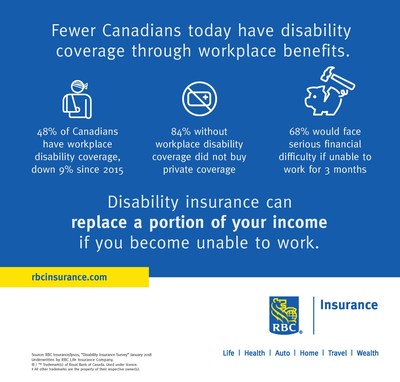
Summary: The number of Canadians with disability coverage through workplace benefits has fallen significantly since 2015 – 48% vs 57%. Of those Canadians without disability coverage through their workplace, 84% have not bought coverage themselves. Yet, if faced with the possibility of becoming disabled and unable to work for three months, 68% admit they would face serious financial trouble. However, when it comes to accessing disability coverage, where and how Canadians find work are strong barriers, along with affordability.
TORONTO, April 24, 2018 /CNW/ - The number of Canadians with disability coverage through workplace benefits has declined significantly since 2015, according to a recent RBC Insurance survey. Fewer than half (48 per cent) of employed Canadians say they have disability coverage through their workplace benefits, compared to 57 per cent in 20151. Of those without disability coverage through their workplace, 84 per cent have not bought coverage themselves, leaving them at financial risk if unable to work due to a disability.
"With the majority of employed Canadians indicating that they do not have disability insurance through their workplace benefits package, workers need to review what coverage they do have and take immediate steps to ensure that they are well protected in case something were to happen," explains Maria Winslow, Senior Director, Life & Health, RBC Insurance. "Without the proper financial protection in place, Canadians are putting themselves and their families at risk if they are faced with a disability and have to take time off work."
Being off work takes a financial toll that many people are not prepared to handle. A majority (68 per cent) of working Canadians acknowledge the possibility of serious financial implications for them and their family if they were to become disabled and unable to work for three months. In fact, when faced with a disability, 45 per cent of working Canadians would have liked to take time off due to disability but could not because of finances, and 51 per cent said they were forced to go back to work earlier than they wanted because of their financial situation.
"When confronted with a disability, the last thing that should be on your mind is worrying about finances. Purchasing individual disability coverage provides you with the security of knowing you will have money coming in to replace your lost income," says Winslow.
Barriers to Accessing Disability Coverage
Increasingly, where and how Canadians find work are strong barriers to accessing disability insurance coverage. Those without coverage say:
- Their workplace doesn't offer group benefits or disability insurance (35 per cent)
- They work part-time or on contract and aren't eligible for benefits (25 per cent)
- They're self-employed or freelance (22 per cent)
Cost is another key barrier – one in four (26 per cent) working Canadians without disability coverage feel they cannot afford it.
"There's a misconception that disability insurance is expensive, yet it's much less than you might think - generally costing between one and three per cent of your income," adds Winslow.
Here are a few things Canadians should consider:
- The best time to buy disability insurance is before an injury or illness occurs.
- Don't choose a policy on price alone. Be aware that the prices are aligned with the features and benefits of the policy. Make sure you know the policy's definition of disability, as the definition may vary among carriers.
- Review the coverage available through your employer and consider whether you need additional coverage to fill in the gaps.
- Disability insurance is essentially an income replacement policy; it is designed to cover a portion of your income should you become unable to work.
About the RBC Insurance Survey
These are some of the findings of an Ipsos poll conducted between January 2nd and January 4th, 2018 on behalf of RBC Insurance. For this survey, a sample of 1,505 employed Canadians aged 18+ was interviewed. Weighting was then employed to balance demographics to ensure that the sample's composition reflects that of the adult population according to Census data and to provide results intended to approximate the sample universe. The precision of Ipsos online polls is measured using a credibility interval. In this case, the results are considered accurate to within ±3.0 percentage points, 19 times out of 20, had all working Canadian adults been polled. The credibility interval will be wider among subsets of the population. All sample surveys and polls may be subject to other sources of error, including, but not limited to coverage error, and measurement error.
About RBC Insurance
RBC Insurance® offers a wide range of life, health, home, auto, travel, wealth and reinsurance advice and solutions, as well as creditor and business insurance services to individual, business and group clients. RBC Insurance is the brand name for the insurance operating entities of Royal Bank of Canada, one of North America's leading diversified financial services companies. RBC Insurance is among the largest Canadian bank-owned insurance organizations, with approximately 2,500 employees who serve more than four million clients globally. For more information, please visit rbcinsurance.com.
___________________________
1 2015 RBC Insurance survey
SOURCE RBC Insurance
Banque Scotia 21k de Montréal Race Raises a Record $1.3 Million
Ontario runners Woodfine and Gollish, big winners in Montréal
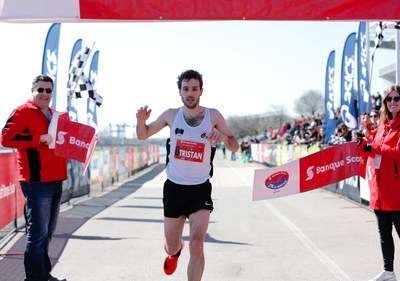
MONTRÉAL, April 22, 2018 /CNW/ - Taking advantage of ideal conditions at the start, Ontario runners Tristan Woodfine, in men's, and Sasha Gollish, in women's, won unequivocal victories on Sunday at Parc Jean-Drapeau in Montréal, for the 16th edition of the Banque Scotia 21k de Montréal. Woodfine, 24, of Cobden, Ont., crossed the finish line located at the edge of the Olympic Rowing Basin in 1:05:43. Gollish, 36, of Toronto, won the women's event in 1:16:14.
At press time, the Scotiabank Charity Challenge had raised $1.3 million for 71 charities in the Montréal area and the number is expected to continue to grow as fundraising remains open for 30 days after the event.
"The Scotiabank Charity Challenge participants showed great commitment again this year," said Tom Apostolis, District Vice President Montréal Centre at Scotiabank. "Not only did they train hard to cross the finish line, but they also went the extra mile with their fundraising efforts. We are thrilled that the 2018 Scotiabank Charity Challenge has raised $1.3 million, a record for the Banque Scotia 21k de Montréal. We're proud that the Scotiabank Charity Challenge continues to be an important part of the weekend events, year after year. We know that the funds raised will have a huge impact in the communities where we live, work, run and do business."
Taking place over two days, the Banque Scotia 21k de Montréal featured a 1k Kids Run, 5k, 10k and 21k distances. Nearly 7,000 racers crossed the start lines of the various distances and the event was sold out for yet another year!
Introduced last year, the Kids run and the 10k distance grew in popularity. With an increased capacity to meet the demand, these distances welcomed a new wave of fundraisers happy to find a middle step between the 5k and the 21k to motivate them.
"We are proud that this has been a record-breaking weekend in terms of funds raised for the Scotiabank Charity Challenge," said Francois Lecot, Race Director, Canada Running Series. "The sun was shining on the 7,000 runners who took part in the 21k, 10k, 5k & Kids Run, making it a fun and meaningful weekend for the whole family. We are also proud of the turnout and performances of our athletes, particularly our Quebec elite runners, including Francois Jarry and Olympian Anne-Marie Comeau who both placed second overall."
The Scotiabank Charity Challenge is a turnkey fundraising program that provides a simple way for runners in these races to support local causes that make a significant impact on Canadian communities. Participating charities keep 100 per cent of the proceeds raised, as Scotiabank pays for all transaction and credit card fees. Scotiabank offers the Scotiabank Charity Challenge at six sponsored marathon events across Canada including Montréal, Halifax, Ottawa, Calgary, Vancouver and Toronto.
Scotiabank believes in helping young people reach their infinite potential, and many organizations who take part in the Scotiabank Charity Challenge have a direct impact on our local youth. Young people are our future leaders and it's crucial to provide them with the skills and resources they need to succeed.
Banque Scotia 21k de Montréal Results :
Half marathon, Men
- Tristan Woodfine – Cobden, Canada – 1:05:43
- François Jarry – Lachine, Canada – 1:07:08
- Kip Kangogo – Lethbridge, Canada – 1:08:15
Half marathon, Women
- Sasha Gollish – Toronto, Canada – 1:16:14
- Anne-Marie Comeau – Saint-Ferréol-les-Neiges, Canada – 1:16:25
- Laura Desjardins – Toronto – 1:17:59
10k, Men
- David Le Porho – Montréal, Canada – 32:37
- Marc-Antoine Senneville – Repentigny, Canada – 32:40
- Mathieu Desbiens – Cookshire-Eaton, Canada – 33:42
10k, Women
- Celine Best – Ottawa, Canada – 38:34
- Annie Laperle – Candiac, Canada – 40:07
- Marie-Christine Carette – Sherbrooke – 40:12
5k, Men
- Gregoire M. Bouchard – L'Assomption, Canada – 15:56
- Alvaro Cueto – Saint-Hubert, Canada – 16:00
- Karl Belley – Longueuil, Canada – 16:00
5k, Women
- Emy Legault – L'Île-Perrot, Canada – 18:00
- Ali Barwick – Montréal, Canada – 18:07
- Delphine Hansen – Montréal, Canada – 18:40
The Banque Scotia 21k de Montréal race weekend is a world-class sporting event that brings together recreational and elite runners from across Canada and beyond for a race in Parc-Jean Drapeau, one of Montréal's most beautiful locations.
For a complete list of 2018 charities participating in the Scotiabank Charity Challenge, please visit the Banque Scotia 21k de Montréal's website.
For more highlights and complete race results, please visit the results page.
Twitter and Instagram Hashtag: #SCOTIA21KMTL, #InfinitePotential and #runScotia
About Scotiabank
At Scotiabank, we aim to support organizations that are committed to helping young people reach their infinite potential. Young people are our future leaders and Scotiabank's goal is to help ensure that they have the necessary skills and resources they need to support their success. Together with our employees, the Bank supports causes at a grassroots level. Recognized as a leader for our charitable donations and philanthropic activities, in 2017, Scotiabank contributed more than $80 million to help our communities around the world.
Scotiabank is Canada's international bank and a leading financial services provider in North America, Latin America, the Caribbean and Central America, and Asia-Pacific. We are dedicated to helping our 24 million customers become better off through a broad range of advice, products and services, including personal and commercial banking, wealth management and private banking, corporate and investment banking, and capital markets. With a team of more than 89,000 employees and assets of over $923 billion (as at January 31, 2018), Scotiabank trades on the Toronto (TSX: BNS) and New York Exchanges (NYSE: BNS). For more information, please visit www.scotiabank.com and follow us on Twitter @Scotiabank.
About Canada Running Series
Canada Running Series is the nation's premier running circuit with 8 events: 4 in Toronto, 2 in Vancouver, 1 in Edmonton and 1 in Montréal. It annually attracts some 60,000 participants and raises more than $6 million for some 320 mostly-local charities.
The Series includes the IAAF Gold Label Scotiabank Toronto Waterfront Marathon, and the Athletics Canada National Marathon Championships. Since 1999, CRS has gained international recognition for innovation and organization.
We are passionately committed to staging great experiences for runners of all levels from Canadian Olympians and International stars, to healthy lifestyle people and charity runners; and to making sport part of sustainable communities and the city-building process. Our mission is "building community through the sport of running." Join us at www.RunCRS.ca
SOURCE Scotiabank
PROVINCE, CITY, JOIN TORONTO POLICE SERVICE AND SPECIAL OLYMPICS ONTARIO TO ANNOUNCE
FIRST- EVER INVITATIONAL YOUTH GAMES May 14-17, 2019
Ground-Breaking Ontario-Based Sporting Competition Set to Go Global
Modelled after the highly successful Ontario-wide School Championship Program, first launched by Special Olympics Ontario in 2011, the IYG will serve as a landmark event during the 50th anniversary year of the Special Olympics movement (June 2018-June 2019).
The games will feature five sports: basketball, bocce, floor hockey, track and field and soccer. All five will offer two types of team divisions: a traditional division, where athletes on the team have an intellectual disability, and, a unified division, where athletes with and without and intellectual disability will have the opportunity to compete on the same team. All sports will be broken down into multiple ability divisions, where athletes will have the opportunity to compete against those of similar ability levels. In addition to sports competition, athletes can also take part in the Healthy Athletes program, a worldwide initiative that provides screening and education across 7 different health disciplines, with the overall goal of increasing the health and well-being of Special Olympics athletes.
The games are expected to create a first-of-its-kind sporting blueprint for athletes across the country and around the globe for decades to come. Four key pillars have been specifically named as central to the IYG games sharing of best practices and legacy-building, namely: A Youth Leadership Summit; an Observers Program; National Coaching Certification Program (NCCP) Training, and a Sport for Youth with Disabilities Leadership Conference.
Enabled by support from the Province of Ontario, the City of Toronto, and host organization the Toronto Police Service, the IYG will showcase Toronto on the world stage. It is also forecasted that the games will contribute an estimated $7M* in economic activity for the City/GTA while also creating a first-of-its-kind sporting event. In addition to community building, the games are poised to become part of a rich history of innovation emanating out of the province beginning with the truly ground-breaking research by Dr. Frank Hayden, that paved the way for what is now a global movement.
- more -
Law enforcement, including the Toronto Police Service, and Honorary Chair Toronto Police Service Chief, Mark Saunders, will play a critical role in supporting and enabling the games, building on a 30-year relationship with Special Olympics which began with Toronto hosting the very first Law Enforcement Torch Run (LETR) in Canada in 1987.
The games will officially open at Metro Toronto Convention Centre May 14, 2019. Admission to all events is free. Details on how to attend an event(s) will be available via the games website.
Quotes:
The Honourable Daiene Vernile, Minister of Tourism, Culture and Sport
“Special Olympics Ontario is supporting young athletes in developing their skills to lead a healthy active life and meet new friends along the way. The investment we’re making will build on the Special Olympics legacy of improving the overall quality of life for people through the transformative power of sport.”
The Honorable John Tory, Mayor, City of Toronto
“Toronto is known as a world-class destination for culture, sports, and tourism and as a welcoming city that embodies and embraces diversity and inclusion. It’s incredibly fitting these games will bring together our great city, across multiple venues, in celebration of athletes from around the world.”
Mark Saunders, Chief of Police, Toronto Police Service, Honorary Chair, 2019 Invitational Youth Games
“For decades law enforcement in Toronto, and around the world, has been an active advocate, fundraiser, and supporter of Special Olympics. It is with the utmost pride that the Toronto Police Service will host these games and bring their powerful unifying message to life.”
Brian Etherington, Chair, the IYG Advisory Committee
“There’s no other forum like the Youth Games. Athletes, with and without intellectual disabilities, will benefit from a unique model which allows them to compete against peers while creating lasting memories and friendships in and out of sport. These games will help chart a new and exciting future for the movement.”
Note to editors: A full suite of images and incremental digital assets are available online.
* Source: Special Olympics Ontario: 2019 Sport Tourism Economic Assessment Model (Steam) Economic Impact Study
Scotiabank donates $1 million to the CHU Sainte-Justine ahead of Banque Scotia 21k de Montréal race weekend
Donation to support hospital's pediatric asthma research and emergency room facilities
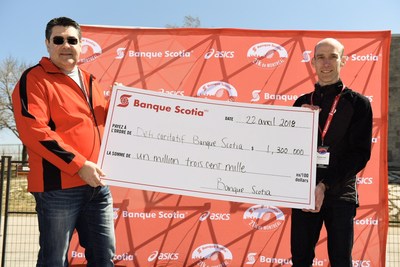
MONTREAL, April 20, 2018 /CNW/ - As thousands of runners are about to take part at the 16th annual Banque Scotia 21k de Montréal, one of Quebec's most important road races and fundraising runs, Scotiabank announces its $1 million donation to Montreal's Sainte-Justine University Hospital Centre.
"Scotiabank aims to support organizations that are committed to helping young people reach their infinite potential," says Tom Apostolis, District Vice-President, Montreal Centre at Scotiabank. "We believe this is an investment in the long-term security, stability and growth of our communities. That's why we are proud to make this important donation to Sainte-Justine Hospital. Through the Scotiabank Charity Challenge at the Banque Scotia 21k de Montréal this coming weekend, we hope others will be encouraged to fundraise and give back to their chosen charity."
Through the Scotiabank Charity Challenge, the event raises money every year for close to 80 local charities that help to create a stronger future for young people and build vibrant communities. The fundraising program provides a simple way for runners to support the charity of their choice and make a significant impact locally as part of their race. Participating charities keep 100 per cent of the proceeds raised, as Scotiabank pays for all transaction and credit card fees.
Scotiabank's million-dollar donation, which is complementary to the funds raised through the Scotiabank Charity Challenge, will directly support the CHU Sainte-Justine's pediatric asthma department and the emergency room. Half of the funds will be allocated to the development of a Rapid Evaluation Zone in Sainte-Justine's high-traffic emergency room. The implementation of this project led by Dr. Antonio D'Angelo, Chief of emergency medicine at CHU Sainte-Justine, aims to improve the management of sick patient care and reduce waiting times. According to the seriousness of the patient's health status, this innovative system allows doctors to evaluate children in the emergency room faster and start their treatment earlier.
The other half of the donation will support childhood asthma research led by Dr. Francine Ducharme, Pediatrician, clinical epidemiologist and researcher at CHU Sainte-Justine. While it has been a long time since the evolution of asthma in children was thought to be irreversible, new research by Dr. Ducharme and her collaborators shows there is new hope to improve not only the control of the disease in the short term, but also the chances of long-term remission, or a complete healing.
"It's a great honor to receive this exceptional support from Scotiabank," said Maud Cohen, President and CEO of the CHU Sainte-Justine Foundation. "It is also a privilege to make this announcement as part of the Banque Scotia 21k de Montreal, of which we were early participants. The impact of this donation on the health of asthmatic children and families visiting our emergency rooms will be major. All of this is made possible thanks to Scotiabank. We are pleased to take advantage of a charity sporting event as rallying as the Banque Scotia 21k to show our immense gratitude to this exceptional donor."
To celebrate this $1 million-dollar donation, Dr. Francine Ducharme, her colleagues and a team from the Pediatric Emergency Department will join the thousands of runners Saturday for the Banque Scotia 21k de Montréal race. They will run to raise additional money through the Scotiabank Charity Challenge for the CHU Sainte-Justine Foundation.
It's not too late to get involved in this year's Scotiabank Charity Challenge:
- Register for an event: Register for Banque Scotia 21k de Montréal on the event website until Friday, April 20 at 6 p.m.
- Fundraise: Once registered, sign up for the Scotiabank Charity Challenge and raise funds for a participating official charity.
- Share! Share your story behind why you support your charity using #runScotia.
- Donate: Visit the Scotiabank Charity Challenge to select an official charity and make a one-time donation.
- Cheer: Support friends and family along the race route and as they cross the finish line. You can also show your support to runners online by using the hashtags #SCOTIA21KMTL and #runScotia.
About the CHU Sainte-Justine
The Sainte-Justine university hospital centre (CHU Sainte-Justine) is the largest mother-child centre in Canada and the second largest pediatric hospital in North America. A member of the Université de Montréal extended network of excellence in health (RUIS), Sainte-Justine has 5,664 employees, including 1,578 nurses and nursing assistants; 1,117 other healthcare professionals; 502 physicians, dentists and pharmacists; 822 residents and over 200 researchers; 300 volunteers; and 3,400 interns and students in a wide range of disciplines. Sainte-Justine has 484 beds, including 35 at the Centre de réadaptation Marie Enfant (CRME), the only exclusively pediatric rehabilitation centre in Quebec. The World Health Organization has recognized CHU Sainte-Justine as a "health promoting hospital." chusj.org
About Scotiabank
At Scotiabank, we aim to support organizations that are committed to helping young people reach their infinite potential. Young people are our future leaders and Scotiabank's goal is to help ensure that they have the necessary skills and resources they need to support their success. Together with our employees, the Bank supports causes at a grassroots level. Recognized as a leader for our charitable donations and philanthropic activities, in 2017, Scotiabank contributed more than $80 million to help our communities around the world.
Scotiabank is Canada's international bank and a leading financial services provider in North America, Latin America, the Caribbean and Central America, and Asia-Pacific. We are dedicated to helping our 24 million customers become better off through a broad range of advice, products and services, including personal and commercial banking, wealth management and private banking, corporate and investment banking, and capital markets. With a team of more than 89,000 employees and assets of over $923 billion (as at January 31, 2018), Scotiabank trades on the Toronto (TSX: BNS) and New York Exchanges (NYSE: BNS). For more information, please visit www.scotiabank.com and follow us on Twitter @Scotiabank.
SOURCE Scotiabank
Brewer interest in the ultra-light beer concept could have global implications, says GlobalData
At a time when the sales of top-selling light beer brands have been contracting in the US, Anheuser-Busch InBev’s (AB InBev) Michelob Ultra is redefining the ultra-light beer concept in a move that could have global implications, says leading data and analytics company GlobalData.
AB InBev launched Michelob Ultra ‘low carbohydrate light beer’ in the US in 2002, when the country was in the middle of the famed Atkins diet craze and was subsequently able to cultivate a devoted core of users, including weight-conscious women, even while the overall light beer sector shrank.
As recently as 2007, Bud Light, Coors Light and Miller Lite collectively accounted for roughly one third of US beer shipments, according to Beer Marketer's Insights and The Wall Street Journal. By 2017, that collective share had shrunk to just over a quarter. However, Michelob Ultra brand bucked the trend and had its biggest year yet in 2017 when US shipments grew by over 21%.
Sensing a revival of the low-carb trend, a number of companies are making a more premium push for ultra-light beer. Heineken USA launched 90-calorie Amstel Xlight aligned with top interests of millennial consumers – wellness and fitness – into a handful of markets in 2017.
Tom Vierhile, Innovation Insights Director at GlobalData, says: "While it sounds odd to link beer with fitness, brewers with a sense of self-preservation are keen to establish the link. Data suggests that younger consumers see alcohol in a more negative light than older consumers and beer that is perceived to be more healthful could thrive in the US and elsewhere.”
According to GlobalData's Q4 2016 consumer survey, 54% of 25–34 year-old Americans are actively trying to reduce consumption of alcohol compared to 28% of Americans overall and just 15% of 45–54 year-olds. A higher percentage of these younger consumers say they are actively trying to reduce consumption of alcohol than fat (51%), sugar (41%), or even carbohydrates (36%).
Globally, the differences are more moderate but still indicate a tendency of younger consumers to more closely evaluate the health consequences of their consumption choices than older consumers. 25% of 25-34 year-olds globally say they are actively trying to reduce consumption of alcohol, versus 22% of global consumers overall. Just 17% of 65+ year-old global consumers say they are actively trying to reduce alcohol consumption.
Vierhile adds: "Lower alcohol, carbohydrate and calorie contents are trends to keep an eye on in global beer innovation. But new entrants promising a higher-quality beer experience than past launches that were obsessed with calorie counts show a maturing of the ‘healthful beer’ concept into something with global growth potential.”
In line with the low-card trend, India-based B9 Beverages launched Bira 91 light lager with just 90 calories per 330ml bottle and 4% ABV. In New Zealand, Speight's Summit Ultra Low Carb lager claims to have 75% fewer carbohydrates than regular beers and 4.2% ABV.
Eager to defend its turf, AB InBev earlier this year launched Michelob ‘Ultra Pure’ Gold with organic grains." With just 2.5 carbohydrates and 85 calories per 12-fluid-ounce serving, ‘Ultra Pure’ Gold is billed as a ‘superior light beer’.
Vierhile continues: "Organic ingredients resonate with younger consumers, who equate the term with a product that is intrinsically more healthful and aligns with popular trends like clean eating and drinking.”
Some companies are even using fruit and fruit flavors to cut calorie and alcohol levels. Indonesia-based PT Beverindo Indah Abadi has recently rolled out 2.9% ABV Prost Alster lemon lager beer with 10% real lemon juice.
Vierhile concludes: “For consumers bored with the ‘same old’ light beer, these new offerings may provide a reason to give reduced-calorie beer another look.”
CROSSFIT GYMS ACROSS THE COUNTRY RALLY FOR VETS
Travis Manion Foundation partners with CrossFit gyms nationwide to raise money for veterans initiatives
DOYLESTOWN, P.A. - To honor the sacrifice of our fallen heroes like the namesake of the Travis Manion Foundation (TMF), 1stLt Travis Manion (USMC), CrossFit gyms around the country will be hosting Workout of the Day (WOD) events to raise funds for events to raise funds for TMF initiatives, which help our nation’s veterans identify their strengths and passion, so they can make a positive impact on their community throughout their post-military lives.
"Travis was the type of person who was big in the little things," said Jimi Letchford, Global Brand Manager for CrossFit, Inc. “Travis lived everyday with character, and I’m in awe of the amazing work being done by the Foundation that bears his name. TMF is empowering veterans and families of the fallen to develop that same character in our next generation, as a way to honor Travis and all our fallen heroes. His legacy is one that I’m proud to help carry on, just as I was proud to serve side by side with him before his death.”
"I'm honored that on April 29th, CrossFit gyms across the country will recognize the sacrifice my brother Travis made 11 years ago. The CrossFit community continues to exemplify the strength of America's national character, by paying homage to our nation's fallen heroes through teaching their values of accountability and integrity to future generations," said Ryan Manion, President of the Travis Manion Foundation.
Manion WOD events will be occurring at CrossFit gyms across the United States on Sunday, April 29, 2018. Times vary by location. Proceeds from each event will go towards TMF veteran initiatives such as TMF veteran expeditions, veteran-empowerment programs, and scholarships.
WHO: Travis Manion Foundation, CrossFit, Inc.
WHAT: Manion Hero Workout of the Day (WOD)
WHERE: More than 50 participating gyms across the U.S., including:
- CrossFit University City (Philadelphia)
- Brooklyn Athletic Club (Brooklyn)
- Crossfit Glen Burnie (Odenton-Baltimore)
- Crossfit Identity (Atlanta)
- Crossfit Stonecutter (Tomball, TX)
- Iron Will Fitness LLC (Fruit Cove, FL)
WHEN: Sunday, April 29, 2018 - Time Varies By Location
Travis Manion Foundation (TMF) empowers veterans and families of fallen heroes to develop character in future generations. In 2007, 1stLt Travis Manion (USMC) was killed in Iraq while saving his wounded teammates. Today, Travis' legacy lives on in the words he spoke before leaving for his final deployment, "If Not Me, Then Who..." Guided by this mantra, veterans continue their service, develop strong relationships with their communities, and thrive in their post-military lives. As a result, communities prosper and the character of our nation’s heroes lives on in the next generation. The story of 1st Lt. Travis Manion and his Naval Academy brother Lt. (SEAL) Brendan Looney have been publicized in the book Brothers Forever, and additional information about the Foundation can be found at www.travismanion.org.
5 Ways to Learn Fast and Retain More

The sooner you realize that learning never ends, the more willing you’ll be to expand, elevate in your profession, thrive in your life and even generate more income. Learning and studying can be difficult once we are long past our college years. For all the old dogs who might be reluctant to learning new tricks, we tapped the expertise of Dr. Sanam Hafeez, a New York based Neuropsychologist and Teaching Faculty at Columbia University to share 5 ways to learn fast and retain more so we can quickly grasp new concepts, technologies, business strategies and up-level our willingness to learn.
Independent learning is the hot new brain trend. Thanks to digital media, we see a new renaissance when it comes to learning. On the professional side, nearly two-thirds of U.S. workers have taken a course or sought additional training to advance their careers, according to a March 2016 study by Pew Research Center. On the personal development side, a simple Google search can lead anyone to a plethora of courses on everything from mastering personal finances, parenting, our relationships, nutrition, cooking, designing clothes, home organization and design.
“The key to longevity is the learning and application of new things. When we stop learning, we stop growing and that is a slow death to our brains and bodies. Luckily today there are online seminars and other ways to learn that speak to our interests. It’s also incredibly convenient to learn,” explains Dr. Hafeez.
What are the best ways to learn new things quickly? Dr. Sanam Hafeez offers the following 5 ways to learn fast and retain more.
- Learn in quick sprints.There’s a sweet spot for learning in the 30-50 minute timeframe. Dedicate that amount of time to learning and then take a 10 to 15-minute break to end a learning segment before starting a new task. “You’re more likely to retain more when you focus for a shorter amount of time at once,” explains Dr. Hafeez who helps people with ADHD to enhance their ability to focus and learn. “Using tools like notecards with quick points helps the brain absorb concepts even more,” she adds. Which leads to…
- Take written notes and use color!Ditch the laptop and go old school with a pen and paper. Outline important points with a different color pen or highlighter and if you can draw a concept out in the margin, go for it. Writing fuels comprehension and enhances listening skills. Studies out of UCLA and Princeton found students who took notes on laptops didn’t perform as well as students who wrote by hand. “When we handwrite notes we listen then process the information before writing. When we type on a laptop, we transcribe what we hear without any self-interpretation which is where the actual learning comes into play,” offers Dr. Hafeez.
- Give your brain time to rest and recharge with sleep.People brag that they work so much and sleep so little. Arianna Huffington’s book, “The Sleep Revolution,” and choice to add nap rooms at her Huffington Post offices turned the light onto sleep as a performance enhancer. “People who get a full 8 hours of deep uninterrupted sleep retain what they learn and have bandwidth to grasp more information quicker. We often feel tired after a course or following instructions. This is because focusing requires energy. Naturally, when we rest we get to reboot the brain,” says Dr. Hafeez.
- Read out loud, record, replay.Research has shown that reading out loud engages both senses of sight and sound which heightens retention.“Recording yourself reading and elaborating with your own idea of how the concept resonates then replaying the recording a day or two later, is a great technique that fires up the part of the brain that processes concepts like a computer filing information for later use," explains Dr. Hafeez.
- Break things down and relate it to what you already know.We all heard of the math teacher who used the example of rock concert ticket sales to get kids to grasp algebra. According to Dr. Hafeez, “when we take a concept and link it to something we already know about or have genuine interest in, we retain that concept. Anytime we can internalize a concept is has resonance. It sticks.”
About the Doctor:
Dr. Sanam Hafeez PsyD is a NYC based licensed clinical psychologist, teaching faculty member at the prestigious Columbia University Teacher’s College and the founder and Clinical Director of Comprehensive Consultation Psychological Services, P.C. a neuropsychological, developmental and educational center in Manhattan and Queens.
Dr. Hafeez masterfully applies her years of experience connecting psychological implications to address some of today’s common issues such as body image, social media addiction, relationships, workplace stress, parenting and psychopathology (bipolar, schizophrenia, depression, anxiety, etc…). In addition, Dr. Hafeez works with individuals who suffer from post-traumatic stress disorder (PTSD), learning disabilities, attention and memory problems, and abuse. Dr. Hafeez often shares her credible expertise to various news outlets in New York City and frequently appears on CNN and Dr.Oz.
Connect with her via twitter @comprehendMind or www.comprehendthemind.com

Positive Health and Well-Being: Sleep and Fitness
If you want to get in better shape, you should start by going to sleep.
Sounds a little counter-intuitive, right? Because what does dozing and snoozing have to do with getting fit?
Actually, quite a lot. Sleep affects us a lot more than we might think. It impacts our relationships, our work life, our appearance and both our mental and physical health. With enough, good-quality sleep on a regular basis, we’re happier and healthier people. Whereas, if we’re sleep-deprived, we’re more prone to sickness, to turn to unhealthy habits and to be lethargic, unmotivated and irritable in our daily lives.
Not exactly the recipe for a fitness machine!
It’s true – sleep has a big impact on both our fitness and our health. Here’s why:
1. Sleep aids performance
When you don’t sleep properly, you’re reducing your body’s ability to perform. Your reaction times are less, your motivation and energy levels are low and your frustration is high. Even though you do the same sequence as two days’ previous, you find yourself much more exerted, and a lot less fit.
So if you try and stick to that training schedule when you’re sleep-deprived, it’s likely to end in disappointment. And you’ll be more likely to give up.
2. Sleep reduces the risk of injury
A sleep-deprived body could be more prone to injury. In fact, researchers looking at performance amongst athletes discovered that one of the biggest causes of injury was a lack of the snoozy stuff. One study in particular showed that athletes who slept for less than 8 hours a night were considerably more likely to get injured than athletes who did. This was probably because they didn’t have sufficient time to “repair” the body… but more on that in a sec.
The thing is, even if you do a warm-up beforehand, you may end up pushing yourself too hard during the workout itself. Something which your well-rested brain would never allow! An impaired judgement means you don’t respect your boundaries, or accept the fact that maybe you should be gentle on your stiff, tired body. Instead, frustration and impatience drive you to injury… which is bad news for keeping fit afterwards, or for a calm state of mind.
3. Sleep affects recovery time
As you’re probably aware – or at least, you should be – the “recovery time” between workouts is pretty important. This time to rest is essential to help you build strength, allowing body tissue to repair and grow. And recovery period can only occur if we’re well-rested; hence the athletes who got more than 8 hours’ sleep being at less of a risk of injury.
But if you’re sleep-deprived, high cortisol levels, combined with the disruption of the anabolic growth hormone, creates an unfavourable metabolic environment for growth and repair. Your body can’t recover as it should, and your ability to stay in better shape is reduced as a result.
4. Sleep boosts the immune system
Chronic poor sleepers are at greater risk of catching viruses and infections. Furthermore, they’re more likely to become obese, to develop diabetes and to suffer from high blood pressure. They’re even more prone to strokes, heart disease and heart attacks. Yikes!
Staying well-rested, however, means your immune system can do its job. It keeps you stronger and healthier for longer, meaning you can fight of illness and stay in better physical health.
4. Sleep nurtures good mental health
Sleep doesn’t just affect our bodies; it has a big influence on our minds, too. Think of the last time you slept badly. How irritable and lethargic were you the next day? Now imagine that feeling lasting weeks, months or even longer. It ain’t a pretty picture.
The sad thing is, those who toss and turn every night are five times more likely to be depressed than those for whom sleep isn’t a problem. Sleep-deprived people are also 20 times more likely to have a stress-related condition. So clearly, it pays to sleep better… your very happiness depends on it.
5. Sleep leads to fitness, and vice versa
When you get enough sleep, you have the motivation, energy and physical ability to exercise. Similarly, when you make sure to exercise, you’ll be able to sleep better at night. Your body will be stretched, your mind will be calmer and you’ll be able to enjoy a sounder sleep as a result; no matter who you’re sleeping with (!!), or what you’re sleeping on.
And once you start sleeping better on a consistent basis, you’ll notice the benefits to your health, your happiness, and your general well-being, too.
P.S. If you are thinking of purchasing a new bed check out the Dream Cloud Mattress review I recently wrote on the Sleep Advisor. You’ll love it!
So what’re you waiting for? Get thee to bed, now!
Ontario Pharmacies Welcome NDP Commitment to Declare Opioid Public Health Emergency
TORONTO, April 17, 2018 /CNW/ - The Neighbourhood Pharmacy Association of Canada (Neighbourhood Pharmacies) welcomes the Ontario NDP platform commitment to declare the province's escalating opioid crisis a public health emergency.
Recent data released by the Office of the Chief Coroner of Ontario reported that opioid-related deaths in the province have increased by 52 per cent from January to October 2017 compared to the same period from 2016. Further, emergency department visits related to opioid overdoses jumped 72 per cent between January to December 2017 to 7,658 from 4,453 in 2016.
"Every day, five Ontarians become dependent on opioids – a human toll we simply cannot afford," said Justin Bates, CEO of Neighbourhood Pharmacies. "If the current trend continues then over the next decade the number of Ontarians who are dependent on opioids will fill BMO Field in Toronto," Bates went on to say.
The Ontario NDP's commitment to expand the distribution of Naloxone and other anti-overdose medications is laudable, but will not stem this crisis on its own. A truly multifaceted response to this crisis is required. It involves a focus on both the treatment and prevention of addiction.
The entire health care system must work in concert to fight the scourge of dependency and overdose. Pharmacy professionals can use their unique tools and position in the health care system to help prevent dependency before it starts – saving lives and saving the system precious dollars. Our members can ensure Ontarians are using medications safely and responsibly, preventing tragedy before it occurs.
Therefore, Neighbourhood Pharmacies, along with the Ontario Pharmacists Association, has proposed a pharmacy-delivered pain management program for Ontarians who are prescribed opioids. The aim of this program is to focus on preventing opioid addiction in the first place. The program will provide patients with one-on-one support to appropriately assess and manage their pain, while mitigating the potential risk of opioid dependence. This will make a real difference in the lives of patients and save lives now.
While this type of pharmacy-administered pain management program would be the first of its kind in Canada, there is evidence that this program has had success in other jurisdictions like Australia. To ensure its success the implementation would be phased-in – quickly, yet thoughtfully – with ongoing quality improvement metrics and adjustments.
About Neighbourhood Pharmacy Association of Canada:
The Neighbourhood Pharmacy Association of Canada represents the business of pharmacy and advocates for Canada's leading pharmacy brands who deliver high value, quality care to Canadians in all models including chain, banner, long-term care, specialty and independent pharmacies as well as grocery chains and mass merchandisers with pharmacies. Our focus is on improving the delivery of care environment for pharmacy, while fostering the right business conditions for business success. By leveraging the over 10,000 points of care with pharmacies conveniently located in every neighbourhood across Canada, we aim to advance sustainable healthcare for all stakeholders.
SOURCE Neighbourhood Pharmacy Association of Canada
How Physical Therapy Can Help You Heal from an Injury
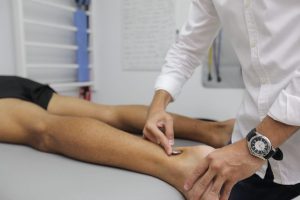
Physical therapy is performed by trained therapists in a medical facility or sport venue. You might need physical therapy for a variety of reasons so that you can heal faster from an injury. If you want to avoid surgery or taking an assortment of medications, then physical therapy is an excellent choice after different types of injuries. Here are some of the ways that physical therapy can help you to heal quickly.
Increasing Your Body’s Blood Circulation
When you have an injury, moving can feel impossible, but a physical therapist can perform treatments such as massages that will increase the blood circulation in the injured area. With additional blood flow, your lymph glands also function better, and these body parts secrete chemicals that can help you to heal. If your blood circulation is better, then you may also feel more energized. With additional energy, you might feel ready to begin using an injured limb on your own.
Decreasing the Discomfort from an Injury
Physical therapy can decrease the discomfort from an injury so that you can move easily and sleep comfortably. If you are feeling a lot of pain in an injured body part, then you likely won’t want to move around. This can lead to more immobility, causing additional health problems. In addition, if you can’t sleep because you are feeling too much pain, then an injury won’t heal. While you are sleeping, your body’s glands will produce hormones that are required for healing an injury.
Helping a Knee Injury
Your knees are complex joints, and if one is injured, then physical therapyis vital. A physical therapist can create a treatment plan that is appropriate for your knee’s tendons, cartilage, and muscles so that all of the different parts heal without developing adhesions. With professional knee physical therapy, you can recover from an injury faster so that you can return to normal daily living.
Avoiding an Additional Injury
If you have an injury to your back, hips or knees, then having professional physical therapy can help to prevent an additional injury from a fall. A therapist can help you to improve your body’s muscular strength and flexibility so that you have better balance while walking and standing.
After you are injured, seek treatment from a physician. Within a few days, talk to your physician about beginning physical therapy, and your physician can provide a recommendation for an excellent therapist. Alternatively, you can contact your insurance provider to learn more about the physical therapists who are in your network.