80% Experience Back Problems: What to Know Before Your Spine Is Affected

According to the American Chiropractic Association, 80 percent experience back problems at some point in their lives. Because of the likelihood that this may happen to you, you need to know the major causes of back pain. It can be mechanical or stem from serious conditions. Here is what you need to know before your spine is affected:
Most Back Pain is Mechanical
Movement that causes back pain would be categorized as mechanical. It is not the only cause of back pain to fit in the mechanical category, though. A few other mechanical causes of back pain are sprains, strains, and herniated discs. Some of the causes can be avoided by taking preventative measures. Mechanical causes are serious, but back pain caused by more serious conditions could be life-threatening.
Your Back Pain May Come from Serious Conditions
A few examples of serious conditions that cause back pain are cancer, blood clots, and kidney infections. There is little difference, however, to how back pack pain is caused. Mechanical cause is associated with the spine’s movement. Yet, serious conditions can come from anywhere. Back pain caused by such conditions can be easily masked and mistaken for a mechanical cause without proper diagnosis by a doctor. If you feel back pain, make an effort to visit the doctor as this could be one of the most important preventative measures that you take.
You Can Minimize Your Back Pain
One of the best ways to minimize your back pain is through practicing good posture. You have most likely heard it before—maybe from a teacher or parent—but it’s important! Being active is also crucial. Make sure to stretch before doing a workout session, though. If you work in an environment where you’re pretty stationary, you can minimize the chances of getting back pain by using ergonomic chairs, desks, and workstations.
It’s Possible to Avoid the Chronic Pain That Results from a Back Injury
A back injury can happen at any time. Lifting with the wrong posture or a sports accident could cause a back injury. Unfortunately, it can lead to chronic pain that will need to be dealt with proper pain management techniques in order for you to function in life properly.
If you have yet to experience serious back pain, do what you can now to prevent it from happening in the future. Be like the 20 percent! If you do experience some pain, don’t put it off. Ask a doctor if it is mechanical or serious and what can be done to get your back feeling better again. Don’t let it get to the point where chronic pain becomes an issue for you.


Pantone recently announced Ultra-Violet, as the 2018 Color of the Year. Serving as the hue of some of our favorite superfoods, Dr. Christopher Calapai, D.O., a New York City Osteopathic Physician board certified, has compiled a list of the impressive benefits these cosmic colored foods have to offer and why you should incorporate them into their diet.
- Blackberries are loaded with vitamin C, as well as vitamins A, E, K, and B vitamins, antioxidants lutein and zeaxanthin, which sift free radicals and reactive oxygen species.
- Blueberries are a top superfood of the fruit world, containing iron, phosphorous, calcium, magnesium, manganese, zinc, and vitamin K, which help and maintain bone health.
- Red cabbage contains disease-fighting properties known as polyphenols, which offer antioxidant, anti-inflammatory and anti-cancer benefits. It also is a great source of dietary fiber and a rich source of several vitamins.
- Lavender Oil created from the lavender herb, has been proven to assist with getting rid of bloating and calming itching.
- Plums are rich in fiber and help to ease digestion, as well as great source of vitamin A.
- Açaí Berries are loaded with antioxidants, as well as being rich in fiber, protein, carbohydrates, vitamins A, B, C and E, mineral salts (calcium, iron, phosphorus and potassium) amongst others.
- Figs are rich in natural health benefiting phytonutrients, antioxidants and vitamins. Dried figs are a great concentrated source of minerals and vitamins.
About the doctor:
Dr. Christopher Calapai, D.O. is an Osteopathic Physician board certified in family medicine, and anti-aging medicine. Proclaimed the "The Stem Cell Guru" by the New York Daily News, Dr. Calapai is a leader in the field of stem cell therapy in the U.S. His stem cell treatments have achieved remarkable results in clinical trials on patients with conditions as varied as Alzheimer's, arthritis, erectile dysfunction, frailty syndrome, heart, kidney and liver failure, lupus, MS and Parkinson's. He has worked with Mike Tyson, Mickey Rourke, Steven Seagal, and Gotham's, Donal Logue; and as a medical consultant for the New York Rangers. Connect with him via twitter @drcalapai or at www.drcal.net
The International Day of Zero Tolerance for Female Genital Mutilation is a United Nations sponsored annual awareness day that takes place on February 6 as part of the UN's efforts to eradicate female genital mutilation. FGM involves removing and damaging healthy and normal female genital tissue, and interferes with the natural functions of girls' and women's bodies.
Lucinda E. Clarke, author of the suspenseful literary fiction, Amie Cut for Life (Umhlanga Press), which deals with FGM and human sex trafficking, is available to discuss essential aspects of FGM with your audience – the what, who, where, why and how – as well as why the International Day of Zero Tolerance is so important.
OVERVIEW OF FEMALE GENITAL MUTILATION:
WHY
The practice, rooted in gender inequality, attempts to control women’s sexuality and ideas about purity, modesty and beauty. It is usually initiated and carried out by women (!), who see it as a source of honor, and fear that failing to have their daughters and granddaughters cut will expose the girls to social exclusion.
The reasons why female genital mutilations are performed vary from one region to another as well as over time, and include a mix of socio-cultural factors within families and communities. Where FGM is a social convention (social norm), the social pressure to conform to what others do and have been doing, as well as the need to be accepted socially and the fear of being rejected by the community, are strong motivations to perpetuate the practice. In some communities, FGM is almost universally performed and unquestioned.
FGM is often considered a necessary part of raising a girl, and a way to prepare her for adulthood and marriage.
FGM is often motivated by beliefs about what is considered acceptable sexual behaviour. It aims to ensure premarital virginity and marital fidelity. FGM in many communities is believed to reduce a woman's libido and therefore it will help her resist extramarital sexual acts. When a vaginal opening is covered or narrowed, the fear of the pain of opening it, and the fear that this will be found out, is expected to further discourage extramarital sexual intercourse among women with this type of FGM.
FGM is more likely to be carried out where it is believed that being cut increases marriageability.
WHERE
Female genital mutilation is widely practiced in Africa, Asia and the Middle East. However with many people now making their home is new countries, the practice is now seen in North America (USA and Canada) and most countries in Europe – despite it being illegal. Children are often sent overseas to their country of origin for the procedure during the school holiday (the cutting season). UNICEF estimated in 2016 that 200 million women living today in 30 countries have undergone the procedure. Since 1990, the estimated number of girls and women in the US who have undergone or are at risk of the practice has more than tripled.
SOME OF THE DANGERS
The procedure can cause bleeding (haemorrhage), chronic pain, scar tissue and keloid, recurrent infections (eg tetanus), swelling of the genital tissue, fever, wound healing problems, difficulty urinating and passing menstrual flow, the development of cysts, an inability to get pregnant, sexual problems, complications during childbirth, infant mortality, shock and even death.
This does not even touch the damage to the dignity and self-esteem of the victim.
More than 40,000 Ontarians were newly started on high-dose prescription opioids in 2016
TORONTO, Jan. 25, 2018 /CNW/ - More than 40,000 Ontarians were newly started on high doses of prescription opioids (over 90 mg of morphine per day, or the equivalent dose of a different opioid) in 2016. This is despite evidence that those who receive prescription opioids at higher than recommended doses are several times more likely to overdose compared to those on lower doses.
In addition, according to Starting on Opioids, a new report by Health Quality Ontario, the provincial advisor on health care quality, 1.3 million people overall were started on opioids in 2016 – at any dosage. This is a slight decrease of about 25,000 new starts, or 2%, from 2013.
"At current rates of decrease, it would take Ontario more than a decade to reach the same prescribed opioid consumption rates as other economically similar countries such as Australia and the U.K.," says Dr. Joshua Tepper, President and CEO of Health Quality Ontario. "We are hopeful the intervention of initiatives currently underway in Ontario to change opioid prescribing practices will bring the rate down much faster."
The report also shows that of the 1.3 million Ontarians started on opioids at any dosage, nearly 325,000 were started with a prescription for more than 7 days. Evidence tells us that initial prescriptions for more than 7 days of opioids have been associated with a higher risk of long-term use.
Starts of opioids, as defined in the report, are prescriptions for people who have not filled an opioid prescription in at least six months.
"We encourage prescribers and patients to consider if there are non-opioid therapies that might be useful, before prescribing opioids," says Dr. Tepper. "If opioids are the best option, the current standards and guidelines encourage the lowest possible dose and a short duration."
For acute pain, a duration of 3 days or less is often recommended, according to expert opinion. And for starting on opioids for chronic pain, standards and guidelines say it's preferable not to exceed a dose of 50 mg of morphine or equivalents per day, and to initiate opioids only after other therapies have been tried.
"It should be emphasized that chronic pain is very difficult to manage. For example, patients may not be able to afford non-opioid therapies, such as physiotherapy," says Dr. Tepper. "And given the overdose crisis, which is increasingly related to non-prescription heroin and fentanyl, it is also very important for prescribers to not suddenly discontinue prescription opioids so patients don't turn to street sources."
To reduce the risk of addiction and opioid poisoning, there are some encouraging initiatives underway across the province to improve the prescribing of opioids.
In recognition of troubling trends in opioid prescribing and increasing opioid-related deaths, in 2016, the Ministry of Health and Long-Term Care launched a comprehensive strategy to address opioid-related harms, with a focus on modernizing opioid prescribing and monitoring, improving access to pain treatment, and enhancing addictions supports and harm reduction.
At the request of the Ministry of Health and Long-Term Care, Health Quality Ontario, in collaboration with patients, health care providers, caregivers, and organizations across the province, is in the final stages of developing three quality standards, that outline for clinicians and patients what high-quality care looks like. Two are about opioid prescribing for acute pain (short-term) and chronic pain (long-term), with a third outlining how to identify and treat people with opioid use disorder.
These standards of care will be put into action through coordinated efforts with a number of health care organizations who are providing customized data, tools and supports to physicians for appropriate prescribing.
Other initiatives are underway to prevent opioid addiction and overdose. To name a few, there are various hospitals designing programs to help with the post-discharge period for patients who have had major surgery to better manage their pain, and the Royal College of Dental Surgeons of Ontario produced a guideline for the province's dentists and dental specialists. And, Ontario is expanding Rapid Access Clinics across the province to help people with hip, knee and lower back pain access the right treatment faster, including non-opioid treatments.
To provide a personal perspective of the issues raised by the data, the Health Quality Ontario report also features stories from patients and health care professionals.
Related findings:
- Canadians are the second-largest per-capita users of prescription opioids after the U.S. at over 34,000 daily doses per million in 2013-2015, according to the Report of the International Narcotics Control Board for 2016.
- About 44,000 health care professionals in Ontario prescribed opioids in 2016.
- Together, family doctors, surgeons, and dentists represented 86% of all new-start opioid prescriptions in 2016.
- In 2016, 865 people in Ontario died from opioid toxicity, up from 366 in 2003. Although many deaths involved opioids that were obtained from street sources, opioid-related deaths have also been shown to be concentrated among patients who are prescribed opioids more often, according to Public Health Ontario.
- Opioid related emergency department visits more than doubled to 4,427 in 2016 from 1,858 in 2003: Public Health Ontario.
To read the full report visit: www.hqontario.ca/StartingonOpioids
About Health Quality Ontario
Health Quality Ontario is the provincial advisor on the quality of health care. With the goal of excellent care for all Ontarians, Health Quality Ontario reports to the public on how the system is performing, develops standards for what quality care looks like, evaluates the effectiveness of health care technologies and services, and promotes quality improvement aimed at sustainable positive change. Visit www.hqontario.ca for more information.
SOURCE Health Quality Ontario

What are YogaPaws?
YogaPaws gloves and socks are made out of an ergonomic design that keeps the webbing of the hands and feet happy while you exercise. The thick pads encourage correct posture and technique while providing all the comfort and support that Yogi desires. Finger and toe cutouts allow you to take full control of your positioning, while fitted palm and feet coverage boosts your balance and helps evenly distribute your weight while in movement. The gear makes exercising both indoors and outdoors feel effortless and natural - just like it should.
Why YogaPaws?
YogaPaws allow you to practice yoga anytime, anywhere, without the use of a mat. They’re convenient to pack lightly, and have many different uses, too. Check out other ways yogis are using their gloves and socks here! Plus, it’s not just for women – there are men’s sizes and options available, too.
Where can YogaPaws be purchased?
Online, at several different retailers, including their website and Amazon, YogaOutlet.com and more.

Other info & Quick Stats
Click here for the company website: http://www.yogapaws.com
Interview: Jamie Getwiller, CEO/inventor
YogaPaws is a mother/daughter adventure which started in 2001 and officially in launched in 2003. Gail (mother) and Jamie (daughter) Getzwiller share a love for travel and yoga which lead to a natural development of the YogaPaws. Since then, they have embarked on a journey of love and working dedication to produce the best “paws” possible. Yoga Paws have been a product and company that cares about spreading the love and allowing all the yogi's around the world to enjoy as non-slip practice, anytime, anywhere.
Pricing: Full sets begin at $35.00 and in a variety of sizes, ranging from petite, wide and regular.
Donation and Transplant in Ontario Makes Headway in Last 10 Years
TORONTO, Jan. 24, 2018 /CNW/ - Since 2008, the number of deceased organ donors in Ontario has nearly doubled, increasing by 98 per cent.
Trillium Gift of Life Network (TGLN), Ontario's government agency responsible for organ and tissue donation and transplantation, released its 2017 results today and reviews its progress over the past 10 years (January 1, 2008 – December 31, 2017).
TGLN has applied a number of leading practices that have contributed to its success over the last decade, including: implementing routine notification at 69 hospital corporations, which requires hospitals to refer all potential donation cases to TGLN, and appointing 58 donation physicians that work alongside the hospitals' executive and operational staff and TGLN to ensure donation is part of quality end-of-life care.
Ontario is a leader in donation
In 2017, there were 347 deceased organ donors compared to 175 in 2008.
TGLN's leading practices have included the application of donation after circulatory death (DCD), which, in conjunction with other advanced efforts, has been a significant contributor to the growth of deceased organ donors in Ontario.
There are two types of donation after death: donation after neurological death (NDD) and donation after circulatory death (DCD). DCD is an option when a patient has a severe neurological injury, with no chance for recovery, and the decision to withdraw life-sustaining treatment has been made. The first DCD case in modern Canadian history was performed in Ontario in 2006. In the last 10 years, DCD has increased by 260 per cent and today, approximately 1 in 3 organ donors are a result of DCD.
Similarly, as a result of the expansion of routine notification from 21 hospitals in 2011 to 69 hospital corporations today, the number of tissue donors has climbed considerably, growing 102 per cent from 1,061 in 2008 to 2,141 in 2017.
One tissue donor can enhance the lives of up to 75 people: eyes can restore sight; skin can help burn patients; bone can be used for joint replacements; heart valves can help patients with congenital heart disease; and tendons and ligaments can help people walk and run.
Transplant performance results give people hope
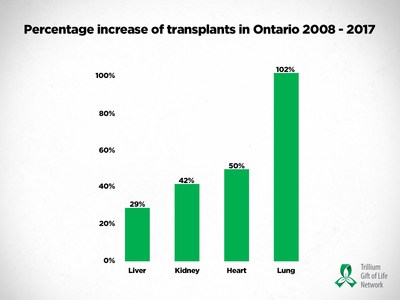
Largely due to the rise in deceased donation, the number of organ transplants in Ontario has increased by 46 per cent in the last 10 years (1,268 in 2017 compared to 867 in 2008). However, despite the increase in both donation and transplant, the need for transplant continues to outweigh the number of organs available for transplant.
"We all, as Ontarians, deserve to feel great pride in the advancements in our province's donation and transplant system," said Ronnie Gavsie, President and CEO, Trillium Gift of Life Network. "More and more medical conditions are being treated by organ transplant; more and more lives are being saved; we have an internationally renowned system. But as long as there are people waiting for a lifesaving organ transplant, there is much more to be done. Together, with our committed hospital partners, we are continuously working to make improvements to ensure that there are no missed opportunities for donation."
A culture of donation in Ontario
In 2008, only 16 per cent of eligible Ontarians were registered. Today, 32 per cent (nearly four million Ontarians) have registered their consent to organ and tissue donation. Over the last ten years, the number of registered organ and tissue donors have grown by 126 per cent.
"Ontario's success in organ donation and transplant is only possible because of the incredible donors and their families who make the generous and difficult decision to give the gift of life," said Dr. Eric Hoskins, Ontario's Minister of Health and Long Term Care. "Because of their gift, over 1,200 people were given a second chance at life in 2017. Register today at www.BeADonor.ca and give hope to the 1,500 people waiting."
Trillium Gift of Life Network is a not-for-profit agency of the Government of Ontario responsible for planning, promoting, coordinating and supporting organ and tissue donation for transplantation across Ontario and improving the system so that more lives can be saved.
SOURCE Trillium Gift of Life Network
Swimming VS Lifting Weights: a Guide to Effective Exercise

Putting together a solid exercise regimen can initially be overwhelming and hard. There are so many different and diverse physical fitness options available to people who are open-minded and attentive. There are many people who swim to stay fit and healthy. There are many people out there who lift weights, too. These forms of exercise both bring their own distinct advantages to the table.
The Advantages of Lifting Weights
What exactly can weightlifting do for health-conscious folks? A lot. Lifting weights, first and foremost, can enhance muscle mass significantly. If you want to look like the portrait of muscular glory, you can’t go wrong with weightlifting. Weightlifting can promote the strength and power of your bones, too. People who want their bones to be powerful often turn to lifting. It can be great for people who want better bone density. Note that better density can minimize the negative consequences that are associated with osteoporosis, a medical condition that involves the weakness of the bones.
Other Weightlifting Perks
There are various other major advantages that are linked to regular weightlifting sessions. These advantages include reduced blood pressure and enhanced stability. People who suffer from hypertension can get a lot out of weightlifting. The same goes for people who simply want to stay safe. Trips and falls can lead to fatalities. You can protect yourself from the risks of falls by working on your bodily stability. Powerful muscles translate to dependable stability. People who go through severe falls often have balance troubles.
The Advantages of Swimming
If you want to feel amazing, then you should consider signing up for swimming lessons. Swimming is a type of exercise that offers many diverse perks. These advantages are generally nothing like those that are associated with weightlifting. The two activities couldn’t be more different. Their perks, however, are equally valid and worthwhile. Swimming makes a fine exercise choice for many for a wealth of notable reasons. People enjoy swimming. It’s not a chore. If you take swimming classes, the time will fly by. You won’t be staring at your phone waiting to go home.
Swimming Lessons
Swimming can enhance your wellness considerably, too. It can help you improve your stamina and endurance. If you’re the kind of person who always tires quickly, and want to learn to swim, swimming lessons may change your life for good. Swimming can also help enhance cardiovascular fitness. It can even boost the strength of your muscles. This activity can do wonders for people who want to keep their weight in check. Excess weight can be problematic in many ways. It can make people markedly more susceptible to all kinds of severe and potentially fatal medical conditions. Swimming, last but not least, even offers convenient muscle toning. It can be great for your entire physique, no exaggerations. When you swim, you employ the vast majority of your hard-working muscles, interestingly enough.
Try Weightlifting or Swimming Today
Weightlifting and swimming are two types of exercise that can transform your existence, body and health in general. They can do things beyond that as well. Weightlifting and swimming can help you gain clarity. People often do a lot of thinking when they’re in the middle of exercise sessions. Weightlifting and swimming can even be calming activities.
If you’re looking for an exercise path that can keep your mind off of all of your problems, lifting weights can work. Swimming can, too. It’s always a great idea to explore all of the fitness choices that are accessible to you. People should try to move their bodies in different ways all of the time. It can help to keep the body guessing.
Canadian patients to benefit from major investment in genomics and precision health research
Government of Canada and partners invest $255 million in genomics research bringing new hope for Canadians living with cancer, cystic fibrosis, juvenile arthritis, childhood asthma and other diseases.
TORONTO, Jan. 23, 2018 /CNW/ - Precision health promises to transform the way Canadians receive medical care. In the near future, doctors may be able to precisely diagnose symptoms based on a patient's unique genetic makeup and offer them tailor-made treatments that can save the patient's life.
To help make that possibility a reality, the Government of Canada announced two new major investments in genomics research totalling $255 million from federal and provincial governments, as well as research institutions and private sector partners.
The federal Minister of Science, the Honourable Kirsty Duncan, made the announcements at The Hospital for Sick Children (SickKids) in Toronto, where she highlighted a $162 million investment through Genome Canada, the Canadian Institutes of Health Research and co-funding partners, in 15 genomics and precision health projects across Canada.
The projects funded at SickKids will provide targeted treatments for children with brain cancer and will transform treatment for children living with arthritis. The funding also supports a targeted initiative to address health challenges facing Indigenous populations, improving diagnostic outcomes for Indigenous children that have genetic diseases.
Minister Duncan also announced a second major investment to support advanced genomics technology platforms across the country. These technology platforms support the development of improved technologies that underpin research advances in health, agriculture and natural resources. A total of $93 million is being invested in 10 platforms nationwide, with $45 million in federal funding through Genome Canada and an additional $48 million from other sources.
The combined totals of these two investments will provide researchers with access to cutting-edge tools, technologies and services while furthering the Government of Canada's goal to strengthen and support the country's scientific community.
Quotes
"It is an honour to support some of Canada's leading genomics and precision health researchers through investments that will allow them to further their discoveries and innovations. Their incredible work brings hope to Canadians living with chronic illnesses, such as cancer, cystic fibrosis and arthritis, while strengthening Canada's health-care system."
– Honourable Kirsty Duncan, Minister of Science
"All Canadians stand to benefit from the innovative and collaborative research projects being announced today. The platforms, tools, technologies and services that will be developed through this funding will improve our understanding of many illnesses, particularly those that affect the most vulnerable patients, including children and Indigenous peoples."
– Honourable Ginette Petitpas Taylor, Minister of Health
"What's exciting about these genomics and precision health projects is how clinically-oriented they are. Most are led by clinical scientists who deal with patients on a day-to-day basis and are well positioned to apply the research to health-care settings. Further, they are not just about developing new therapies to treat diseases, but about early diagnosis and intervention to better curb or manage diseases at their onset."
– Mr. Marc LePage, President and CEO, Genome Canada
"Our understanding of the human genome and epigenetics is advancing at an unprecedented pace. As a result, today we are creating knowledge that will improve health and health care delivery in ways that were unimaginable only years ago. CIHR is proud to partner with Genome Canada on this important initiative, and to support the outstanding scientists who are at the forefront of this rapidly growing field of research."
– Dr. Roderick R. McInnes, Acting President, Canadian Institutes of Health Research
Quick facts
Associated links
Backgrounder – precision health projects
Backgrounder – genomics technology platforms
This event will be livestreamed on Genome Canada's Facebook page. Also follow us on Twitter, LinkedIn and YouTube @GenomeCanada
Follow Minister Duncan on social media.
Twitter: @ScienceMin
Instagram: sciencemin
SOURCE Genome Canada
BEST HAIR TIPS FOR GIRLS WITH NATURAL CURLS
International Stylist and Curl Master Creator of The Doux
Gets Real About Real Hair

People with wavy or curly hair are always looking for new products, tips and tricks to lock in their desired look. Whether they want to blow it straight, create looser curls or maximize their tighter coils, Maya Smith, Celebrity Hair Stylist, salon owner and creator of The Doux, the “Indie” haircare line with cult following available at Target is truly the master. Here she shares her best tips for girls with curls who want to revel in their natural hair and create a style they love.
Understand the battle between oil and moisture.
The first thing people must understand is that there are opposite things going on at the same time. “Due to the shape of curly haired strands, the hair tends to be under moisturized. On the other hand, the curly haired scalp can get very oily. Managing these opposite demands is the struggle of girls who wish to keep their curls. The key here is knowing how best to address both,” explains Maya who led the movement for women to transition from relaxers to natural curls.
Be gentle when washing curly hair.
According to Maya, kinky, thick, coiled textures tend to appear “tough” and strong enough to withstand heavy manipulation. “In my experience, these hair types are actually the most delicate, and should be handled with care, she recommends.”
Step One: Pick your products wisely.
Maya applied over 2 decades of research and development based on working knowledge of hair texture and listening to what people wanted. “I created The Doux™ SUCKA FREE Moisturizing Shampoo and FRESH RINSE Moisturizing Conditioner as the one-two step that delivers both deep cleaning plus exceptional nourishment necessary for styling.” It’s now available in Target stores and the full product line is available online at www.thedoux.com.
Step Two: Prep for shampoo.
Maya’s professional instructions for curl mastery begins with rinsing hair thoroughly with water for a minimum of 30 seconds. “This helps to eliminate any water-soluble product buildup, such as hair gel or heat protectant. It also helps you save shampoo! Assuming you’re shampooing in the shower, letting the water run over the hair in a downward motion helps prevent further tangling, and allows the hair shaft to swell and the curl pattern to fully rebound.” For those with extremely thick hair, Maya suggests separating hair into 4 sections prior to wetting the hair for increased manageability.
Once the shampoo is applied, Maya recommends light manipulation at the scalp, going from the crown of the head to the nape of the neck. “Squishing” the hair up toward the scalp is a no-no. “Shampooing this way can cause unforgivable tangling and matting. I recommend repeating the shampooing process at least once.”
Step Three: Condition and comb through like a pro.
If your scalp was properly shampooed, conditioning is easy. “This time, you’re focusing on your thirsty ends first, working upward toward the scalp. Gently detangle with a wide-toothed comb or detangling brush (our favorite is Felicia Leatherwood’s “Brush with the Best” detangling brush) before rinsing, starting at the ends, working up toward to the roots. Remember to rinse with cool water which snaps cuticles shut, locks in moisture, makes your hair shinier and reduces frizz.”
When it comes to “co-washing” or “conditioner washing” Maya equates the popular trend to washing your clothes with fabric softener. “In my experience, co-washing causes build-up on the hair, coating the cuticle and impairing the hair’s natural ability to absorb water. Oils, waxes, and product residue harden on the hair shaft, making it more brittle and less porous over time. When the hair can no longer effectively absorb water, the elasticity of the hair is compromised, leaving the hair “crunchy” and stiff, where it is more likely to break. The result is hair that feels dry and brittle, no matter what product you use to moisturize it,” explains Maya.
One of the things Maya Smith and her team of stylists are known for is their ability to restore hundreds of their clients’ curls, simply by getting them to trade in the co-wash for a gentle, pH-balanced moisturizing shampoo, like The Doux’s SUCKA FREE which properly cleanses hair of product residue. “Once you have the hair thoroughly clean it “drinks” up the necessary amount of moisture, and returns to its natural softness,” Maya clarifies.
Avoid alcohol and kick the crunch to the curb.
Styling products high in alcohol give curls a crunchy feel. They suck up every last bit of moisture. Hair spray tends to contain the most alcohol, while gels, mousses and anything that provides hold or lift come in second. “I recommend water-soluble gels that don't feel sticky on your skin, and aerated mousses or foams that resemble beaten egg whites, to give hair fullness, control, and non-brittle curls,” Maya says.
She adds that she created The Doux so it can be used on hair that is worn curly or straight. “Our clients purchase one set of products, and apply them differently to achieve the style they want. If you’re rocking curly hair today, you’re using The Doux’s Mousse Def and Bonita Afro Balm for softness and definition, and The Light for shine. If you’re wearing a blowout, you’re still using the same products, but applying them less liberally, and using the shine mist as a heat protectant. It’s super simple and easy to follow once you’ve seen the results each of them deliver,” Maya explains.
Blow-Dry with a diffuser or hooded dryer.
Maya’s first choice for curly styles is to air dry. “If you don’t have the time to air dry then dry with a diffuser or hooded dryer on a low heat setting. A regular blow dryer nozzle disrupts the curl pattern and focuses hot air on one small section at a time while a diffuser, dries curls evenly for a full, uniform look,” she explains.
Maya recommends always applying a heat-protecting product, then flipping your head upside down using a diffuser at the roots and mid-length making sure to dry the area completely to lock in volume. “It’s important to leave the ends for last, and leave them only semi-dry. Air drying the ends is your best option.”
Care for the curls you were born with!
About Maya Smith:
Maya Smith is an International Master Stylist and Founder of The Doux Salon and haircare line now available in Target. With over two decades of styling experience Maya dedicated two decades to cracking the code on curl care, maintenance and expert styling. When it comes to caring for one’s natural hair and styling it, Maya is the best there is.
While still in high school, Maya got her hair cutting license and graduated from beauty school. Soon after graduating high school, Maya began following her passion and worked as an assistant for celebrity stylist Tracy Johnson. She learned from Johnson and progressed as a hair stylist for celebrities and entertainers. Years later the military wife would relocate to Germany, where Maya opened up her first salon The HoneyComb, a mecca for textured hair care for women from all over Europe, The UK, and as far as Africa. Maya's unique system of textured hair styling sparked the development of The DOUX® haircare products, first launched overseas, and distributed throughout Germany, France, Italy, and the Netherlands.
Currently, Maya leads a carefully selected team of stylists at The DOUX® Salon in Macon, Georgia and on Christmas Eve 2017, celebrated the arrival of The DOUX® in Target stores nationwide. Maya Smith, wife, mom of 5 and savvy business woman is an example not just for women of color but for all women who believe their gifts can impact the world, striving for entrepreneurial endeavors with grace, ease and hustle.
DR. ARTHUR AGATSTON AVAILABLE FOR INTERVIEWS
Creator of the Agatston Calcium Score and Founder of the Heart-Healthy
South Beach Diet
|
|
|
| You’ve likely heard about President Trump’s recent physical examination as well as Sanjay Gupta’s reference to Trump’s calcium score as it relates to heart disease.
But what exactly is the calcium score, also known as the Agatston calcium score? How was it developed and how is it used today?
The Agatston score was created in 1990 and named after Dr. Arthur Agatston, founder of the heart-healthy South Beach Diet, who continues to practice cardiology in Miami Beach, Florida. The work leading to the Agatston calcium score was done at Mount Sinai Medical Center in Miami Beach in the late 1980s.
In short, because of the increasingly widespread use of cardiac CT imaging, the Agatston calcium score has received great scientific and clinical interest as it was the first approach to quantifying coronary artery calcium. Knowing a patient’s coronary artery calcium score facilitates a more informed physician-patient discussion and the decision of whether or not to go on decades-long statin therapy, which helps reduce the risk of a heart attack and stroke. |
|
|
|
|
|
ARTHUR AGATSTON, M.D.
Biography
Arthur Agatston, M.D., is the Medical Director of Wellness and Prevention for Baptist Health South Florida. A pioneer in cardiac disease prevention, Dr. Agatston worked with Dr. Warren Janowitz to formulate the Agatston Score, a method of screening for coronary calcium as an indicator of atherosclerosis that is used at medical centers throughout the world and considered by most experts to be the best single predictor of a future heart attack. Dr. Agatston is a clinical professor of medicine at Florida International University Herbert Wertheim College of Medicine and an associate professor of medicine at the University of Miami Miller School of Medicine. His cardiology practice in Miami Beach is focused on preventing heart attacks in high-risk patients.
Known as the author of the internationally best-selling book, The South Beach Diet, his first nonacademic work, Dr. Agatston created his balanced approach to healthy eating to help his patients improve their blood chemistries and lose weight. Today, the South Beach Diet is the trusted choice of millions and there are more than 23 million copies of The South Beach Diet and its companion books in print worldwide. The lifestyle program has grown to include Web-based materials and a family of healthy and convenient foods, including delicious and nutritionally balanced bars and snacks, as well as a popular online program, SouthBeachDiet.com. Dr. Agatston’s most recent books, The South Beach Diet Gluten Solution and The South Beach Diet Gluten Solution Cookbook, were published in 2013.
Dr. Agatston has published more than 100 scientific articles and abstracts in medical journals and is a frequent lecturer across the U.S. and around the world on diet, cardiac imaging, and the prevention of heart disease. In recognition of his contributions to cardiac prevention, the Society of Cardiovascular Computed Tomography (SCCT) created the prestigious Arthur S. Agatston Cardiovascular Disease Prevention Award in 2011, which is given annually to pioneers in cardiac prevention. Among his many television appearances, Dr. Agatston was featured along with President Bill Clinton on Sanjay Gupta’s 2011 CNN special, “The Last Heart Attack.” |
|