Building a Culture of Accommodation and Inclusion Across British Columbia Workplaces
PORT ALBERNI, BC, June 10, 2021 /CNW/ - The BC government recently announced a Workforce Development Grant to NIDMAR which provides BC residents and workplaces with a range of supports designed to improve Return to Work (RTW) and Disability Management (DM) knowledge, programs and practices, and promote Disability Management professionalization, similar to major efforts currently underway across the UK, Belgium, Malaysia and other jurisdictions.
Building a Culture of Accommodation and Inclusion Across British Columbia Workplaces
People with disabilities are disproportionately affected by much higher poverty and unemployment rates than almost all other sectors in our society. As over 80% of mental and physical health impairments occur during someone's working life, effective accommodation efforts made by workplaces can play a pivotal role in workers maintaining, what are often good quality jobs, rather than entering the disability social security system (whether public or private) and all the associated obstacles of trying to successfully re-enter the workforce at a later stage.
Early intervention and a workplace commitment towards creative and collaborative solutions in the accommodation process are key in maintaining equitable and gainful attachment to the workforce, especially when national and international evidence clearly indicates rapidly declining long-term employment prospects for those with mental or physical health challenges who are on social security. Research indicates that one year on social security leads to a less than 1% chance of sustained future employment.
Workplace knowledge, skills and education in a range of RTW/DM program, policy and accommodation practices are critical first steps in maintaining equitable employment for the disabled worker, while fostering a workplace culture of inclusion where the hiring of persons with disabilities from outside the organization no longer has the level of disability stigma which we still see all too often across the country and around the world.
This grant recognizes that employers and workers jointly have a key role to play in achieving much improved socio-economic outcomes, which are reflected in successful efforts across Canada and comprehensive strategies in other jurisdictions. The various elements of this unique initiative include:
Support for DM/RTW Continuing Education
Scholarship Opportunities in the Bachelor of Disability Management
Support to Obtain Professional DM Designations
Support for Workplaces to have an Assessment of their DM program
Detailed information regarding these opportunities can be found at: www.nidmar.ca
SOURCE National Institute of Disability Management and Research
Nabati Foods Expands Distribution to Asia and Beyond
Nabati cheesecakes are now available in Hong Kong, the Virgin Islands and Hawaii
VANCOUVER, British Columbia, June 11, 2021 (GLOBE NEWSWIRE) -- Nabati Foods Global Inc. (CSE: MEAL Reserved) (“Nabati Foods” or the “Company”), a plant-based food tech company offering whole, natural, plant-based foods for health-conscious consumers, is announcing that its products are now available in Hong Kong, the Virgin Islands, and Hawaii.
Nabati Foods dairy-free chocolate cheesecake will be available in Natures Village in Hong Kong, a health food and lifestyle chain that has seven locations in the metro Hong Kong area, which is home to 7.6 million people. Google trends indicate a more than 250% increase in searches for “vegan” in Hong Kong in the last five years. The total “flexible vegetarian population in Hong Kong is estimated at nearly 24%, according to a 2019 report from Statista.
“We are on a mission to lead the evolution of food, and that means expanding our geographic footprint beyond North America,” Nabati Foods CEO Ahmad Yehya said. “We’re thrilled to partner with such a strong, well established, healthy living brand like Natures Village to make our debut in the lucrative Asian market.”
Nabati Foods’ dairy free cheesecakes are also now available at Quality Food St. Croix in the U.S. Virgin Islands, and at Down to Earth locations across Hawaii.
Nabati Foods products are made with whole, natural ingredients and are kosher, vegan, and do not contain refined sugar or GMOs.
“Nabati Foods remains committed to ensuring our production processes and supply chain is created with sustainability and environmental health and wellness in mind,” Yehya said. “We look forward to these new opportunities to share our vision of healthy mouthwatering meals that bring people together from the tropical waters of the Atlantic, to the sunshine in the Pacific, and to the kitchen tables in bustling Hong Kong.”
Nabati Foods products are now available in more than 700 stores in the U.S. in addition to the new locations in Hong Kong, Hawaii, and St. Croix.
About Nabati Foods Global Inc. Nabati Foods Global Inc. is the owner of Nabati Foods Inc. (“Nabati”), a family-founded food tech company offering whole, natural, plant-based, gluten, and soy-free foods for health-conscious consumers. Nabati was founded in 2014 and has four signature product lines including dairy-free cheesecakes, cheese alternatives, and plant-based meats. Nabati products are distributed in Canada and the U.S. through grocery, foodservice, and industrial channels. Learn more: https://invest.nabatifoods.com/
For further information, please contact the Nabati investor relations team: ir@nabatifoods.com
Disclosure and Caution
Completion of the financing is subject to a number of conditions, including ensuring the financing and listing application are compliant with CSE requirements. The transaction cannot close until the required conditions are satisfied and required approvals are obtained. There can be no assurance that the financing will be completed as proposed or at all. Trading in the securities of the Company should be considered highly speculative – there is no active market for Company’s securities at this time. No regulatory body has reviewed or approved the terms to this financing.
This news release contains forward-looking information, which involves known and unknown risks, uncertainties and other factors that may cause actual events to differ materially from current expectation. Important factors - including the ability to complete the financing, the ability to satisfy the conditions required and approvals needed to complete the transaction, availability of funds and the results of financing efforts, - that could cause actual results to differ materially from the Company's expectations are disclosed in the Company's documents filed from time to time on SEDAR (see www.sedar.com). Readers are cautioned not to place undue reliance on these forward-looking statements, which speak only as of the date of this press release. The Company disclaims any intention or obligation, except to the extent required by law, to update or revise any forward-looking statements, whether as a result of new information, future events or otherwise.
The securities referred to in this news release have not been, and will not be, registered under the United States Securities Act of 1933, as amended, or any state securities laws, and may not be offered or sold in the United States unless pursuant to an exemption therefrom. This press release is for information purposes only and does not constitute an offer to sell or a solicitation of an offer to buy any securities of the Company in any jurisdiction.
How to Prevent Aches and Pains When Starting a New Exercise Routine
No matter your level of fitness, a new workout can mean new aches and pains. To protect yourself, you will want to stretch cold muscles that have been pushed in new ways. Staying hydrated is also critical to avoid cramps, some joint massage can help, and resting is critical to building new tissue.
Warm Up, Cool Down, and Stretch
You will need to start your workout with a warm up. If you are trying to start a jogging routine, begin by walking to loosen up your joints and get your leg muscles moving. At the end of your jog, make time to walk again.
Before you shower, take care to stretch your spine, quads, hamstrings, and calves. Do some stretches on the mat as well to fully engage your upper body. Expect some soreness, and be ready to stretch your legs again if you have pain.
Hydrate
Make sure that you take in plenty of water before, during, and after your new exercise routine. Additionally, consider increasing your intake of fruits and juices that are high inantioxidants, including pineapple and cherries.
Massage
Sore knees are often a problem after a new workout. Consider using a 2000 mg CBD joint pain cream after a new routine. CBD is high in antioxidants, so consider applying it right after you shower to keep inflammation low and reduce the intensity of delayed onset muscle soreness. Avoid applying this cream right before a workout. If you are sore before a workout, you either need to do something lighter or focus on another area of your body. Go ahead and warm up those muscles and joints, but do not push.
Build in a Rest Day
There is a reason that leg day is followed by shoulder, back, or arm day. A hard workout creates tiny breaks or tears in existing muscle. Those tears hurt, and new growth takes time. Give the targeted area of the body time to heal to avoid tissue damage outside your muscles. For example, sore knees after a hard stair workout could be an indication of inflammation, or it could be an indication of cartilage damage. Until the muscular inflammation goes down, you cannot be sure you are not doing more serious damage.
Carefully monitor sore joints and muscles for swelling and bruising. Delayed onset muscle soreness can take time to show up and last for a few days. If you notice it lasting longer, you may need to contact your physician.
New study to monitor COVID-19 illness and vaccine safety, effectiveness in children and youth in Canada
MONTREAL, June 11, 2021 (GLOBE NEWSWIRE) -- The Government of Canada, through its COVID-19 Immunity Task Force (CITF) and Vaccine Surveillance Reference Group (VSRG), is supporting a new pan-Canadian study that will monitor the effects of illness from COVID-19, as well as the safety and effectiveness of COVID-19 vaccines in children and youth. Approximately $1.8 million is being invested in this research project.
The vaccines being administered to guard against COVID-19 have gone through rigorous safety and efficacy evaluations in all eligible age groups. Continued surveillance for any vaccine is an important component of ensuring the safety and effectiveness of all vaccines for the general population. This research study is complemented by ongoing safety monitoring by the Public Health Agency of Canada, Health Canada, and multiple public health organizations.
“Our study will monitor most pediatric hospital visits in Canada and will aim to identify those that may be associated with a COVID-19 infection or vaccination,” says Dr. Karina Top, a principal investigator on the study and a lead investigator at the Canadian Center for Vaccinology at Dalhousie University and the IWK in Halifax. “We want to monitor the symptoms of any children or adolescents admitted to hospital due to COVID-19, including for multisystem inflammatory syndrome in children (MIS-C), as well as track the continued safety and effectiveness of COVID-19 vaccines, as we move toward a return to normal life.”
The study will be conducted through Canada’s IMPACT (Immunization Monitoring Program ACTive) network, which has been continuously monitoring multiple pediatric vaccines for more than 30 years. Its efforts inform public health and medical experts of unusual post-vaccine events. The IMPACT network captures about 90 per cent of tertiary pediatric hospital admissions in Canada and is well positioned to evaluate the impact of vaccination programs on cases of COVID-19 in children and youth who are in hospital.
“As COVID-19 vaccines are made available to 12- to 17-year-olds, and potentially younger age groups in the future, our team will work to ensure continued vaccine effectiveness by studying whether vaccination is associated with fewer children and youth being admitted to hospital with COVID-19, and fewer severe cases of disease,” explains Dr. Shaun Morris, a principal investigator on the study and a pediatric infectious disease physician at The Hospital for Sick Children (SickKids) in Toronto. “This study, which began on June 1, will build upon the information gathered in our research team’s Canadian Paediatric Surveillance Program COVID-19 Study (CPSP COVID-19 Study). That study collected data on this illness from the beginning of the pandemic until the end of May 2021, to provide a more complete understanding of how COVID-19 affects children and youth and how we can best protect them.”
“With the vaccine rollout in youth ages 12 to 17 already underway in Canada, this study is extremely relevant,” says Dr. Caroline Quach Thanh, VSRG Co-Chair and Medical Lead in Infection Prevention and Control at the CHU Sainte-Justine, where she works as a pediatric infectious disease consultant and a medical microbiologist. “This study will bring together information from hospitals across Canada, to more quickly identify patterns of experience that will help determine whether some of the things that they are seeing are related to vaccination. The faster our experts are able to react, the faster we will be able to find solutions.”
“Children and youth have made a lot of sacrifices to help reduce the spread of COVID-19,” says Canada’s Chief Public Health Officer Dr. Theresa Tam. “These studies on the effects of illness from COVID-19, and COVID-19 vaccine safety and effectiveness will help us learn more about the best ways to protect younger Canadians and their families. Monitoring safety and effectiveness of COVID-19 vaccines in this population will also contribute to optimal COVID-19 prevention and control, population wide.”
About the Canadian Immunization Monitoring Program ACTive (IMPACT)
The Canadian Immunization Monitoring Program ACTive (IMPACT) is funded by the Public Health Agency of Canada (PHAC) in collaboration with the Canadian Paediatric Society (CPS) to conduct hospital-based sentinel surveillance for vaccine-preventable diseases and select adverse events following immunization (AEFIs) leading to hospitalization at 12 pediatric tertiary care centres from Vancouver, BC to St John’s, NL which capture approximately 90 per cent of tertiary care pediatric beds in Canada and about 50 per cent of pediatric hospitalizations.
About the Vaccine Surveillance Reference Group
The Vaccine Surveillance Reference Group (VSRG) supports the monitoring of the safety and effectiveness of COVID-19 vaccines in Canada. It is a consortium of Canadian organizations —the Public Health Agency of Canada (PHAC), the Canadian Research Immunization Network (CIRN), the National Advisory Committee on Immunization (NACI), and the COVID-19 Immunity Task Force (CITF)— working collaboratively to pool expertise on vaccine surveillance. The VSRG reports to PHAC and is supported by the CITF Secretariat. It is co-chaired by the leaders of NACI and CIRN. Among its responsibilities, the VSRG, through the CITF Executive Committee, makes recommendations to PHAC on funding research teams that can address important aspects of the immune response, safety, and effectiveness of COVID-19 vaccines with public health relevance and with attention to all priority groups. For more information visit: https://www.covid19immunitytaskforce.ca/vaccine-surveillance-reference-group-vsrg/
About the COVID-19 Immunity Task Force
The Government of Canada established the COVID-19 Immunity Task Force in late April 2020. The Task Force is overseen by a Leadership Group of volunteers that includes leading Canadian scientists and experts from universities and healthcare facilities across Canada who are focused on understanding the nature of immunity arising from the novel coronavirus that causes COVID-19. To that end, the CITF is supporting numerous studies to determine the extent of SARS-CoV-2 infection in Canada (in the general population as well as in specific communities and priority populations), understand the nature of immunity following infection, develop improved antibody testing methods, and help monitor the effectiveness and safety of vaccines as they are rolled out across Canada. The Task Force and its Secretariat work closely with a range of partners, including governments, public health agencies, institutions, health organizations, research teams, other task forces, and engages communities and stakeholders. Most recently, the Task Force has been asked to support vaccine surveillance, effectiveness and safety as part of its overall objective to generate data and ideas that inform interventions aimed at slowing—and ultimately stopping—the spread of SARS-CoV-2 in Canada. For more information visit: http://www.covid19immunitytaskforce.ca
Switch Health introduces AuraPass as the next step to safely reopen Canada's economy
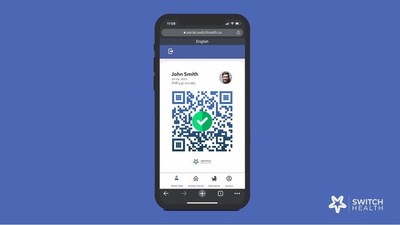
TORONTO, June 11, 2021 /CNW/ - Switch Health today announced the introduction of AuraPass, its groundbreaking digital vaccine and COVID-19 test verification technology that paves the way as the next reliable solution in keeping Canadians safe, as the country begins reopening for business.
AuraPass is a privacy-first, three-step medical record and results-sharing solution, that will verify a patient's government-issued ID, vaccination status, or recent COVID-19 test result, to help facilitate Canada's reopening. AuraPass holds historical vaccination and COVID-19 result data for registered patients through its encrypted blockchain technology that allows the user to securely share required status with venues, airlines and workplaces as they choose. The technology's cutting-edge standards and framework are aligned with those due to be discussed at this week's G7 meetings, with Canadian privacy standards at the forefront, allowing for future integration and communication with partnered countries for the purposes of travel.
Indicative of its seamless and interoperable design, the technology is already compatible with over two dozen leading airlines around the world with more being added weekly.
"Canadians are ready and eager for life to get back to normal with the peace of mind that they are doing so safely and securely," said Dr. Gregory Taylor, Chief Medical Officer at Switch Health. "Once public health officials across all Canadian jurisdictions set the guidelines and recommendations, AuraPass will be ready, with partnering organizations, to welcome them back safely."
"AuraPass is a safe and sustainable solution to help industries that have been hardest hit during the pandemic to begin their journey back to recovery," said Dilian Stoyanov, Chief Executive Officer at Switch Health. "To reopen, and stay open, Canada requires a Canadian-owned solution that puts patient privacy first and bridges jurisdictional healthcare gaps."
AuraPass will empower Canadians to share vaccination and testing status with partners in order to get back to our favorite activities, whether it be attending a concert or hockey game, going to the movies, boarding a flight or dining out at a restaurant.
AuraPass will be accessible to everyone in Canada and powered by Switch Health's secure, proprietary patient portal ASMO, which has been a relied on by hundreds of thousands of Canadians for at-home COVID-19 testing and results-reporting throughout the pandemic. ASMO currently allows for the secure integration and sharing of health data between the patient, trusted laboratories, and public health authorities. AuraPass will also be compatible with Canadian and international protocols to facilitate travel.
About Switch Health
Switch Health Holdings Inc. (Switch Health) is an industry leader that is transforming how healthcare is delivered in Canada through cutting edge decentralized next generation diagnostics and patient-focused digital solutions. Switch Health developed an end-to-end, innovative, and accessible testing-solution in Canada's fight against COVID-19, with its at-home and mobile collection kit to test Canadians safely, rapidly, and reliably for COVID-19. Switch Health offers its gold standard of rapid and PCR testing in over 200 languages from the comfort peoples' homes or workplaces, with the guidance of trusted healthcare professionals and the delivery of results through some of Canada's top laboratories.
SOURCE Switch Health Inc.
New Brunswick’s rushed flavour ban fails to consider the consequences
Beamsville, ON, June 11, 2021 (GLOBE NEWSWIRE) -- The Canadian Vaping Association (CVA) is deeply saddened by New Brunswick’s decision to ban flavoured vape products. The CVA warned the province that banning flavoured products would be ineffective for youth protection and would cause a spike in smoking rates and black-market products. Unfortunately, regulators largely refused to engage on the issue and rushed to pass the ill-conceived ban.
Not only has New Brunswick failed the adult smokers that rely on flavoured products to remain smoke-free, but it has also failed to consider the economic costs of the policy. Specialty vape shops are small family run businesses, and their survival is dependent on flavoured products. Unlike the products sold in convenience stores, specialty store products rely on flavours to convert smokers. The flavour ban will result in the closure of dozens of small businesses, broken lease agreements and approximately 200 lost jobs. The destruction of these small businesses comes at a time when local economies are especially fragile after months of COVID related shutdowns.
While well intentioned, the flavour ban will do little to protect youth as surveys find that most youth are acquiring vape products through social sourcing and foreign websites. There is also little evidence to suggest that flavour bans are effective for preventing youth use. Following Juul’s removal of flavours in the US, youth did not stop vaping but instead switched to tobacco, mint and menthol flavours. Additionally, there has yet to be any data to suggest Nova Scotia’s flavour ban had any impact on youth vaping rates.
“We are saddened that another province has refused to take the time to get vaping regulation right. This decision was made using flawed and, in some cases, completely inaccurate information about vaping. As a final warning to the province, a new study has found that San Francisco, an early adopter of flavour bans, has had a 30% increase in youth smoking rates. I will be sending an official letter to the Premier ensuring that when the results of San Francisco are replicated in New Brunswick, the Premier acknowledges responsibility as a supporter of this bill,” said Darryl Tempest, Executive Director of the CVA.
The CVA has shared the research and the science on vaping. This government has knowingly and willingly ignored the facts. The result of the ban will be a flood of black-market products, an increase in cigarette sales and smoking related deaths. These consequences must be acknowledged.
TORONTO, June 11, 2021 /CNW/ - Ontario's doctors will be joining many others in cautiously taking part in patio dining, larger outdoor gatherings and other activities permitted in the first stage of the province's reopening plan today.
But the Ontario Medical Association urges everyone to avoid closed spaces, participate only in what is permitted with the new guidelines and continue with existing public health measures to ensure the third wave of COVID-19 was the final wave.
The OMA encourages everyone to get vaccinated as soon as they can. It asks the government to continue to focus vaccination efforts on hotspots where the highly contagious Delta variant remains a threat.
"Like many Ontarians, we are excited to begin the process of recovery and reopening," said OMA President Dr. Adam Kassam. "We know that the outdoors and seeing loved ones is vital to our well-being. Being fully vaccinated is crucial to ending this pandemic, and we encourage all Ontarians to book their next vaccine appointment as they become eligible."
About the OMA
The Ontario Medical Association represents Ontario's 43,000 plus physicians, medical students and retired physicians, advocating for and supporting doctors while strengthening the leadership role of doctors in caring for patients. Our vision is to be the trusted voice in transforming Ontario's health-care system.
SOURCE Ontario Medical Association
Parents say the pandemic has introduced new mental health challenges in their children
OTTAWA, June 09, 2021 (GLOBE NEWSWIRE) -- A new poll shows 62 per cent of parents say the pandemic has worsened the mental health challenges of their children, and 48 per cent say it has even introduced new mental health challenges where none previously existed.
The survey, commissioned by the Inspiring Healthy Futures initiative and conducted by Abacus Data, also shows the majority of parents expect longer-term residual effects of the pandemic on their children’s mental health, even after it ends.
“While the numbers are alarming, they are not surprising,” said Emily Gruenwoldt, President and CEO of Children’s Healthcare Canada and Executive Director of Pediatric Chairs of Canada. “These concerns from parents match what we are seeing in children’s hospitals across the country: record numbers of children visiting the hospital with mental health concerns, many of whom did not have any identified symptoms before the pandemic.”
According to the poll, only a quarter of parents say they have received enough support from governments during the pandemic, and the vast majority would like to see a variety of policy solutions to address child and youth mental health and broader well-being.
“As the end of Canada’s public health crisis lies ahead, what we are going to see left behind it is a children’s crisis,” said Lisa Wolff, Director of Policy and Research for UNICEF Canada. “Inspiring Healthy Futures presents a roadmap for recovery; for how Canada can address their immediate needs, and make sure children, youth and families are our collective focus for the long haul.”
The Inspiring Healthy Futures report is the result of eight months of consultations, including more than 1,500 voices from across the country. Youth, parents, service providers, youth-serving agencies, educators and researchers co-created inclusive, accessible, and flexible policy solutions to tackle child and youth post-pandemic recovery proactively and sustainably.
You can read the Inspiring Healthy Futures vision here.
About
About the survey The survey was conducted by Abacus Data with 2,000 Canadians, including 456 parents of children under 18, from May 26 to 28, 2021. A random sample of panelists was invited to complete the survey from a set of partner panels based on the Lucid exchange platform. These partners are typically double opt-in survey panels, blended to manage out potential skews in the data from a single source.
The margin of error for a comparable probability-based random sample of the same size is +/-2.17 per cent and 4.58 per cent respectively, 19 times out of 20.
The data were weighted according to census data to ensure that the sample matched Canada’s population according to age, gender, educational attainment, and region. Totals may not add up to 100 due to rounding.
About UNICEF Canada’s One Youth UNICEF Canada’s One Youth is working to make Canada the best place in the world to grow up. As the global UN agency for kids, UNICEF has worked to improve conditions for every child around the world for 75 years, and has saved more children’s lives than any other humanitarian organization. UNICEF Canada’s One Youth brings that work to Canada by measuring child and youth well-being, and advocating for the right to a childhood.
About Children’s Healthcare Canada Children’s Healthcare Canada is a national association representing health service delivery organizations serving children and youth across the continuum of care. Through purposeful partnerships, Children’s Healthcare Canada accelerates excellence and innovation in health systems caring for children and youth.
About Pediatric Chairs of Canada Pediatric Chairs of Canada represents the Department Heads (Chairs) of Pediatrics within the 17 Canadian medical schools. Collectively they provide national leadership in research and education to promote the health and healthcare of children and youth in Canada.
Canadian Medical Auctions Launches First Auction in Toronto, Canada
TORONTO, June 9, 2021 /CNW/ - Canadian Medical Auctions, dedicated to the re-marketing and auction of surplus healthcare equipment, is delighted to announce their official launch, as the first specialized medical equipment auction house in Canada.
Part of the BMA Group, Canadian Medical Auctions facilitates the collection, asset management and sale of used medical equipment to 10,000 buyers in more than 60 countries worldwide.
EVP and COO Helen Wilks leads the Canadian Medical Auctions team. "Transparency and flexibility in service are at the heart of our operations. The CMA team are thrilled to be partnering with hospitals, clinics, manufacturers and healthcare providers to help realize maximum market value for surplus equipment," she said. "We offer a very local and personal service, while facilitating access to a dynamic international marketplace. It's an exciting time to present a unique opportunity for Canadian healthcare providers to take advantage of the group's established global reach, using our service to alleviate traditional challenges that come with managing used equipment."
President and founder, Markus Grad, is behind BMA Group's expansion to North America. "Our exponential growth has been evident in the UK and more recently France – and expanding across the Atlantic was the logical next step for us," he explained. "Our international proposition is derived from a desire to give a wider audience access to realising the full potential of their surplus assets, alongside continuing to satisfy our ever-growing buyer demand for purchasing used medical devices and equipment."
With the auction model, both buyers and consignors benefit from the transaction. When bidding, the buyer sets the price they are willing to pay, while sellers receive the highest true market value.
A key motivation behind the group - and one that has received a welcome reception across Canada so far - is the sustainability impact. "Historically, surplus equipment has often been destroyed, involving high levels of landfill," says Wilks. "As we all rightly focus more on the circular economy, this service to prolong the life of surplus medical assets is a timely one for Canada".
Canadian Medical Auctions is this week pleased to kick-off of their first timed medical equipment auction, taking place now until Wednesday June 16th, 2021 at 11:00 a.m. EST. The auction is held online, with the equipment located at their warehouse in Oakville, Toronto. 240+ lots include ventilators, dialysis machines, ultrasounds, ECG machines, spectrometers and much more. To view the catalogue and bid, visit https://www.canadianmedicalauctions.ca.
Canadian Medical Auctions is Canada's specialist medical equipment auction house. Dedicated to managing surplus, obsolete, end-of-line and decommissioned medical equipment from all healthcare environments, Canadian Medical Auctions holds regular online auctions and private sales, catering to more than 10,000 buyers in over 60 countries.
SOURCE Canadian Medical Auctions
OMA estimates pandemic backlog of almost 16 million health-care services
TORONTO, June 9, 2021 /CNW/ - The COVID-19 pandemic has created a backlog of almost 16 million health-care services, or more than one for every Ontario resident, according to new estimates taken from OHIP data and released today by the Ontario Medical Association.
The OMA compared OHIP billings for six procedures in 2020 and the same period in 2021, and found the estimated backlog was greatest for MRIs (477,301), followed by CT scans (269,683), cataract surgery (90,136), knee (38,263) and hip (16,506) replacements and coronary artery bypass grafts (3,163).
"Three serious waves of infections have created a lengthy backlog of surgeries, diagnostic exams and other health-care procedures," OMA President Dr. Adam Kassam said Wednesday.
"We have also heard from community-based family doctors and specialists, who are reporting conditions that were left undiagnosed during the pandemic as patients avoided seeking help. Some conditions have grown more serious as non-COVID patients waited longer for treatment."
The pandemic backlog is more pronounced in community settings over hospitals, suggesting that while Ontarians have been actively getting their COVID vaccinations they have been deferring visits with their family doctors where they could have been screened and treated for chronic conditions.
Highlights:
Total estimated backlog of 15.9 million health-care services across all services and settings
The backlog is greater in community settings (9.6 million) than in hospitals (6.5 million)
Clearing the backlog working at 120 per cent would take:
22 months for knee replacements
21 months for cataract surgeries
14 months for hip replacements
10 months for cardiac surgery
10 months for MRIs
4 months for CT scans
The OMA has posted an infographic with this information at the bottom of this page.
The pandemic backlog estimated by the OMA is in addition to the wait list for procedures that existed before the pandemic began.
The OMA is developing recommendations on how to address the backlog so that Ontario patients can get the care they need as quickly as possible.
The OMA data follows a recent report by the province's Financial Accountability Office that showed it will take more than three years and $1.3 billion to clear the backlog of surgeries and diagnostic procedures. Ontario's Science Table said in April that almost a quarter million Ontarians were waiting for surgery.
Addressing the surgery backlog will require supportive services such as home care, long-term care and primary care as the pandemic's impacts reach beyond operating rooms.
Ontario's doctors expect the demand for mental health and addictions care will exist and grow for years after the CVID-19 pandemic. Mental health diagnoses attributed to the 1918 Influenza Pandemic continued for six years after it ended.
"The pandemic has created a significant backlog of services and procedures that will require a multi-disciplinary and collaborative approach to address," said OMA CEO Allan O'Dette. "The OMA is committed to working closely with government and other allied health professionals on practical solutions to wait times for diagnostic tests and treatments that Ontarians need."
About the OMA
The Ontario Medical Association represents Ontario's 43,000 plus physicians, medical students and retired physicians, advocating for and supporting doctors while strengthening the leadership role of doctors in caring for patients. Our vision is to be the trusted voice in transforming Ontario's health-care system.
SOURCE Ontario Medical Association
TRAIN IT RIGHT NEWSLETTER
Sign Up and get a free 7 day Train it Right HIIT Program!