Whistleblowers’ Vindicated in Novartis Foreign Corrupt Practices Act Case
$300 Million to be Paid for Bribes and FCPA Violations in Greece
Washington, D.C., June 25, 2020. Today, the U.S. Securities and Exchange Commission (SEC) and the U.S. Department of Justice (DOJ) announced settlements with the global pharmaceutical and healthcare company Novartis AG (“Novartis”) for violations of the Foreign Corrupt Practices Act (“FCPA”). Novartis, headquartered in Switzerland, agreed to pay over $225 million to settle the Department of Justice FCPA charges for bribery in Greece. The SEC sanctioned Novartis approximately $85 million for Greek related bribery. The total sanctions, with interest, are over $300 million.
“The confidential and anonymous Greek whistleblowers who documented these crimes are heroes. They put their reputations and careers at risk to inform law enforcement about widespread bribery schemes in Greek healthcare programs. Even today, their safety is under threat from corrupt officials who stole from the health care system and took bribes,” said whistleblower attorney Stephen M. Kohn, a founding partner in the qui tamwhistleblower law firm of Kohn, Kohn and Colapinto.
Kohn, who is the U.S. based attorney for the Greek whistleblowers, said: “The government of Greece must immediately stop retaliatory actions against the people they think are the whistleblowers. Instead the Greek government must publicly hail the whistleblowers as the heroes they are.”
In Greece, the whistleblowers were represented by the law firm of Pavlos K. Sarakis & Associates, who are also issuing a statement today.
“The SEC and DOJ sanctions should serve as a wakeup call throughout Europe and the entire international community. Whistleblowers can confidentially and anonymously report bribery and hold multinational corporations accountable. The time has come for the millionaires and billionaires, who profit from bribery and undermine the rule of law by corrupting democratic institutions, to be held fully accountable,” Kohn continued.
“The SEC and DOJ worked effectively with the whistleblowers. This case once again demonstrates the effectiveness of the Dodd-Frank Act and U.S. whistleblower laws in holding corrupt officials and corporations accountable,” Kohn said.
Based on the sanctions issued today, the total breakdown in fines and penalties paid by Novartis for FCPA violations in Greece are as follows:
SEC: $85.667 million
DOJ - $225 million
Total: $310.667 million
COVID-19 Testing – The U.S. is STILL in the Middle of the Pack
COVID-19 cases have surged tremendously in the U.S. in the last couple of weeks. The latest excuse cited by some federal and state government officials is that the increase is the result of more testing. This note challenges those assertions as flatly dishonest.
Below is a graph comparing the total testing done by about 40 countries over the last ten weeks. These countries include most of Europe, plus relatively affluent countries in the rest of the world – it would be unreasonable to include poor and developing nations in this comparison. The metric used is Strategic Tests (see note below for further detail), which measures the extent to which a country is testing proactively in its effort to control the spread of the pandemic.
Strategic testing has improved significantly in the U.S., from being virtually nonexistent ten weeks ago. But most of the other countries shown have made similar increases. Of the 41 countries shown, as of yesterday (6/25) the U.S. ranks 24th in number of Strategic Tests per 1MM population. Most of the countries included in the above graph have seen significant declines in the number of new cases reported over the last ten weeks, which is not true in the U.S. If the increase in reported COVID-19 cases in the U.S. is due to increased testing, why has the number of new cases continued to decline in those countries, but not the U.S.?
NOTE: The testing metric used is “Strategic Tests”. Total testing includes both “necessary tests” and “strategic tests”. Necessary tests arise because a case has occurred: a person complaining of symptoms must be tested at least once to confirm the diagnosis and at least two more times to confirm recovery, and the patient’s immediate family and other obvious suspects must be tested as well. We estimate that every reported COVID-19 case generates an average of six Necessary Tests.
Strategic Tests equals Total Tests – as reported in Worldometer – minus Necessary Tests. Strategic Tests measure a country’s proactive efforts to control the spread of the pandemic. Strategic Tests would include, for example, testing done as the result of contact tracing, and regular (and possibly frequent) testing of people working in medically sensitive industries such as health care, food services, and public safety.
A CARDIAC SURGEON’S LIFE STORY SETS THE STAGE FORAN INSPIRATIONAL GUIDE TO UNLEASHING PEOPLE’S FULL POTENTIALIn HEART TO BEAT, Dr. Brian Lima Challenges Readers To Strive For Greatness And Never Settle For Second Best
College, medical school, and then ten years of grueling surgical training, that’s what it took for Brian Lima to become a leading heart transplant surgeon – literally able to breathe new life into critical ill patients. Not only has Lima never shied away from a challenge, he has spent his life actively seeking them in pursuit of seemingly near-impossible goals. In his insightful new book, HEART TO BEAT: A Cardiac Surgeon’s Inspiring Story of Success and Overcoming Adversity—The Heart Way (Clovercroft Publishing/February 18, 2020), Dr. Lima shares his story, giving everyone – not just aspiring physicians – the tools and encouragement needed to be their best selves.“We all have free will, and we all have a choice,” he writes. “You can choose to live aimlessly, halfheartedly going with the flow and suppressing that inner voice, the one beckoning you to unleash your full potential and to grab the world by storm. Or you can achieve success by committing to hard work and unceasing effort.”In HEART TO BEAT, Dr. Lima candidly shares, often with a wry sense of humor, how this approach enabled him to reach the pinnacle of success in all of his undertakings – whether it was building the strength and skill to become a varsity football player, becoming valedictorian of his high school class, earning a scholarship to Cornell University, or winning coveted residency opportunities as he trained to become a heart surgeon.“You don’t have to be the smartest or most talented person in the room to get ahead, just the one who wants it the most,” he writes. Indeed, Dr. Lima credits his own achievements purely to his intense effort. In his eminently readable, down-to-earth book, he breaks down the keys to advancing beyond your comfort zone and perceived limitations to unleash your full potential. Dr. Lima’s powerful lessons include:Heart Over Matter – “You, and you alone, are responsible for how much or how little you achieve in this life,” he writes. Only when you realize that you are master of your own destiny, and refuse to allow insecurities, past experiences, and fears to limit your potential, will you realize your dreams.Heart Of War – Complacency is your biggest adversary. You must never cease working and bettering yourself – if you do, you will surely slide off the top of your game. “The minute you rest on your laurels and kick your feet up, you’ve settled for defeat,” says Dr. Lima.Kickstart My Heart – Dr. Lima explains that the “propulsive power of ambition” has been one of the most impactful forces of his life. “Your eagerness to move ahead contributes more to your success than natural talent or being born with a silver spoon.” Ambition is what enables people to overcome the primary hurdle to success: self-doubt.Till Death With My Heart – If something is truly your calling – meaningful, bigger than you, and well-intended – it is likely not going to be easy to achieve, says Dr. Lima. For him, the rule must be “it’s all in or no win.” Being “well-rounded” is incompatible with true excellence, he contends.Not For the Faint of Heart – Fear of failure can disrupt the pursuit of any goal, and overcoming this fear is a monumental task that requires you to meet it head-on again and again, until you’re desensitized to its paralyzing influence. Dr. Lima urges readers to see every moment as just that – a moment – whether they’re going for a buzzer beater in basketball or performing heart surgery. This is what gives people the courage to take their shot at every opportunity.The Heart Sell on Entrepreneurship – “One way or another, you have to get the word out about how great your ‘brand’ is – in other words, how great you are,” says Dr. Lima, contending that the sales mantra “always be closing” is critical to success. He points to such key fundamentals as avoiding pigeonholes and being open to opportunities; never second-guessing yourself; continuing to invest in yourself; and using your time wisely.In addition to the author’s compelling personal story, HEART TO BEAT also includes a fascinating look at the current technologies and medical care available to treat heart disease, along with the basics about living a heart-healthy life – straight from the mouth of one of the country’s leading heart transplant surgeons.“There are those who choose to chase victory and to live life on their own terms, and there are those who don’t,” declares Dr. Lima. HEART TO BEAT will help you choose the path to victory, giving you the motivation you need to achieve your dreams, whatever they may be.# # #ABOUT THE AUTHORDr. Brian Lima is a cardiac surgeon, associate professor of surgery, and recognized authority in advanced heart failure. He has published nearly 80 articles in peer-reviewed medical journals and presented at numerous national and international medical conferences. As the surgical director of heart transplantation at North Shore University Hospital, Dr. Lima helped launch the first and only heart transplant program on Long Island. Dr. Lima completed his undergraduate studies at Cornell University and was awarded a Dean’s Full Tuition scholarship to attend Duke University School of Medicine. During medical school, Dr. Lima spent a year at Harvard Medical School’s Transplantation Biology Research Center as a Stanley Sarnoff cardiovascular research fellow. He then completed his general surgery residency training at Duke University Medical Center, and subsequent heart surgery training at The Cleveland Clinic, where he was awarded the prestigious Dr. Charles H. Bryan Annual Clinical Excellence Award in Cardiovascular Surgery.
Temporary Isolation Can Be TheOpportunity To Permanently Transform Your Weight And Health
Los Angeles, CA, June 25, 2020 ̶ Not sure how to eat and stay healthy this quarantine season without resorting to your familiar diet of spaghetti, bread, pizza, and sugar? Candice Rosen, R.N., MSW, and author of the upcoming book Forget Dieting: It’s All About Data-Driven Fueling! encourages "trophology," or "food combining," which is one of the foundations of Rosen's Data-Driven Fueling Plan. As you combine foods, Rosen adds that "monitoring blood glucose is the key to weight gain vs. weight loss; good health vs. poor health."
1. Make Wednesdays and Fridays Vegan Days. According to Rosen, avoid dairy! Try vegan yogurts, cheeses, and milks. Dairy is inflammatory and will deplete your bones of calcium (it’s true!). There are unsweetened milks of almond, hemp, cashew, etc., and all are available in grocery stores. A low blood glucose breakfast idea would be a sprouted grain English muffin, spread with a tofu or nut-based cream cheese, some sliced tomatoes, and topped off with sea salt or Trader Joe’s Everything But The Bagel Sesame Seasoning Blend.
2. Eat fruits that are high in fiber. Apples, bananas, oranges, berries ̶ the list goes on! You will still want to avoid sugary fruit juices, as well as very sweet fruits like pineapples and mangos while trying to lose weight. Fruit is always eaten alone with two exceptions: they can be added to a vegan smoothie and they can be eaten with a nut or seed butter. These healthy fats reduce the chance of a blood glucose spike.
3. Nothing white. To lower blood glucose, do not eat or combine animal proteins with any white potatoes, bread, rice, or pasta… EVER. Sorry!
4. Eat More Sweet Potatoes. Think wholesome, nutritious, responsibly grown, pancreatic-friendly foods (food that doesn’t raise your blood glucose) like sweet potatoes and yams, which are an incredibly nutritious carbohydrate that are low in sugar levels and provide fiber. They’re best consumed baked or steamed, but can also be cooked in a variety of other ways. A great lunch or dinner option (and it is inexpensive) is a baked sweet potato, split down the middle with a large spoonful of black beans, a tablespoon of tomatillo salsa, and a side salad. To lower blood sugar, eat them with veggies and plant-based protein together… NOT MEAT!
5. Try Fish. Give your body a break from animal protein. Red meats increase inflammation and provide poor sources of fat. However, if you crave protein, try fish! For those who aren’t allergic, fish is a fantastic source of protein that’s low in carbohydrates and contains high amounts of omega-3 fatty acids, one of the few consumable healthy fats! If consuming fish raw, remember only sashimi-style – no white rice! To lower blood sugar, combine fish with veggies, not starches or fruit.
About the author:
Candice P. Rosen, RN, MSW, CHC, is a registered nurse based in Los Angeles, CA. As the founding member of Gilda’s Club Chicago and its first executive director and program director, she created and coordinated a diverse array of wellness-related programs. She was appointed by Mayor Richard Daley to serve as Chair of Healthcare Initiatives for Chicago’s Sister Cities International Program (CSCIP). CSCIP provided an opportunity to advocate for preventive medicine, improve maternal and infant healthcare, stress disability access, promote nourishing diets, and bring awareness to the obesity and diabetes epidemics that now affect populations on a global level. She is married and the mother of four adult children and grandmother to a precious granddaughter. For more information on Candice, please visit https://candicerosenrn.com.
Safe and Healthy Breastfeeding During COVID-19: What Every New Mom Needs to Know
Celebrity breastfeeding specialist and two-time author Jennifer Ritchie, IBCLC shares essential tips to support both mom and baby during Coronavirus outbreak
Dana Point, CA – (June 25th, 2020): For new and expecting mothers concerned about breastfeeding safely during COVID-19, trained breastfeeding specialist and renowned author Jennifer Ritchie shares five keys to success. For more than a decade, Internationally Board Certified Lactation Consultant (IBCLC) Jennifer Ritchie has provided hands-on guidance to help moms navigate a variety of breastfeeding challenges. She has worked with celebrities as an on-location consultant, in addition to authoring two guidebooks to successful breastfeeding. Now, Ritchie provides essential tips to keep both mom and baby healthy amid the Coronavirus pandemic.
For 12 years, Jennifer Ritchie has grown an impressive catalog of resources - including a series of “how-to” YouTube videos and personal consulting services - that have helped thousands of new moms successfully breastfeed. Countless parents rely on her books, entitled “I Make Milk, What’s Your Superpower?” and “Bringing Baby Home - A New Parent’s Guide to Breastfeeding,” to overcome challenges such as latching difficulties, painful nursing, and low milk production. Here, Ritchie offers insights new and expecting moms need to know in order to safely breastfeed and confidently bond with baby during COVID-19:
Rest assured: your breastmilk is still a safe bet. According to the CDC, breastmilk is still the best source of nutrition for most infants and is believed safe to consume even after mom has been infected. In limited reports of lactating women infected with SARS-CoV,* virus was not detected in breast milk, and antibodies against SARS-CoV were detected in at least one sample.
Reduce stress in any way you can. This is a stressful time to have a baby, and anxiety can have a substantial impact on a child's developing oxytocin systems. Oxytocin helps us relate to others, strengthens trust, fosters closeness in relationships, and can be triggered by eye contact, empathy, or touch. Studies show a new mother's oxytocin levels can influence her behavior and, as a result, the bond she makes with her baby - so reduce stress in any way you can.
Focus on the first two weeks. Most breastfeeding problems occur in the first two weeks of a child’s life, leading many moms to give up too early. Your focus, in the beginning, should be to make it past these first two weeks before throwing in the towel.
Supplementing with formula is perfectly okay. Some mothers cannot find adequate time to pump or simply cannot produce enough milk to completely nourish baby with breast milk alone - don’t give up! Just one drop of breastmilk contains one million white blood cells. If your baby gets at least 1 teaspoon of breastmilk per day, they will still get the antibody benefits and bacteria-eating cells that are so important to a developing immune system.
Stay connected to what really matters. Finding answers to your questions can be frustrating. When you look online, less than half of the websites on breastfeeding are accurate. What really matters is the scientific evidence, so look for published research and (preferably) “randomized triple blinded” studies. In the end, trust your gut, love your baby, and take care of yourself. After delivery, your Left Brain stops working as well, so you may find yourself experiencing more emotions than logic (much like when you were a teenager). Don’t give in to guilt, focus on learning through experience, and build that family unit with lots of skin to skin contact!
Find more insights and answers to a wide range of breastfeeding questions online at JenniferRitchie.tv, Discover articles, videos, and more information about Ritchie’s breastfeeding books. Plus, get to know a bit about her own journey as a mom to a 15-year old daughter and 12-year old son. For an exclusive interview with Ritchie, reach out to Leigh-Anne Anderson at LeighAnne@Anderson-PR.com.
# # #
About Jennifer Ritchie, IBCLC:
Jennifer Ritchie is an Internationally Board Certified Lactation Consultant (IBCLC), Ritchie spent more than a decade helping countless parents navigate breastfeeding challenges, including latching difficulties, painful nursing, low milk production, inadequate weight gain, and induced lactation. She has worked with big-name celebrities and as an on-location consultant, in addition to authoring "I Make Milk What's Your Superpower?" and "Bringing Baby Home - A New Parents Guide to Breastfeeding.” Committed to providing community-based, long-term support to breastfeeding mothers, Ritchie’s insights and approach empower thousands of new and expecting moms to embrace the joys and challenges of motherhood. Find answers to a wide range of breastfeeding questions online at JenniferRitchie.tv, along with articles, “how-to” videos, and more. For an exclusive interview with Ritchie, reach out to Leigh-Anne Anderson at LeighAnne@Anderson-PR.com
Canadian company AccessNow wins Novartis Innovation Prize for Assistive Tech
Initiated in late 2019, the Novartis Innovation Prize: Assistive Tech for Multiple Sclerosis (MS) identified and encouraged technology ideas from all over the world with the aim to improve mobility, accessibility and daily life for people living with MS
AccessNow receives the first prize worth USD 250,000 for a mobile app and web platform that provides information about the accessibility status for people with disabilities of locations around the world, enabling them to move around with more confidence and ease
Over 150 submissions were received for the Innovation Prize, of which ten were chosen as finalists for the judging panel. Finalists included innovative proposals from the US, the UK, Canada, Denmark, Germany and Switzerland
DORVAL, QC, June 25, 2020 /CNW/ - Novartis Pharmaceuticals Canada Inc. (Novartis Canada) is pleased to announce today that AccessNow, a platform that crowdsources information on the accessibility of public spaces and venues, has won the Novartis Innovation Prize for Assistive Tech for MS. AccessNow developed a mobile app and web platform designed to empower people living with MS, as well as millions of others with disabilities, to live more independently. AccessNow provides people with insight and information on the accessibility status of various locations in 34 countries to help navigate the world with greater confidence and ease.
"As a Canadian entrepreneur, it's an honour to be awarded the Novartis Innovation Prize. Accessibility is a critical component of establishing a welcoming and barrier free world for people with disabilities. MS touches the lives of Canadians at one of the highest rates in the world and this community has acted as an integral voice in our movement," said Maayan Ziv, Founder and CEO, AccessNow. "AccessNow grew from my personal experience navigating around Toronto and while accessibility has come a long way since then, we know there's so much more to do to achieve equality and inclusion. At AccessNow we believe technology plays an integral role in achieving this vision and we are so excited for the next step in our journey."
Mobility issues are often the first significant symptoms of MS and can have a profound impact on mental wellbeing and general quality of daily life for people living with MS. Innovations that improve mobility can help make everyday life more manageable for people living with MS and help keep them connected to their lives and communities, which is part of why beyond-the-pill solutions considered by the Novartis Innovation Prize are so important.
"Novartis is deeply invested in the MS community, and it is our hope that through this Innovation Prize, we have been able to help reimagine care for people living with MS by encouraging new technologies addressing some of the challenges people with MS face every day," said Andrea Marazzi, Country Head, Novartis Pharmaceuticals Canada.
About the Innovation Prize The Novartis Innovation Prize: Assistive Tech for MS identifies and embraces technology that aims to improve the mobility, accessibility, and activities of daily life for these individuals and others living with mobility-limiting conditions. The Prize aims to spur investment and dialogue across the many needs of people living with MS, and other people living with mobility-limiting conditions. To support pioneering solutions for increased mobility and accessibility, Novartis worked with WIRED Brand Lab, alongside other key collaborators such as Selma Blair, representatives from Sequoia, Airbnb, Whill, Shift.ms, the National Multiple Sclerosis Society, and people living with MS.
Applications were open to the tech community, innovators, design experts, patient advocates worldwide – anyone with an idea to make everyday life better for those with MS or mobility-limiting disabilities. The Prize judging panel consisted of a wide variety of experts including accessibility leaders, representatives from the MS patient community, investors, and consumer technology experts within the mobility and healthcare space. More information including an overview of the 10 finalists and their innovations can be found at www.wired.com/msinnovationprize/.
Novartis has a strong ongoing commitment to bring innovation to people with MS and will continue to explore innovative initiatives and therapies that improve their lives.
About Multiple Sclerosis MS disrupts the normal functioning of the brain, optic nerves and spinal cord through inflammation and tissue loss1. MS affects over 77,000 Canadians – one of the highest prevalence rates in the world.2,3 It is often characterized into three forms: primary progressive MS (PPMS) relapsing remitting MS (RRMS), and secondary progressive MS (SPMS), which follows from an initial RRMS course and is characterized by physical and cognitive changes over time, in presence or absence of relapses, leading to a progressive accumulation of neurological disability4,5. Approximately 85% of patients initially present with relapsing forms of MS2.
About Novartis Pharmaceuticals Canada Novartis Pharmaceuticals Canada Inc., a leader in the healthcare field, is committed to the discovery, development and marketing of innovative products to improve the well-being of all Canadians. In 2019, the company invested $51.8 million in research and development in Canada. Located in Dorval, Quebec, Novartis Pharmaceuticals Canada Inc. employs approximately 1500 people in Canada and is an affiliate of Novartis AG, which provides innovative healthcare solutions that address the evolving needs of patients and societies. For further information, please consult www.novartis.ca.
About Novartis Novartis is reimagining medicine to improve and extend people's lives. As a leading global medicines company, we use innovative science and digital technologies to create transformative treatments in areas of great medical need. In our quest to find new medicines, we consistently rank among the world's top companies investing in research and development. Novartis products reach nearly 800 million people globally and we are finding innovative ways to expand access to our latest treatments. About 109,000 people of more than 145 nationalities work at Novartis around the world. Find out more at https://www.novartis.com.
International study discovers three potential new targets for treating epilepsy
Dublin, 25 June 2020: A major international study has uncovered three molecules that have the potential to be developed into new drugs to treat epilepsy. The findings are an important step towards discovering new drugs for people with epilepsy whose seizures cannot be controlled with current treatments.
The study was led by researchers at FutureNeuro, the SFI Research Centre for Chronic and Rare Neurological Diseases and RCSI University of Medicine and Health Sciences. It is the result of seven years of research, involving contributions from 35 scientists, based in eight different European countries, across the fields of neuroscience, genetics, computer science and synthetic chemistry. The research is published in the current issue of Proceedings of the National Academy of Sciences (PNAS) USA.
In one of the largest sequencing projects of its kind, researchers identified and measured levels of over a billion strands of microRNAs, small molecules that control gene activity in the brain, to investigate if they were changed in epilepsy. They discovered a small set of microRNAs which were always elevated in epilepsy and designed drug-like molecules, synthesized by chemists from the group, to target these. Three of the synthetic molecules were found to stop seizures in preclinical tests.
Computer simulations demonstrated how the potential treatments influenced molecule networks inside brain cells by changing the inflammatory response, part of the brain’s immune system which is thought to contribute to seizures.
“Our approach to drug discovery has led us to new types of molecules that can be targeted to prevent seizures with hopefully fewer side effects.” said Dr Cristina Reschke, FutureNeuro Research Fellow and Honorary Lecturer at RCSI, and Co-Lead Author. “Currently, most drugs used to treat epilepsy work by blocking the signals brain cells use to communicate. This results in many of the side effects experienced by people with epilepsy.”
Epilepsy is one of the most common chronic brain diseases, affecting over 40,000 people in Ireland and 65 million people worldwide. People with epilepsy are prone to repeated seizures, but for the majority of people, these can be well controlled. There are more than 20 medicines available to prevent seizures in people with epilepsy, but progress has slowed in recent years and new treatments offer little benefit over those that have been around for decades.
“By characterising and targeting an entire new class of molecules in epilepsy, we hope to develop novel and innovative treatment strategies for temporal lobe epilepsy.” said Dr Gareth Morris, Marie Sklodowska-Curie Actions Fellow at FutureNeuro and Co-Lead Author of the paper. “This is an important step closer to fulfilling the urgent and unmet clinical needs for the one third of people whose seizures are resistant to currently available drugs.”
Senior author on the study, Professor David Henshall, Director of FutureNeuro and Professor of Molecular Physiology and Neuroscience at RCSI said: “The project is a great example of team science, where groups with different areas of expertise combine to create innovative solutions that keep people with epilepsy as the central focus. The discoveries here may be just the tip of the iceberg for new strategies in the treatment of epilepsy. I’m optimistic this can be translated to the clinic.”
The work began under EpimiRNA, an RCSI-led pan-European project, funded through the EU 7th Framework Programme and concluded in FutureNeuro which is funded by Science Foundation Ireland.
ENDS
About FutureNeuro
FutureNeuro is the SFI Research Centre for Chronic and Rare Neurological Diseases. We aim to change the patient journey through research informed by the needs of both patients and neurologists. This includes developing rapid and accurate tools for diagnosis, the development of therapies to correct damaged brain networks, technologies to enable patients to monitor their own health and well-being, and linking this to Ireland’s national imaging, diagnostics and eHealth infrastructure.
We are multi-disciplinary, inter-institutional and working with industry, patient organisations and the health service to transform the lives of patients in Ireland and worldwide.
About RCSI University of Medicine and Health Sciences
Ranked number one globally for Good Health and Well-being in the Times Higher Education (THE) University Impact Rankings 2020, RCSI University of Medicine and Health Sciences is an international not-for-profit university, with its headquarters in Dublin.
RCSI is exclusively focused on education and research to drive improvements in human health worldwide. It is among the top 250 universities worldwide in the THE World University Rankings (2020) and its research is ranked first in Ireland for citations. RCSI has been awarded Athena Swan Bronze accreditation for positive gender practice in higher education.
Visit the RCSI MyHealth Expert Directory to find the details of our experts across a range of healthcare issues and concerns. Recognising their responsibility to share their knowledge and discoveries to empower people with information that leads them to better health, these clinicians and researchers are willing to engage with the media in their area of expertise.
AG HAIR DONATES 5,000 BOTTLES OF HANDS FREE SANITIZER TO LOCAL CHARITIES AND RESTAURANTS
Vancouver-based haircare brand elevates hand sanitizer category with natural ingredients, luxurious packaging and charitable cause
Vancouver, B.C. (June 25, 2020): In response to the global pandemic that spread to North America in March, AG Hair swiftly redirected production towards manufacturing hand sanitizers to help meet public demand. Now, the Vancouver-based haircare company has donated 1,200 bottles each of its Hands Free hand sanitizer to the United Way, Canuck Place Children’s Hospice, Greater Vancouver Food Bank and BC Cancer Society, as well as to local restaurants. AG Hair’s Hands Free hand sanitizer exceeds the Centre for Disease Control (CDC) and World Health Organization’s (WHO) sanitizer guidelines with a powerful combination of germ-killing corn-derived alcohol and soothing vitamin E, glycerin and aloe. The stylishly packaged sanitizer – available in a gel or spray formula – is now available to the public for $12.99 through the AG Hair website. Both products are manufactured in the company’s state-of-the-art, 70,000-square-foot headquarters in Coquitlam, B.C.
“As businesses open and people begin to resume their lives after months of quarantine, we are proud to offer a natural hand sanitizer that fits seamlessly into everyday routines,” says Graham Fraser, CEO of AG Hair. “Recognizing that sanitizers and disinfectants are now a key part of self-care, we’ve designed our Hands Free sanitizers to be gentle enough for frequent use and aesthetic enough for display. We’re thrilled to donate thousands of these bottles to frontline and restaurant workers, to thank them for keeping us safe and healthy.”“Throughout the COVID-19 pandemic, Canuck Place Children’s Hospice continues to provide critical care to children with life-threatening illnesses and families across B.C.,” says Margaret McNeil, CEO of Canuck Place. “Generous donations like the hand sanitizer from AG Hair supports our clinical teams, staff and children and families in hospice through this challenging time. We are immensely grateful for the gift of this product and partnership with an incredible local business, AG Hair.”
Over the past 30 years, AG Hair has built a reputation as a leading producer of professional grade haircare products that are cruelty-free and crafted without salt, PABA, parabens or DEA. Certified by Health Canada and the FDA as an over-the-counter (OTC) drug production facility and a Health Canada Natural Health Product (NHP) facility, AG Hair follows strict GMP guidelines with a qualified team of R&D and QC/QA technicians overseeing all aspects of production. The company was also recognized as one of Canada’s Best Managed Companies in 2020 for overall business performance and sustained growth.
Committed to giving back to communities around the world, AG Hair is a proud partner of One Girl Can, a Vancouver-based charity that strives for gender equality through education for girls living in extreme poverty in Kenya. For more information about AG Hair or to purchase Hands Free hand sanitizer, visit www.aghair.com.
-###-About AG Hair Known for their meticulous selection of natural ingredients, AG creates a new standard of beauty through handcrafted products that deliver on their promise. Founded in 1989 in Vancouver, Canada by John and Lotte Davis, AG has become a name synonymous with integrity and a brand whose devotees can't help but 'Use. Love. Repeat.' A portion of every bottle sold supports One Girl Can, a registered charity that provides educational opportunities to impoverished girls living in marginalized areas of Kenya. www.aghair.com
Canada may be losing its status as a top global destination for new medicine launches
TORONTO, June 25, 2020 /CNW/ - Canada has long been considered a top global jurisdiction for new medicine launches. However, a new report published by Life Sciences Ontario (LSO) shows that new medicine launches in Canada fell dramatically in 2019.
LSO commissioned IQVIA Inc., a global leader in health data and analytics, to examine the commercialization of new medicines in Canada and other top global jurisdictions from the past 20 years (2000 to 2019). The report shows that Canada has been a top destination for new medicine launches over the past 20 years and has steadily improved its global standing over time. Up until 2018, Canada was gradually getting faster and more extensive access to therapies relative to other countries.
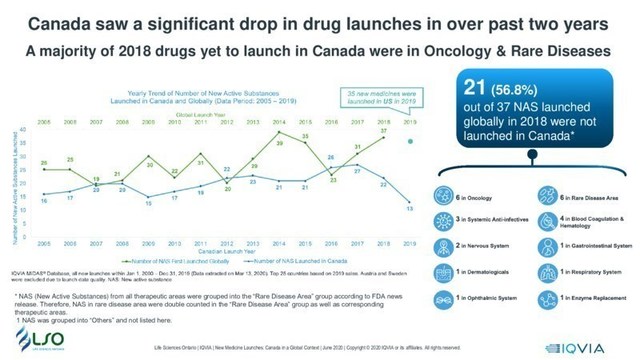
However, the research shows a sharp decline in the number of new drug launches in Canada in 2019, from 22 in 2018 to just 13 in 2019, despite the overall number of global launches rising during the year. In the last quarter of 2019, there was only one new drug launch in Canada.
This report substantiates concerns raised by Canadian and global life sciences leaders in a survey commissioned by Life Sciences Ontario earlier this year to help measure the impacts of the federal government's new price controls for patented medicines in Canada (http://bit.ly/MedPriceControlsSurvey). The survey revealed unanimity on the expected negative impacts of the changes, including delayed medicine launches in Canada.
"This new research shows that Canadian patients have been benefiting over recent years from new treatments being made available in Canada almost as quickly as anywhere else in the world but that we are throwing away this advantage in a short-sighted attempt to lower drug prices at unreasonably low levels. And we are doing this at a critical time where Canadians need access to new medicines and vaccines, especially to combat COVID-19," states Jason Field, President and CEO of Life Sciences Ontario.
The report shows that among 37 new therapies launched globally in 2018, over half of them (21) were not launched in Canada. The majority of the medicines not commercialized in Canada were for rare diseases and cancer.
For Barry Stein, President and CEO of Colorectal Cancer Canada and President of the Coalition Priorité Cancer au Québec, the report flags a number of concerns. He notes that "Timely access to new and effective drugs that improve patient outcomes, including access to new therapies through clinical trials, may mean the difference between life and death for many patients, but particularly those with cancer." Stein also observes that "New innovations in precision medicines, immunotherapies and other targeted treatments benefit cancer patients and society as a whole. It is therefore crucial that we maintain a fertile research environment encouraged by reimbursement for these new innovations so that all Canadians can benefit from them in a timely manner."
LSO's Jason Field supports the government's decision to delay implementation of the federal regulations as an opportunity to revisit the policy, noting that "we hope the federal government will revise the regulations to ensure Canadians don't suffer further from delayed or lack of access to new treatments and vaccines."
About Life Sciences Ontario Life Sciences Ontario is a member-driven organization that represents and promotes the province's vibrant and diverse life sciences sector. Ontario is currently home to one of the largest life sciences clusters in North America, contributing $58 billion to Ontario's GDP, and providing almost 200,000 direct and indirect jobs for Ontarians. About 1-in-13 jobs in Ontario are in life sciences or supported by its activity. LSO collaborates with governments, academia, industry, and other life science organizations in Ontario and across Canada to promote and encourage commercial success throughout the sector. Membership in Life Sciences Ontario includes individuals, students, emerging companies, investors, service providers, and companies with marketed products. LSO is dedicated to promoting Ontario's life sciences sector internationally. Visit lifesciencesontario.ca for more information.
ROUSSELOT INTRODUCES X-PURE® GelMA FOR TRANSLATIONAL MEDICINE
Irving, United States [25 June 2020] — Rousselot, a Darling Ingredients brand and the global leader of collagen-based solutions, takes on the digital challenge and introduces X-Pure® GelMA at Bio Digital 2020. The first GMP-ready range of gelatin methacryloyl (GelMA) biomaterials suitable for preclinical and clinical applications, X-Pure® GelMA is part of the X-Pure portfolio of ultra-pure gelatins and collagens, suitable for use as biomaterials in 3D bioprinting, tissue engineering, and regenerative medicine.
GelMA, the most versatile biological environment for cells
Methacryloyl is a commonly used crosslinker, important to increase the melting point and mechanical strength of gelatin-based constructs. In GelMA hydrogels, the inherent bioactivity, biodegradability, and cell compatibility of gelatin are combined with the tailorability of photo-crosslinking. This combination holds a huge potential for the creation of tunable biological environments for the culture of various eukaryotic cells at body temperature.
X-Pure GelMA - The first GMP-ready gelatin methacryloyl
GelMA-oriented patent applications have been growing exponentially over the last 5 years, with many of these research concepts now being translated into the clinic. However, standard GelMA products often carry high and variable levels of soluble impurities originating from either the gelatin raw material or the chemical synthesis process. The presence of these impurities such as endotoxins and/or MA residues are detrimental for in-body use but can also affect the success of in vitro applications.
Rousselot’s unique purification process, centered around a two-stage routine, results in ultra-low levels of pyrogens and residual methacrylic acid, providing an excellent safety profile to the product. Further, consistent batch-to batch quality ensures reliable results and shorter lead times to the clinic.
Readily available, X-Pure GelMA can be produced in compliance with GMP regulatory requirements for quality, raw material sourcing, and documentation for approval across all major regulators worldwide, thereby minimizing regulatory risks and optimizing the pace of product development.
With full and validated traceability of raw materials, and with ultra-low levels of impurities such as pyrogens and methacrylic acid, X-Pure GelMA can significantly reduce time to clinic”, explains Tanja Vervust, Global Director Rousselot Biomedical. ‘Rousselot’s global presence and biomaterials expertise enable access to an extensive IP portfolio as well as a reliable security of supply, providing real added value to the high purity of the new range.’
The new range covers a broad choice of molecular weights and modification degrees of gelatin methacryloyl biomaterials. This allows close collaboration with customers to determine the right specifications to accurately produce custom-made solutions.
ENDS
Editor’s note:
Rousselot is the global leader of collagen-based solutions[1] for the food, health and nutrition, biomedical and pharmaceutical sectors. Working in partnership with our global customer-base we deliver advanced ingredient solutions that enable innovation, excite today’s consumers, and contribute to public health. Through our state-of-the-art operations, extensive technical expertise and sustained scientific research, we help our customers to achieve their goals and create world-class products. Rousselot is a brand of Darling Ingredients. www.rousselot.com
TRAIN IT RIGHT NEWSLETTER
Sign Up and get a free 7 day Train it Right HIIT Program!



 Vancouver, B.C. (June 25, 2020): In response to the global pandemic that spread to North America in March,
  “As businesses open and people begin to resume their lives after months of quarantine, we are proud to offer a natural hand sanitizer that fits seamlessly into everyday routines,” says Graham Fraser, CEO of AG Hair. “Recognizing that sanitizers and disinfectants are now a key part of self-care, we’ve designed our Hands Free sanitizers to be gentle enough for frequent use and aesthetic enough for display. We’re thrilled to donate thousands of these bottles to frontline and restaurant workers, to thank them for keeping us safe and healthy.”“Throughout the COVID-19 pandemic, Canuck Place Children’s Hospice continues to provide critical care to children with life-threatening illnesses and families across B.C.,” says Margaret McNeil, CEO of Canuck Place. “Generous donations like the hand sanitizer from AG Hair supports our clinical teams, staff and children and families in hospice through this challenging time. We are immensely grateful for the gift of this product and partnership with an incredible local business, AG Hair.”
 Committed to giving back to communities around the world, AG Hair is a proud partner of