Understanding the Importance of Protecting Your Joints When Starting a New Workout Routine
Each year people get motivated to begin new exercise routines for health purposes, as well as, other goals. Those that are already-fit have to be realistic when developing these routines. It is easy to overdo workouts, which can lead to injuries. In some cases, individuals with different conditions experience pain and discomfort related to how they exercise or workout.
Foot injuries or conditions may make it necessary to visit a podiatrist. These specialists will assist you in addressing pain and help you to prevent injuries. One thing that needs to be considered when exercising is how to protect your joints. The type of fitness routine can have a negative impact on existing joint problems. Finding the best approaches for arm and leg movements will be useful in protecting your joints.
Shed Unwanted Pounds
Men’s Journal encourages those starting new exercise routines to prepare to prevent accidents and injuries. This can be done through proper care, as well as by balancing low and high-impact activities. Most people adopt these workouts so that they can shed unwanted pounds. Having balance involves also avoiding stiff joints, which sometimes leads to painful experiences. Stretching before working out is one way to protect the joints.
Improve Flexibility & Strength
It doesn’t matter whether you’ve suffered injuries in the past. The process of improving flexibility and strength can be challenging. Exercise and sports activities should be done correctly with joint protection in mind. In the beginning, it may be difficult to achieve the flexibility that you want. Over time these activities become more apparent and productive. Cardio, weight lifting, and even dance routines are good options for these goals. No matter what the routine joint health is essential.
Reduce Stress Levels
Stress can have an impact on not simply a person’s health alone. Studies have shown that stress may lead to physical and emotional problems. According to the Mayo Clinic, regular exercise improves moods, as well. This is another reason why these routines are important to do either on a daily or weekly schedule. Wearing the right shoes and having the correct posture while exercising is critical. These are just some things that can be done to keep joints healthy and protected.
Listening to your body and being in touch with how you feel is one of the best ways to prevent injury or damage to the joints. If you are feeling some sensitivity or even inflammation, it may be better to rest these areas. This doesn’t mean avoiding physical activity but simply modifying the routine. Practicing safe options to maintain health is just as important as exercise.
Prime Minister Announces $450M Fund to Support Health Researchers in Canada
Vital funds will save thousands of world-class researchers from having to walk away from Canada and their lifesaving work on COVID-19, cancer and other diseases and help them ramp up their labs after the pandemic
TORONTO, May 15, 2020 /CNW/ - Prime Minister Justin Trudeau today announced a $450M support package for medical researchers across Canada who are working on a cure and treatment for COVID-19 and other diseases.
The money will enable important research projects that were suspended because of the pandemic to begin again, with Canadian researchers redoubling their efforts to find cures and treatments for the country's most pressing health concerns, including COVID-19.
"Science and research is our door to a brighter future and that has never been clearer," the Prime Minister said today in his daily address. "But because of the pandemic, many labs have closed or are at risk of imminently closing. (So) today we are announcing $450M to help researchers and research institutions bridge to better times."
That "bridge to better times" includes start-up fees to help Canada's research institutions ramp back up to full operation once physical distancing measures are lifted. The money will also provide wage supports to universities and health research institutes, up to 75% per worker, with a maximum of $847 per week.
Research hospital foundation CEOs across Canada laud the new funding as a lifesaver, not only for the researchers and patient populations, but for the Canadian medical research sector.
"Without the subsidy, tens of thousands of world-class researchers across the country were at risk of being laid off, starting next week. Without them, the medical research infrastructure was in real danger of collapse. We are talking about the people in Canada who are working on COVID-19. They're also working on cures and treatments for nearly all of the most serious diseases we face: cancer, diabetes and heart disease," says Michael Burns, President and CEO of The Princess Margaret Cancer Foundation.
Researchers typically go where they will best be able to do their research; where it will be funded, where they will get resources and where they will be supported. Canada has been able to attract and retain the most talented minds in the world, and has built up a world-class brain trust.
"We're lucky, because Canadian researchers are among the best in the world. Every day they make discoveries that help us to stay healthy and safe. And we have to support them," the prime minister said, speaking in French through a translator.
"It has taken decades of careful recruiting and vetting, and billions of dollars, to get Canada to the point where our biomedical research community is one of the best in the world. And the pandemic was threatening to dismantle all that in one fell swoop," said Bram Freedman, President and CEO of Montreal's Jewish General Hospital Foundation.
The new fund will allow medical research institutes to retain researchers. Those institutes receive limited or no direct funding from their provincial governments; their funding is pieced together from hospital foundations, external charities, federal and provincial government granting agencies and pharmaceutical industry partners. That money has largely dried up or been redirected to COVID-19 during the pandemic.
"Families across Canada depend on research to find effective solutions for serious health issues. Federal support is critical to protect the vital research infrastructure that saves lives," said Sarah Roth, President and CEO of the BC Cancer Foundation.
Supporting medical researchers through this fund will not only help in the immediate race for a cure for COVID-19 and keep cancer researchers working, it will allow the medical research enterprise in Canada to more easily rebound after the pandemic. It will also keep pharmaceutical industry partners engaged, to continue to develop the life-saving treatments, diagnoses and vaccines that will be vital in the wake of COVID-19.
"We applaud the federal government for this critical fund," said Burns. "They acted quickly, understanding the immense impact Canada's medical research professionals have, and the importance of the research enterprise as a whole."
SOURCE Princess Margaret Cancer Foundation
OMA urges increased public health measures to avert COVID-19 surge as province emerges from lockdown
"There is going to be a new normal in the health-care system as well as the world at large," says OMA CEO Allan O'Dette. "The OMA is committed to working collaboratively with the government and other partners to ensure that the health system's recovery in the post-pandemic environment is managed in the most efficient and effective manner for patients and providers alike."
Among measures that need to be taken at least until a vaccine or treatment for COVID-19 are developed, the OMA is recommending:
1. Continuing personal protective measures, including wearing masks, physical distancing, influenza vaccination and hygiene practices.
People should wear masks in public spaces to protect themselves – not just protect others. Those who can, should continue to work from home. Employers should stagger shifts, be flexible and provide separate workspaces for staff who need to return to a physical workplace.
2. Continuing necessary testing with investment in and uptake of innovative testing solutions, as well as serology testing (antibody testing) and immunity research.
Ontario must have sufficient fast and accessible testing capacity for all COVID cases, close contacts, essential workers and vulnerable people, and this capacity must be sustainable. The province should also explore innovative solutions such as point-of-care testing, drive-through testing and test pooling.
3. Creating capacity to trace all case contacts, and enforce and support contact isolation.
Thorough and sustainable contact tracing must be feasible for all cases, which may require hiring more contact tracers. Ontario should use innovative technology solutions such as Bluetooth applications to support existing time-consuming interviews and identify unknown contacts. The benefits of digital contact tracing must be balanced with protecting people's privacy.
4. Protecting all populations -- targeted approaches to protecting children and vulnerable populations.
Decision-makers need to take a nuanced approach to decisions about reopening schools and childcare facilities considering the unique needs of children, particularly their social and emotional development during prolonged isolation. Vulnerable populations, such as seniors and those with existing medical conditions, will need to move through transition phases slower than the general public.
5. Balancing public trust in and public compliance with the other public health pillars to safely reopen Ontario.
Education and communication to the public will be key to ensure continued compliance with public health measures and that the public has confidence and trust that it is safe to return.
Ontario has managed to successfully flatten the peak of its pandemic curve over the past several weeks through an unprecedented shutdown and rigorous physical distancing measures to decrease exposure. However, without a vaccine or treatment, the risk of a surge remains ever-present.
"What we have learnt, from the experiences of other countries, and historically from other viruses and pandemics is that we should not rush," says OMA President Dr. Samantha Hill. "Reopening the province needs to occur in a phased and gradual manner to safely balance the need to restart the economy and ramp up deferred services, while continuing to protect everyone from the risk of exposure and preserving system capacity to respond to another outbreak or surge in cases."
This is the first of a series of white papers that the OMA intends to release over the coming year on important health topics.
"The OMA and its members have an important role to play in using our expertise to provide thought leadership on issues that impact our health-care system," adds Dr. Hill, "I hope that this paper will help the government and businesses reopen safely."
About the OMA The Ontario Medical Association represents Ontario's 43,000 plus physicians, medical students and retired physicians, advocating for and supporting doctors while strengthening the leadership role of doctors in caring for patients. Our vision is to be the trusted voice in transforming Ontario's health-care system.
SOURCE Ontario Medical Association
Dementia under lockdown: the moving accounts of those striving to be heardUniversity of Bradford helps give voice to people living with dementia during the coronavirus pandemic
15 May 2020 Moving accounts of how life under lockdown has affected people living with dementia have been penned by those living with dementia and carersThe online archive - part of the University of Bradford’s Centre for Applied Dementia Studies - was viewed thousands of times in April alone.For some, the ability to blog has become a lifeline. For others, the outpourings offer hope and comfort and the catharsis which comes through shared experience.Wendy Mitchell’s emotive blog Which Me Am I Today? sums up the emptiness felt by many living with dementia during lockdown.“Before we entered this strange world we find ourselves in, I was used to travelling about, meeting new people in new environments, chatting to people all day long,” she says. “It was my sudoku, keeping dementia at bay, giving me something to fight it with but now that social interaction has disappeared.“Talking to others is now a luxury. No longer am I starting off my day chatting to my taxi driver, chatting to fellow commuters, chatting to people at events and then all the way home in reverse. Sadly, this isn’t working in my favour as I’ve found myself having to concentrate so much when I do talk; have more problems word finding; find myself stuttering and grappling with words, my speech slowing down… a strange unexpected consequence I’d never considered.”Wendy, who holds an honorary doctorate from the university and is an ‘Expert by Experience’, continues: “I suppose it can be compared to when I gave up typing for two weeks one Christmas and when I next opened my iPad I couldn’t remember what to do. I’ve never stopped typing since. Now I just find creeping signs of the same thing happening with talking.”Mother-of-two Wendy, 58, was diagnosed with early onset Alzheimer’s in July 2014 and was at the time working in the NHS. She adds: “I’m hoping I can convey that, although we've been diagnosed, people like me still have a substantial contribution to make. We still have a sense of humour. We still have feelings. I’m hoping to show the reality of trying to cope on a day to day basis with the ever-changing environment that dementia throws at those diagnosed with the condition. What I want is not sympathy. What I want is simply to raise awareness.”Another who well understands those frustrations is former long-distance lorry driver Michael Andrews, 60, who was diagnosed with posterior cortical atrophy (a rare form of dementia which affects his eyesight, visual perception and memory) in 2017.Michael works closely with the University of Bradford as an ‘Expert by Experience’. A former soldier in the British Army, his life is now dominated by routines, but lockdown has changed everything.Read his blog here.“A big part of my life was going out of the house,” he explains. “When I was first diagnosed, some things would confuse me and then what I call ‘the fog’ would descend. It means you can’t remember where you are or what you’re doing. Having routines helps to combat that. When I was in the Army, they used to say there’s no obstacle you can’t overcome. So, I’d go see people, have appointments, go for coffee and so on. But coronavirus has brought all that to an end.”Thankfully, he is finding new activities to combat ‘the fog’. “I’m cooking a lot more, playing the flute and accordion and I’ve just started learning the alto saxophone, I also play chess. The lockdown has been confusing for everyone but for anyone with dementia, it’s even more difficult.”Asked about his work with the university, he said: “The University has been a great help and I’m happy to be involved in the research. You can read all the books you like but you cannot ask a book question, so sometimes it’s better to hear it from a person.”The University of Bradford recently partnered with Exeter University to publish a leaflet offering advice for people living with dementia during lockdown. It also launched a study to highlight the need to reopen dementia services as quickly as possible after lockdown ends.Dementia care trainer in the Faculty of Health Studies Clare Mason, says the blogs help bring people together. “It’s another way of reaching people, a way of sharing experiences and that can help in terms of improving people’s well-being and other people’s understanding of dementia.”Dr Ana Barbosa, interim programme leader on the MSc Advanced Dementia Studies Programme, says: “The blogs have been going for four years, usually with one every month but since Covid we have made a point of trying to do two a week. It’s a way to share what we do at the Centre. Bradford is well known around the world for its work on dementia.“Since the outbreak people are more active on social media, so blogs are more important than ever. It’s a way to reach a lot of people and get immediate feedback.”The University of Bradford’s Centre for Applied Dementia Studies is world renowned, thanks in part to the pioneering work done by the late Prof Thomas Kitwood (1937-1998), who developed the ‘person centred’ approach to care and ‘dementia care mapping’, which are recognised by the National Institute for Health and Care Excellence and are widely used across in the UK.
4 Must-Have Mindfulness Tips for the Pandemic
“When we go through times of crisis,” says Julie, “it can feel like we just have to push our way through in order to make it out the other side. It’s exhausting! In times like these, yes, we need stamina… but we also need coping strategies that help to soothe us right here, right now. Mindfulness is a highly effective tool that is easy for anyone to learn and use. It has saved my life in the past when I navigated hardship and chaos, and it has proven to be an invaluable resource during this pandemic.”
Julie shares four mindfulness tips anyone can use right now to help reduce feelings of depression, fear, panic, and overwhelm and increase feelings of calm and peacefulness.
Name it to tame it: Sometimes we’re so busy fighting with how we feel that we don’t pause long enough to actually acknowledge our feelings. Call out your emotion for what it is: “Oh, that’s anger. That’s resentment. That’s worry.” This simple step begins to calm your brain down and give you some space around your feelings.
Feel the emotion in your body: When we feel things intensely, we often feel them in more than our emotional reality. Strong feelings also manifest physically for most people. Can you feel where the emotion is in your body? Do you feel it in your stomach? In your jaw? In your neck? Where do you feel tension or discomfort?
Use gentle touch: Place your hands over the location where you feel the emotion in your body. Imagine warm oil or a warm compress opening up the constricted area. If that doesn’t work, you can place your hands anywhere on your body that you find comforting, such as over your heart, on your belly, cradling your face, around your shoulders in a hug, etc. When you give yourself this soothing touch, you are loving yourself. This takes you out of reactivity mode and into a more loving, calm space. You are releasing the nurturing effects of oxytocin and endorphins, which calm your system.
Change the channel: If this had been step one, you might have checked out of this practice then and there! Changing the channel can be quite a challenge when we’re in the heat of intense feelings. That’s why it’s worth your time to take the other steps here first. Give yourself some distance from the intensity before you try to change the channel. Then, when you’re ready, pull up a wonderful memory and marinate in those feelings. Install the goodness in your body and mind, pushing the mental state into a neural trait so the happy bridge gets reinforced in your brain.
Amid Historic Unemployment Rates, Opportunity is Knocking for Cannabis Entrepreneurs as My Green Network Opens Up Limited Membership
MyGN empowers entrepreneurs to harness the multi-billion dollar potential of a seemingly recession-proof, “essential” sector
SANTA ANA, Calif.(May 14th, 2020): In the midst of sky-high unemployment rates due to COVID-19, My Green Network (MyGN) offers a clear path to entrepreneurship in the recession-proof cannabis sector. Founded by internationally recognized attorneys Ken Hwang and James Shih, along with visionary brand strategist Maria Cordeiro, MyGN is poised to make a lasting impression on a multi-billion dollar (and growing) cannabis industry while fueling powerful innovation within the “green” community.
“After years of experience advising and assisting cannabis start-ups, we saw the enormous need for growth and innovation in the space - but also the extremely high barriers to entry,” explains company Co-Founder James Shih. “When you see a “$50M cannabis facility with the ‘latest technology making it easy’ – they forgot one thing, their customers are paying a corresponding price.”
“We are different. Our ethos is Leaders, Empowering, Community. We design each facility to be affordable and flexible so we can revolutionize this industry with our members. We seek innovative members with the passion and will to harness the incredible potential of one of the nation’s fastest-growing, “essential” industries – then we remove the industry barriers for them.”
Every cannabis business faces 3 almost impassible barriers, high capital startup costs (around $1M minimum), complex licensing, and draining overhead before releasing their first product causing many companies to fail. –With MyGN, these start-up costs are reduced by 90% in an industry where many owners are seeing little COVID-19-related business interruption. New York Times calls this “essential” consumer good “one of the country’s fastest-growing job sectors” with dispensaries reporting increases in early spring sales. Despite a pandemic, Cannabis is showing a solid foundation with the ability to withstand economic downturns while having incredible upside potential.
MyGN clears a path for entrepreneurs to create and execute solid business plans - a factor Forbes reports will be the biggest indicator of success in the coming years. With a comprehensive network of in-depth knowledge, support, connections, and compliance measures to guide members in creating a stand-out brand. “Anyone can be the next Loreal, Nestle, or Coca-Cola of cannabis,” explains Shih. “With My Green Network by your side, you get to do all the fun stuff without any of the headache.”
MyGN offers entrepreneurs a licensed cannabis facility with shared-workspaces , an extensive network of cultivators and manufacturing partners, and the essential elements of guidance and supervision from industry experts. MyGN fully empowers business owners to remain completely independent, maintaining their own cannabis license along with branding and marketing control. Plus, they eliminate nearly all of the risk and uncertainty associated with a traditional cannabis operation by offering a generous license or money-back guarantee.
MyGN opens in Q3 2020 in Santa Ana, Orange County - an epicenter of cannabis innovation, offering direct access to the most profitable cannabis markets. Due to state regulations, spaces are currently limited to 30 businesses, so now is the time to join MyGN and “go green the way you want.” Simply choose from four customizable memberships, complete an onboarding call, and start creating your cannabis line. Visit www.MyGreenNetwork.com to learn more and to get in on the “green rush” the right way.
About My Green Network:
Founded by internationally recognized attorneys Ken Hwang and James Shih, and visionary Maria Cordeiro, My Green Network (MyGN) is California’s premier membership-based space intuitively designed for cannabis entrepreneurs. Leveraging the power of community-based collaboration to revolutionize an infamously complex industry, this “cloud-kitchen meets cannabis incubator” accelerates the journey from idea to entrepreneurship. At MyGN, membership provides exclusive access to essential elements of a successful venture: a compliant cannabis facility, an extensive network of cultivators and manufacturing partners, guidance and supervision from industry experts, licenses, legal advice, and much more. Begin transforming your dream into a very real future at www.MyGreenNetwork.com. Follow @OfficialGreenNetwork on Instagram to connect with leaders that are empowering our community.
Re-Opening the Nation: Privacy, Surveillance, and Digital Tools for Contact Tracing A Hastings Center event with Ryan Calo, Ed Felton, and Mildred Solomon
The Hastings Center, the pioneering bioethics center, will host “Re-Opening the Nation: Privacy, Surveillance, and Digital Tools for Contact Tracing,” an online discussion of the ethical issues related to easing Covid-19 pandemic restrictions in the United States. Testing and contact tracing are the keys to re-opening the nation safely. There is growing interest in the development of digital apps to supplement human-to-human contact tracing or warn people if they are exposed. How will these apps work? Will they preserve privacy? Will they lead to surveillance, or raise other ethical issues? Join this Hastings Center conversation with Ryan Calo, Co-Director, Tech Policy Lab and Associate Professor, School of Law at the University of WashingtonEd Felten, the Robert E. Kahn Professor of Computer Science and Public Affairs at Princeton University and former Deputy United States Chief Technology OfficerMildred Z. Solomon, President of The Hastings Center The webinar will take place on May 18, at 11 a.m. Eastern time. To attend the event, please register here. For more information, please contact Susan Gilbert or Mark Cardwell at: communications@thehastingscenter.orgThe Hastings Center addresses social and ethical issues in health care, science, and technology. It is the oldest independent, nonpartisan, interdisciplinary research institute of its kind in the world.Ryan Calo is the Lane Powell and D. Wayne Gittinger Associate Professor at the University of Washington School of Law. He is a faculty co-director (with Batya Friedman and Tadayoshi Kohno) of the University of Washington Tech Policy Lab. Professor Calo’s research on law and emerging technology appears or is forthcoming in leading law reviews (California Law Review, University of Chicago Law Review, and Columbia Law Review) and technical publications (MIT Press, Nature, Artificial Intelligence) and is frequently referenced by the mainstream media (NPR, New York Times, Wall Street Journal).Edward W. Felten is the Robert E. Kahn Professor of Computer Science and Public Affairs and the founding director of Princeton’s Center for Information Technology Policy. He was previously Deputy United States Chief Technology Officer. His research interests include computer security and privacy, especially relating to media and consumer products; and technology law and policy. He has published about 80 papers in the research literature and two books. His research on topics such as web security, copyright, and copy protection, and electronic voting has been covered extensively in the popular press. His weblog, at freedom-to-tinker.com, is widely read for its commentary on technology, law, and policy.Mildred Solomon is President of The Hastings Center. Both a bioethicist and a social scientist, Dr. Solomon’s research has focused on palliative care, organ transplantation, medical professionalism, and the responsible conduct of research. She serves on policy commissions and advises international non-governmental organizations on a wide range of health and science policy topics. In addition to her leadership role at The Hastings Center, Solomon is Professor of Global Health and Social Medicine at Harvard Medical School, where she directs the school’s Fellowship in Bioethics.
Free New Tool from WRAP Now Available for Download
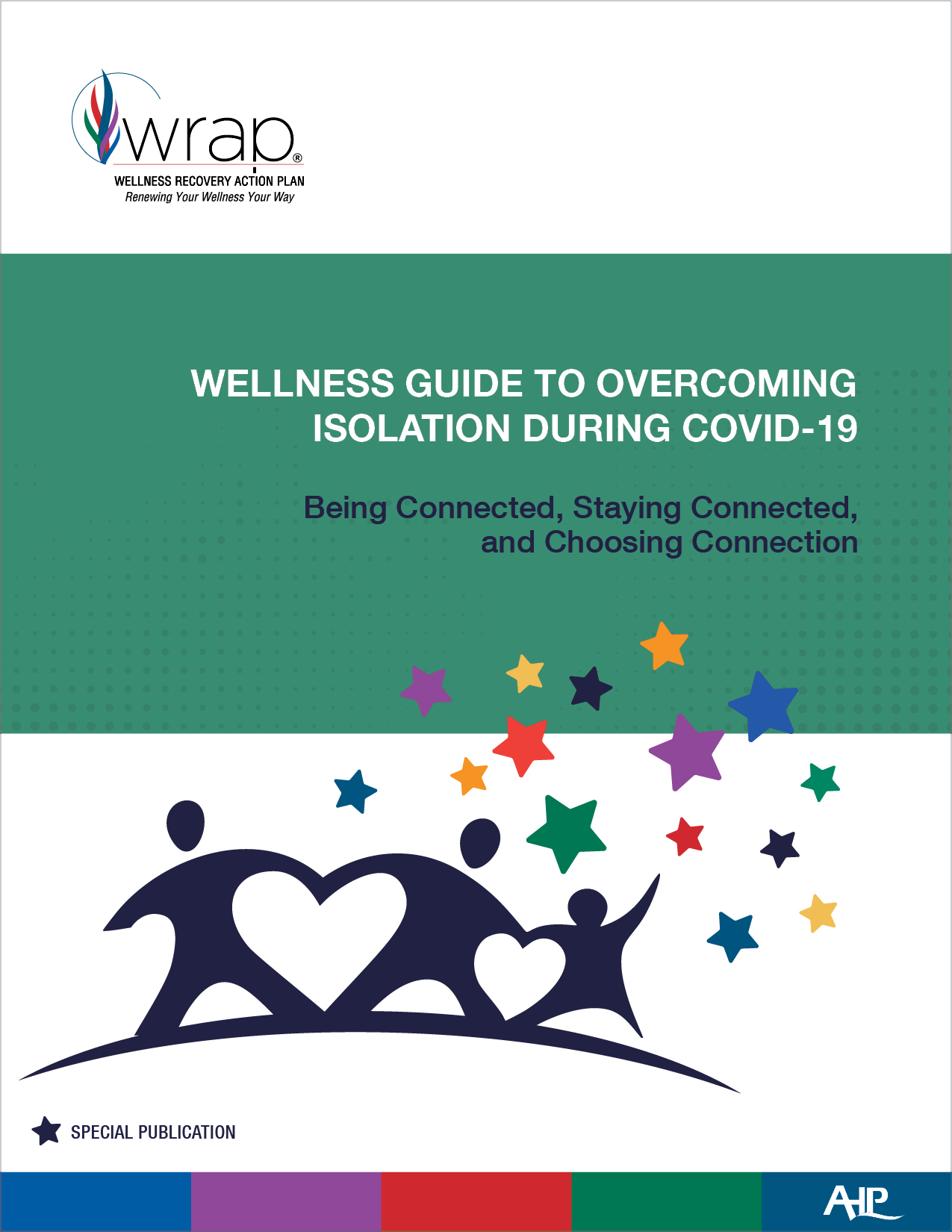
SUDBURY, Mass. — Advocates for Human Potential, Inc.’s (AHP) Human Potential Press today announced publication of an emotional wellness resource titled “Wellness Guide to Overcoming Isolation During COVID-19: Being Connected, Staying Connected, and Choosing Connection.” AHP adapted its evidence-based Wellness Recovery Action Plan (WRAP) publication series to help those who are struggling with isolation find ways to connect with themselves and others. The guide is available as a free digital download.
As rates of depression, stress, and other mental health issues rise during the COVID-19 pandemic, people are seeking ways to reduce feelings of fear, isolation and loneliness.
“Our mission focuses on helping organizations and individuals reach their full potential,” said Neal Shifman, president and CEO of AHP. “It is in the spirit of supporting full health and connection that we offer this new resource to all who might need it during this very difficult time. We encourage people to use it to overcome isolation and strengthen their connections, and we are happy to make it available to all who need it.”
The content helps readers discover ways to take action and create positive changes for themselves through self-exploration around maintaining emotional wellness and whole health. This resource also features:
Six sections, including “What Is Connection?,” “Connection Tools” and “Creating Structure.”
Ideas for first steps toward connection or reconnection.
Encouragement and personal examples that offer inspiration.
Space to write notes and ideas.
The “Wellness Guide to Overcoming Isolation During COVID-19” was developed in collaboration with the Copeland Center for Wellness and Recovery. It can be used individually, with friends or family members or with groups. As with all other WRAP materials, this guideis compatible with other health and wellness strategies, supports and treatment programs, including 12-step programs.
In 2016, Human Potential Press (HPP), the publishing arm of Advocates for Human Potential, Inc. (AHP), took over the publication, management, and distribution of all materials for WRAP and Recovery Books, which was founded in 1997. AHP and WRAP are committed to helping people everywhere reach their full potential. For 30 years, AHP has worked passionately to improve health systems and business operations through research and evaluation, training and technical assistance and professional consulting to help organizations and individuals reach their full potential.
Medicago announces positive results in animal trials for its vaccine candidate against COVID-19
QUEBEC CITY, May 14, 2020 /CNW/ - Medicago, a biopharmaceutical company headquartered in Quebec City, announced today that its vaccine candidate for COVID-19 induced a positive antibody response only 10 days after a single dose in mice.
"These positive results are pivotal to initiate a clinical study in healthy volunteers. Once results from a second 'boost' dose are available, Medicago will submit a clinical trial application to Health Canada and an investigational new drug submission with the FDA in the United States to allow for the initiation of human clinical trials this summer," said Nathalie Landry, Executive Vice-President Scientific and Medical Affairs at Medicago. "We are very encouraged about these promising early results achieved with our plant-derived vaccine candidate developed in Canada."
Though the precise dosage for the vaccine in humans is not yet determined, Medicago estimates its current facilities in Quebec and North Carolina could produce up to 20 million and 100 million annual doses, respectively, of pharmaceutical-grade COVID-19 vaccines. Millions of doses could be available by the end of the year as needed.
"We are working hard to add another 20 million doses capacity in Canada and 100 million in North Carolina for 2022, ahead of the completion of our large-scale factory in Quebec in 2023, which would be able to produce more than 1 billion doses of COVID-19 vaccines per year," said Michael Schunk, Executive Vice-President Operations at Medicago.
In early March, the company produced a Virus-Like Particle (VLP) of the coronavirus just 20 days after obtaining the SARS-CoV-2 gene and quickly initiated pre-clinical testing. The company expects to initiate Phase I clinical trials this summer. Following this trial, it is anticipated that the Phase 2 study will begin prior to the end of 2020.
Medicago is a leader in plant-based technology having previously demonstrated its capability to be a first responder in a flu pandemic. In 2009, the company produced a research-grade vaccine candidate against H1N1 in just 19 days. In 2012, Medicago manufactured 10 million doses of a monovalent influenza vaccine within one month for the Defense Advanced Research Projects Agency (DARPA), part of the U.S. Department of Defense. In 2015, Medicago also demonstrated that it could rapidly produce an anti-Ebola monoclonal antibody cocktail for the Biomedical Advanced Research and Development Authority (BARDA), part of the U.S. Department of Health and Human Services.
The company's first product, a seasonal recombinant quadrivalent VLP vaccine for active immunization against influenza, is currently under review by Health Canada following the completion of a robust safety and efficacy clinical program involving over 25,000 subjects.
Medicago's plant-based platform
The company uses a proprietary plant-based technology to develop protein-based therapeutics. Unlike traditional vaccination development, Medicago does not use animal products or live viruses to create its products. Instead, it uses Virus-Like Particles (VLPs) that mimic the shape and dimensions of a virus, which allows the body to recognize them and create an immune response in a non-infectious way. Clinical trial data suggest that VLPs have a multi-modal mechanism of action that is different from that of inactivated vaccines, activating both arms of the immune system – antibody and cell-mediated responses.
Medicago's proprietary technology is rapid, versatile, and scalable. As soon as the genetic sequence of a virus is made available, Medicago can develop a clinical-grade vaccine candidate in only a few weeks. Its recombinant technology allows the production of a vaccine that precisely matches the circulating strains, such as in the case of seasonal influenza. The technology is easily scalable, allowing the company to increase volume of production by simply increasing the number of plants it uses.
Product portfolio and pipeline
Medicago's first product, a Recombinant Quadrivalent Virus-Like Particle (QVLP) seasonal flu vaccine is presently under review by Health Canada. Vaccine candidates for pandemic flu, rotavirus and norovirus are being tested across pre-clinical and Phase II clinical trials. Medicago is also developing antibodies against hMPV, RSV and Opioids.
Facilities
Medicago is headquartered in Quebec City, Canada, and plans to produce COVID-19 vaccines and antibodies in its Quebec pilot plant to respond to the immediate short-term demand. The company also has a manufacturing facility in Durham, North Carolina (USA), which is currently dedicated to the production of vaccines and antibodies for its clinical trials and is expected to support the launch of the quadrivalent VLP influenza vaccine once it is approved. A new state-of-the-art manufacturing plant is under construction in Quebec City, which will be fully functional by 2023 and will have the capability to deliver up to 50 million doses of recombinant quadrivalent influenza vaccine per year.
About Medicago
Medicago is a biopharmaceutical company with more than 450 employees in Canada and the United States. Medicago's mission is to improve global health outcomes by leveraging innovative plant-based technologies for rapid responses to emerging global health challenges. Medicago is committed to advancing therapeutics against life-threatening diseases worldwide.
Dancing to the Darkest Light: Turning Tragedy Into Something Positive To Enrich The Lives Of Others
Los Angeles, CA, May 14, 2020— Arriving in New York after fleeing the terror of the Islamic revolution in Iran, Soheila Adelipour and her family believed the worst was behind them. Life was great for a while; the kids went to college, worked hard and were successful – then one tragedy after another hit and within a relatively short period of time Soheila had lost her son and two siblings. Determined to survive in spite of unspeakable loss, she established a foundation in her son’s name that provides healing and salvation for those less fortunate. Receiving accolades from broadcast journalist Barbara Walters, Soheila’s book, Dancing to the Darkest Light, tells her remarkably inspiring story of finding happiness in the face of unbearable tragedy.
Chronicling their experiences in Dancing to the Darkest Light, Adelipour recounts how her only brother became a neurosurgeon while others followed different paths. But their successful relocation and the joy they felt over each triumph was soon shattered when the Adelipour's second son, Stefan, was killed in a dorm room fire before his scheduled graduation from Boston University.
Adelipour channeled her grief into the foundation she established in his name. Soon after, her older sister had to undergo five brain surgeries that left her blind and deaf before ultimately claiming her life. The same week, their only brother who was supervising her care was diagnosed with leukemia. Adelipour gave him her bone marrow and 60 percent of her liver when his liver stopped functioning. Doctors ultimately announced he was cancer-free with a perfectly functioning liver, but the week he was to come home, he died from pneumonia.
How one perseveres under the weight of all this loss is at the core of Dancing to the Darkest Light. “When life plays different music, we have to be fluid and dance to the new tune,” Adelipour said.
Adelipour received her bachelor's degree in business and her master's degree in Art Gallery Management while her first two children were in diapers. She was involved with the World of Arts and Antiques in New York City and followed that by operating high-end gift stores.