National Advisory Committee on Immunization (NACI) recommends SHINGRIX for the prevention of shingles for adults aged 50 and up
MISSISSAUGA, ON, June 18, 2018 /CNW/ - The National Advisory Committee on Immunization (NACI) has made a strong recommendation for SHINGRIX, GSK's vaccine for the prevention of shingles. NACI recommends SHINGRIX should be offered to individuals 50 years of age and older without contraindications. Further, NACI indicates a strong recommendation should be followed unless there is a clear and compelling rationale for an alternative approach.i
Shingles is caused by reactivation of the varicella zoster virus (VZV), the same virus that causes chickenpox.ii More than 90 percent of those over 50 years old have had chickenpox and are at risk for shingles. A person's risk for shingles increases with age and an estimated 30% of Canadians will develop shingles in their lifetime.iii,iv,v
Dr Susie Barnes, Vice President and Country Medical Director, GSK Canada said: "After the age of 50 a person's risk for shingles increases. With approximately 130,000 new cases of shingles each year in Canada, the NACI recommendation is an important step forward for prevention of the disease among older Canadian adults."
SHINGRIX is indicated for the prevention of shingles (herpes zoster) in people aged 50 years or older.vi
About shingles
Shingles is caused by varicella zoster virus (VZV), the same virus that causes chickenpox.ii
Shingles typically presents as a rash, with painful blisters across the chest, abdomen or face. The pain is often described as aching, burning, stabbing or shock-like. Following the rash, a person can also experience post-herpetic neuralgia (PHN), pain that can last for months or years. ix PHN is the most common complication of shingles, occurring in up to 30 percent of all shingles cases.vii
Shingles affects an estimated 130,000 Canadians annuallyv Incidence rates are similar throughout North America, Europe and Asia-Pacific regionsxiii Older adults and those with conditions that compromise the immune system have the greatest risk for developing shingles. Nearly all adult Canadians (>90%) have had chickenpox and are therefore at risk for shingles. An estimated 30% will develop shingles in their lifetime and the risk increases to 50% for those who live to 85 years of agei,ix
About SHINGRIX
SHINGRIX [Herpes Zoster vaccine (non-live recombinant, AS01B adjuvanted)] is a non-live, recombinant subunit adjuvanted vaccine to help prevent herpes zoster (shingles) in adults 50 years of age and older. The vaccine is to be given intramuscularly in two doses with a two-to-six month interval between doses and combines an antigen (VZV glycoprotein E) and an adjuvant system (AS01B).viii
The Product Monograph, posted at www.ca.gsk.com, should be consulted for complete administration and safety information.
GSK is a science-led global healthcare company with a special purpose: to help people do more, feel better, live longer. For further information, please visit www.ca.gsk.com.
© GSK group of companies or its licensor. Trademarks are owned by or licensed to the GSK group of companies
Cautionary statement regarding forward-looking statements
GSK cautions investors that any forward-looking statements or projections made by GSK, including those made in this announcement, are subject to risks and uncertainties that may cause actual results to differ materially from those projected. Such factors include, but are not limited to, those described under Item 3.D 'Principal risks and uncertainties' in the company's Annual Report on Form 20-F for 2016. |
________________________
| i |
National Advisory Committee on Immunization (NACI). Updated Recommendations on the Use of Herpes Zoster Vaccines. Public Health Agency of Canada, June 2018 |
| ii |
Harpaz R, Ortega-Sanchez IR, Seward JF; Advisory Committee on Immunization Practices (ACIP), Centers for Disease Control and Prevention (CDC). MMWR Recomm Rep. 2008 Jun;57(RR-5):1-30. Prevention of herpes zoster: recommendations of the Advisory Committee on Immunization Practices. |
| iii |
National Advisory Committee on Immunization (NACI). Statement on the Recommended use of Herpes Zoster Vaccine. January 2010, 36(ASC-1):1-19. |
| iv |
Brisson, M, et al. Modelling the impact of immunization on the epidemiology of varicella zoster virus. Epidemiol. Infect. 2000; 125, 651-669 |
| v |
Canadian Immunization Guide: Part 4 – Active Vaccines, Herpes Zoster (Shingles) Vaccine.Last updated March 2014.Accessed June 1, 2018. http://healthycanadians.gc.ca/publications/healthy-living-vie-saine/4-canadian-immunization-guide-canadien-immunisation/index-eng.php?page=8 |
| vi |
SHINGRIX Canadian Product Monograph, October 2017 |
| vii |
Kawai, et al. BMJ Open. 2014; 4(6). Systematic review of incidence and complications of herpes zoster: towards a global perspective. |
| viii |
The GSK proprietary AS01 adjuvant system contains QS-21 Stimulon® adjuvant licensed from Antigenics LLC, a wholly owned subsidiary of Agenus Inc. (NASDAQ: AGEN), MPL and liposomes. |
SOURCE GlaxoSmithKline Inc.
5 Last Minute Tips for Getting Your Summer Face & Bod Fast from Beverly Hills Concierge Doctor Ehsan Ali, MD
Now that beach season is here, many of us are scrambling to figure out how to look our best in the warm weather, whether that be by toning our bodies or pampering our skin to achieve the ever-desired summer glow. That’s why Beverly Hills Concierge Doctor Ehsan Ali, MD, whose worked with stars including Liam Hemsworth, Bella Thorne and Emma Stone, is sharing his top five last-minute methods to get in ideal summer shape fast:
- CoolSculpting
Like liposuction but non-invasive/non-surgical, CoolSculpting is a pain-free way to efficiently get rid of unwanted fat. CoolSculpting’s reliable technology targets stubborn fat to freeze and kill the cells. During the weeks following treatment, your body naturally eliminates the cells, providing a long-term remedy for unwanted fat storages. Contact a licensed clinician, like Dr. Ehsan Ali, for a consultation.
- Medical Weight Loss Plan
For the most personalized, holistic treatment for weight loss, experienced doctors can work with you to customize a plan to reach your goals. Whether with or without prescription medicine, your doctor can help you to figure out the most appropriate diet/exercise/treatment plan that will target your specific needs to get you in your best shape possible.
- Ketogenic Diet
The ketogenic diet is sweeping the nation as one of the fastest and most effective diets to be used for weight loss. The ketogenic diet is unique in that it does not only require very low dietary carbohydrate intake, but it also requires a very high consumption of dietary fat (and moderate protein). With this general macronutrient ratio, your body switches from using glucose (sugar) as fuel to using fat for energy, which ultimately leads to rapid weight loss and body fat reduction... without you having to count calories! Dr. Ali recommends consulting your doctor while on this diet.
- Microneedling for the Face or Body
Microneedling is a procedure that involves creating a bunch of punctures all over the top layer of your skin in order to boost collagen production. Therefore, microneedling can work wonders for fine lines, sun damage, wrinkles, acne scars/hyperpigmentation, overall skin texture, and more. It is not a painful procedure, it is very fast, and it can be done anywhere on the body. While it is recommended to visit a doctor to discuss this treatment, those who are interested may also consider at-home microneedling as well.
- PRP Treatments
PRP treatment, or plasma rich platelets injection therapy, is another very effective way to treat lackluster skin. With PRP, the patient’s own blood is drawn and then re-injected in the target areas by the doctor. A step up from microneedling, the plasma helps even more to stimulate the formation of collagen. This makes all skin types improve greatly and glow.
Please let me know if you’re interested in speaking with Dr. Ehsan Ali about any or all of these fantastic last-minute fixes for the perfect summer look! I can either connect you over the phone or send him any questions you may have by email.
Looking forward to hearing back!
Best,
Lauren
About Dr. Ehsan Ali
" src="blob:http://www.trainitright.com/30ee28a1-ac62-4a49-b746-686cf0c59f15" alt="Portable Network Graphics image" align="left" hspace="9" class="Apple-web-attachment Singleton">
Dr. Ehsan Ali, MD is Board Certified in Internal Medicine. He also completed a specialized training in Geriatric Medicine. Upon completing his medical training from NYU, Dr. Ali Ehsan moved to Los Angeles. His work experience includes being a physician on staff with the Cedar-Sinai Medical Group, where he was a primary care doctor. He also has worked as a “Hospitalist”, which is the care of patients while they are hospitalized and suffering from acute/critical illnesses. Dr. Ali's office is located in Beverly Hills and he currently offers house calls to his patients in Beverly Hills, Bel Air, West Hollywood, Brentwood, Santa Monica, Malibu and surrounding areas of Los Angeles.
In his spare time, Dr. Ali volunteers at free medical clinics in inner city areas, to help provide medical care to uninsured patients.
Dr. Ali is also a clinical instructor to medical students from UCLA.
Retirees Battling Alzheimer’s Prepare for the Trip of a Lifetime
According to the Alzheimer’s Association, 1 in 10 people aged 65 and older has Alzheimer's — and those numbers are rising fast. Alzheimer’s is now the 6th-leading cause of death in the U.S., and by 2050 it is expected that someone will develop Alzheimer’s or another dementia every 33 seconds.
“When we look at these numbers,” says Lisa Winstel, Chief Operating Officer of Caregiver Action Network (CAN), “it’s clear that now is the crucial time to talk about a vital job that so few people are prepared for, but which so many of us will be asked to perform with grace in the coming years: serving as the primary caregiver for a loved one who suffers from Alzheimer’s or dementia.”
When you picture caregivers for patients with these diseases, you may envision doctors, nurses, and support staff at assisted care facilities. But the long descent of life with Alzheimer’s means most caregiving begins at home, when a dedicated spouse or child takes on the new and often stressful role of primary caregiver. In the US, it is estimated that there are 65.7 million unpaid family caregivers providing care to someone who is ill, disabled, or aged.
For Dick and Ellen Akers, her diagnosis of early-onset Alzheimer’s has led to big changes in both the roles they share in their 53-year marriage and in their long-awaited retirement plans. But they bravely refuse to let these new caregiving challenges stop them from following through on their biggest goal.
“We originally expected to have years to enjoy all the retirement benefits of moving from Ohio to Florida and living in The Villages,” says Dick Akers. “Now, we’re planning one last vacation together, while Ellen is still lucid enough to enjoy it.”
Ellen Akers has never been to Europe, so Dick undertook the challenge of organizing their two-week river cruise up the Danube River on AMA Waterways — which is a big difference from their usual responsibilities. “Ellen has always been the planner,” says Dick, a former aeronautics engineer whose role around the house was intentionally minimal: he’d manage repairs, while Ellen liked to manage almost everything else. (“After 53 years, I’m still on probation,” Dick jokes.) But that all changed three years ago, when Dick noticed a change in Ellen’s behavior.
“I would make simple statements, and she would answer with questions, or with evident signs of forgetfulness,” says Dick. The big indicator came when the staff of their weekly house cleaning service told Dick that Ellen was telling them the exact same stories every time they visited. So Dick helped Ellen arrange some doctors’ visits — first with their primary care physician, and then with a recommended neurologist. But when Dick learned that Ellen had cancelled an appointment with her neurologist and forgot to reschedule, “that was the moment I realized I needed to become more active and take charge of the situation.”
Since then, Dick has helped Ellen navigate the many changes in their daily routine as she adapts to her new life with Alzheimer’s. Where the kitchen was once exclusively Ellen’s domain, Dick now does all the cooking and meal planning. He switched Ellen’s primary care physician to his own, so they can attend their checkups at the same time. He manages a spreadsheet that tracks all of Ellen’s doctor visits, diagnoses, medications, and more — and he takes a copy with him to every new meeting, where he takes notes to ensure that no new prescriptions will create conflicts with existing medications. He also manages a daily online calendar, so their daughter and son can keep track of Ellen’s condition from a distance.
Right now, he’s especially focused on the details of their big trip, which begins on June 21. He wants Ellen to have the time of her life, but he’s also worried about her decreased mobility (which is further complicated by an unrelated knee injury that could eventually require a replacement), as well as managing all of her medicines and troubleshooting any problems that may arise while they’re overseas.
How is Dick coping with all this added stress? So far, he says he hasn’t thought much about it yet — but he knows he needs to. “I still golf a few days a week,” he says, “but I don’t stay to have food and drinks with the guys afterward, because I’m reluctant to leave Ellen alone for more than a few hours at a time.” He says his family has been supportive, and his daughter calls regularly and flies down to Florida to help whenever she can, but the bulk of the daily responsibility is on him. As such, he and Ellen have become active advocates in raising awareness of the role of caregivers across the country.
“It’s so important to be aware of everything that goes into managing Alzheimer’s,” says Dick, who reads books and subscribes to newsletters about the disease. “But each individual patient responds differently, which means every situation is different. You have to continually evaluate as you go.”
Luckily, five decades of marriage have helped Dick and Ellen uniquely prepare for this challenge. “Ellen is one of the most pleasant, nicest, kindest people I’ve ever known,” says Dick. “But it’s still hard, because she gets so frustrated with herself when she notices these changes in her behavior. And I can’t do anything to assuage her, other than to say, ‘it’s not your fault. We’ll get through this together.’”
We invite you to interview Dick and Ellen Akers about the process of caregiving with Alzheimer’s, and about the complications and adventures of traveling internationally while managing the disease. You’re also invited to interview Lisa Winstel, Chief Operating Officer of Caregiver Action Network (CAN), which provides education, peer support, and resources to family caregivers across the US.
Research suggests that the overwhelming physical, emotional and financial burden faced by unpaid caregivers in the US. Alarmingly, nearly half (45%) of unpaid caregivers surveyed feel that their physical health has suffered as a result of their caregiver duties.
Other key survey findings include:
· Nearly half (45%) of unpaid caregivers surveyed in the US don’t often have time to book or attend medical appointments for themselves. This is particularly concerning considering older caregivers, who often face chronic health conditions themselves: 86% of unpaid caregivers surveyed aged 66-75 care for someone aged 65 and over.
· Nearly half (49%) of unpaid caregivers surveyed in the US have feelings of depression with a similar amount (48%) feeling that they needed medical care/support for a mental health condition (e.g. depression, anxiety, stress) due to their role as an unpaid caregiver. Of these nearly a quarter (20%) have not sought medical help.
· 41% of female unpaid caregivers surveyed in the US feel being a caregiver has put pressure on their financial situation, as compared to 28% of male caregivers.
About EMBRACING CARERS TM
Launched in 2017, Embracing CarersTM is a global initiative led by Merck KGaA, Darmstadt, Germany, in collaboration with leading caregiver organizations around the world to increase awareness and discussion about the often-overlooked needs of caregivers. It is understood that caregivers play a crucial role in the lives of patients. What is less understood are caregivers’ needs for resources and support focused on improving their own health and well-being. And while significant progress has been made in certain areas/geographies, serious gaps remain. Embracing Carers™ addresses this by highlighting the unmet needs of caregivers’ within the US and around the world; by empowering caregivers to advocate for their own health and wellbeing, and by driving a call to action for support of caregivers including support within healthcare systems.
https://www.embracingcarers.com/
Caregiving in the United States
In the US, it is estimated that there are 65.7 million unpaid family caregivers providing care to someone who is ill, disabled, or aged. Each day, in every community around the world, people provide care for those who need it most, often putting their own lives on hold or altering their daily routines to ensure that an ill or disabled loved one or friend has the support they need.
Known as caregivers, these individuals often get little support or recognition for the work they do, but they are essential for improving patient outcomes. Caregivers are not limited by culture or country — they are universal, sharing common traits and facing common challenges.
Beyond today, it is estimated that the global population of people aged 60 years and older will more than double, from 900 million in 2015 to about 2 billion in 2050.

If you would rather not receive future communications from Carrie Butler, let us know by clicking
here.
Carrie Butler, 215 E. 42nd Street 19th Floor, New York, NY 10017 United States

Vacation vs. Guilt - Difficult Choices for the Full-Time Caregiver
Many individuals bear the mantle of caregiver, responsible in some form for the care of an aging parent. In the United States, there are an estimated 65.7 million unpaid family caregivers providing care to someone who is ill, disabled, or aged. For some carers, that takes a immediate, physical form as an aging relative lives with them. For many others, such as Dyan Alexander, they may not provide direct physical support, but perform the complex and unending task of coordinating care.
When Ms. Alexander’s mother was 85, she fell and broke her hip. The mobility challenges made it impossible for her mother, Pat LoCascio and her husband Charles, to continue to live independently. The LoCascio’s moved into an assisted living facility in Florida, then after Charles’ death, Ms. Alexander and her sister moved their mother up to Annapolis Maryland where Alexander lives.
Alexander shares, “It fell on me to be the primary liaison for all of her healthcare and living needs.“ She interviewed assisted living facilities, became a self-taught expert in Medicare, and visited her mother nearly every day. All this was added to an already full plate of responsibilities. Alexander was working full-time and often cared for her granddaughter. One evening Alexander had her granddaughter over for a much-anticipated slumber party, when she received word that he mother had fallen and was being transported to the hospital. Her attention quickly went from tea parties to triage.
During the year-and-a-half of her mother’s illnesses,which included COPD and congestive heart failure, Alexander didn’t take any vacations. On the rare occasions she would get away for a rushed, guilty weekend, travel was anything but relaxing.
Lisa Winstel, Chief Operating Officer of Caregiver Action Network, notes that Alexander’s story is far too typical. “Caregivers are seeking to perform an enormous task with finite resources. They often end up shorting themselves on the very resources—such as rest and medical care—that they need to perform this role effectively for a sustained amount of time.”
One organization is seeking to bridge that gap between carers and resources. Launched in 2017, Embracing Carers is a global initiative led by EMD Serono, in collaboration with leading caregiver organizations around the world to increase awareness and discussion about the often-overlooked needs of caregivers. Embracing Carers seeks to provide resources and support to these vital carers.
Pat LoCascio passed away several weeks ago from pneumonia. Alexander has to grieve for her mother while continuing to coordinate memorials and discharge duties as her mother’s power of attorney. “I am exhausted,” Alexander confesses.
About EMBRACING CARERS TM
Launched in 2017, Embracing CarersTM is a global initiative led by Merck KGaA, Darmstadt, Germany, in collaboration with leading caregiver organizations around the world to increase awareness and discussion about the often-overlooked needs of caregivers. It is understood that caregivers play a crucial role in the lives of patients. What is less understood are caregivers’ needs for resources and support focused on improving their own health and well-being. And while significant progress has been made in certain areas/geographies, serious gaps remain. Embracing Carers™ addresses this by highlighting the unmet needs of caregivers’ within the US and around the world; by empowering caregivers to advocate for their own health and wellbeing, and by driving a call to action for support of caregivers including support within healthcare systems.
https://www.embracingcarers.com/
Caregiving in the United States
In the US, it is estimated that there are 65.7 million unpaid family caregivers providing care to someone who is ill, disabled, or aged. Each day, in every community around the world, people provide care for those who need it most, often putting their own lives on hold or altering their daily routines to ensure that an ill or disabled loved one or friend has the support they need.
Known as caregivers, these individuals often get little support or recognition for the work they do, but they are essential for improving patient outcomes. Caregivers are not limited by culture or country — they are universal, sharing common traits and facing common challenges.
Beyond today, it is estimated that the global population of people aged 60 years and older will more than double, from 900 million in 2015 to about 2 billion in 2050.

11 HEALTH BENEFITS THAT YOU CAN OBTAIN WHEN YOU REPLACE ALL DRINKS WITH WATER

The benefits of drinking water are many. From helping you to improve your physical performance to improving your energy levels and relieving common illnesses like constipation, headaches and more, drinking enough water is essential for your overall physical, emotional and psychological well-being.
One of the other advantages of drinking water is that it helps prevent dehydration. You can read in-depth about it in our recent article on the health benefits of drinking water to prevent dehydration. Thus, to put it simply, drinking enough water ensures that cells and organs within our body are working and functioning optimally at all times.
In our post today, we will take a look at what happens when we drink water instead of the usual soft drinks and other caffeinated beverages. What are the health benefits that we can obtain by switching to plain and pure drinking water and how it can help us maintain good health in the long run.
But, before we move forward, here is an infographic on the various Health Benefits one can obtain by replacing all drinks with Water. Take a look!
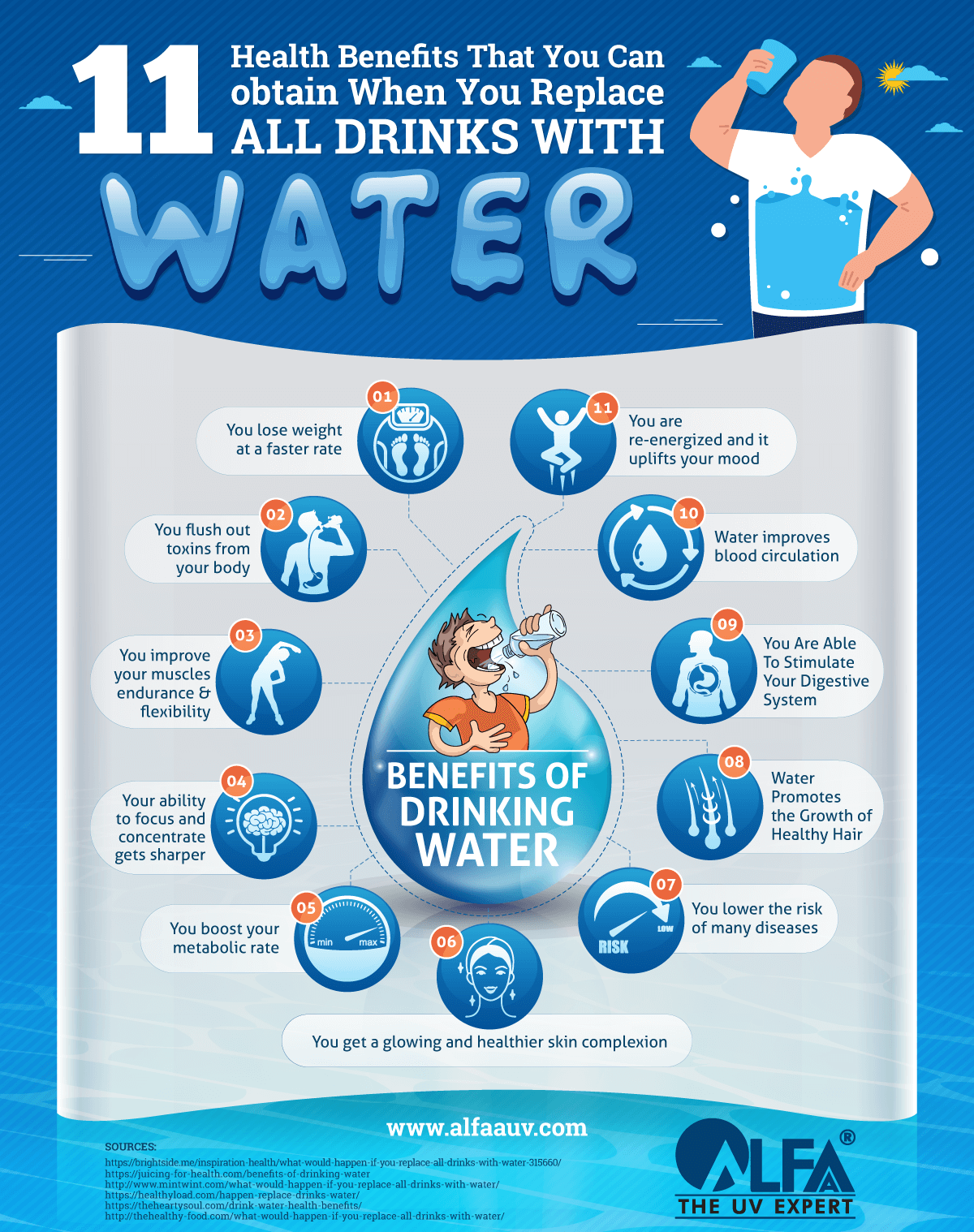
Now, without further ado, let’s find out what happens when you replace all drinks with water!
1. You Lose Weight At A Faster Rate
Drinking water or drinking warm water for weight loss is one of the most recommended methods. As a natural remedy that helps you lose weight, water has zero calories, sugar or fat as opposed to drinks like sweetened beverages and alcoholic drinks that are full of calories.
When you replace the intake of these sugary and fizzy drinks with water, you are helping boost your metabolism, which, in turn, ensures that you lose weight at a faster rate. Water is also a natural appetite suppressant and various health studies have shown that drinking two glasses of water before meals can help dieters lose more weight.
Drinking water to lose weight is a tried and tested technique. Plus, since dehydration makes you weak, fat and sick, consuming enough water will help keep this adverse effect at bay.
2. You Flush Out Toxins From Your Body
Drinking too much soda/soft drinks can cause kidney damage. Since kidneys help eliminate toxins and waste from the body, its inability to perform the said function due to high sugar consumption can lead to the accumulation of metabolic waste which can cause a lot serious health problems.
Water, on the other hand, is a natural lubricant that helps the kidneys to function well. By drinking enough water, your kidneys are able to perform at their maximum helping you flush out toxins from the blood and urine through the bladder, thus helping you keep your body and system clean from the inside out.
3. You Improve Your Muscles Endurance & Flexibility
When it comes to building and maintaining bones, Calcium is one of the important minerals that is required. Consuming large amounts of carbonated drinks (drinks that contain dissolved carbon dioxide) can interfere with calcium absorption, resulting in weak bones and muscles. Thus, in order prevent this, it is essential that you severely cut-back on soft drinks and energy drinks that contain carbonation and replace these with water.
The importance of water in our body can’t be overemphasized. Not many may be aware of the fact that Water constituents for a large part of our muscle composition. Water helps absorb and retain essential minerals, which, in turn, helps us maintain healthy and strong bones. As such, by keeping yourself well-hydrated, you are able to not only improve your muscles endurance but you are also able to improve your flexibility, which will help you achieve peak performance in all that you do.
4. Your Ability To Focus & Concentrate Gets Sharper
Apart from affecting your physical health, sugary fizzy drinks or carbonated drinks can also hurt your mental health. Over-consumption of these beverages can lead to dehydration and can trigger an imbalance in certain brain chemicals, resulting in issues like depression, poor memory, brain fatigue, and lack of mental clarity.
By switching over to water, you are able to effectively combat the ill-effects of these beverages. Also, by ensuring your body is well-hydrated, you are making sure that your brain, which is made up of 80% of water, is able to access the required amount of oxygen which is needed in order for it to function at an optimal level.
Water helps enhance your ability to focus better. It also helps increase concentration and memory power. Additionally, it reduces daytime fatigue and aids in preventing attention deficit disorders in both – children and adults alike.
5. You Boost Your Metabolic Rate
What is Metabolism?
In simple terms, metabolism refers to the rate at which your body is able to convert food into energy.
Drinking large amounts of sweetened, caffeinated and carbonated drinks leads to dehydration, which increases the risk of metabolic disorders resulting in weight gain, sugar cravings, lethargy, joint and muscle pains etc.
By replacing these drinks with water, you are able to hydrate your body, thus speeding up your metabolic rate, leading to a faster burning of calories. Plus, water helps regulate and manage blood sugar levels keeping fatigue, lethargy and sugar cravings at bay which further promotes good health.
6. You Get A Glowing and Healthier Skin Complexion
One of the major benefits of replacing your favourite soft drinks with plain water is bright and radiant skin. Aerated drinks are known to cause damage to skin cells and collagen bonds resulting in premature ageing, dullness, dryness, dark spots, wrinkles and others.
Thus, to nullify the effects of these harmful drinks and to detoxify your body, it is advisable that you drink sufficient water on a daily basis. This helps to flush out toxins and facilitates faster production of blood and muscle cells, providing you with a glowing and healthier skin complexion in a very short span of time.
7. You Lower The Risk Of Many Diseases
It is a proven fact that when you eliminate high-fat and high-sugar foods from your diet it ultimately leads to a healthier life. When you cut-down on sugary drinks, which offers you no essential nutrients, vitamins or minerals, and replace it with water you are able to improve your overall general health.
Water helps improve blood circulation, digestion, and aids in the greater absorption of essential nutrients, thus preventing muscular cramps, headaches, constipation, kidney stones and other illnesses. In addition, water also helps reduce the risk of obesity in children and it helps decrease the risk of cardiovascular diseases in adults.
8. Water Promotes The Growth Of Healthy Hair
Excessive consumption of alcohol and fizzy drinks can also lead to hair loss. Since carbonated drinks make it difficult to produce essential hormones which are needed for hair growth, it can result in stunted hair that is brittle and flaky. As such, if you want to have healthy hair then moving to water is your best bet.
Water helps to deeply nourish your hair roots. It also helps you to hydrate your scalp. Further, by drinking enough water, you will be able to get rid dandruff and itchy scalp, thus promoting hair growth and ensuring that you have a healthy and gleaming hair.
9. You Are Able To Stimulate Your Digestive System
Carbonated drinks primarily consist of dissolved carbon dioxide that can cause indigestion and flatulence. Similarly, soft drinks or soda are mostly acidic and a high consumption of it can lead to pH imbalance leading to a host of serious digestion problems like bloating, stomach ulcers, diarrhoea, gas and stomach pain.
Therefore, to steer clear of these issues and to achieve a healthy and an improved digestive system, switching over to drinking water is essential. Adequate intake of water on a day-to-day basis will help prevent stomach disorders and will improve bowel movements. Plus, it will help improve the balance of pH levels in your body and aid in preventing constipation.
10. Water Improves Blood Circulation
Artificial sweeteners found in many sugary drinks and soda can cause some of the blood vessels to perform irregularly leading to an array of health problems such as high-blood pressure, increase heart rate, reduce blood flow to the brain and the digestive system, and other vital organs.
As one of the most crucial elements of human life, water can help improve blood circulation in the body, thereby ensuring that your blood vessels are not impeded in any way. Hence, if you want your blood circulatory system to work efficiently then you need to quit sodas and other sugary drinks as soon as possible and replace these with pure drinking water.
11. You Are Re-energized and It Uplifts Your Mood
A leading cause of lethargy and chronic fatigue is sugary, caffeinated and carbonated drinks. Too much intake of caffeine and soft drinks leads to dehydration resulting in you feeling tired and sleepy. The sudden spike in blood sugar followed by the sudden crash causes hormonal imbalance, resulting in fatigue, irritability, mood swings, sugar cravings among others.
To tackle this issue, you need to swap sugary drinks for water which will help boost your energy levels, and aid in the process of stress relief. Also, keeping yourself hydrated is the key to maintaining a bright and sunny mood. Plus, it will help improve productivity throughout the day by keeping you energized.
Conclusion
As you can see above, the physical, emotional and mental health benefits of replacing alcoholic beverages, sugary fizzy drinks and carbonated drinks with water are innumerable. When you replace all these harmful drinks with water, you are able to improve your general health, skin, hair and digestives system. Plus, it helps improve blood circulation, boost metabolism and aids in weight loss.
Therefore, if you want to obtain these benefits of water then a lifestyle change, wherein, you replace all sugary fizzy drinks with water is important and by doing this, you will notice a visible change in your overall health.
Lastly, to get the maximum health benefits from water, you need to ensure that you consume pure and safe drinking water devoid of all contaminants. For this, you need to purchase the best water purifier and as such, here is a comprehensive guide on how to select the best water purifier for home use that you can refer to. You can also get in touch with us if you want to know more about different water purifiers.
Carrot Rewards and RBC challenge Canadians to pick up the pace on wellness
RBC encourages Canadians to live healthier lives by offering RBC Rewards points through the Carrot Rewards app
TORONTO, June 14, 2018 /CNW/ - Today Carrot Rewards announced that Canadians can now earn RBC Rewards points when they invest in their wellness by learning how to live healthier, and by achieving daily step goals with the Carrot Rewards app.
"Joining hands with one of our country's largest banks provides us with a terrific opportunity to accelerate our shared vision to make a positive impact on the everyday lifestyles of Canadians," said Andreas Souvaliotis, Chief Executive Officer, Carrot Rewards. "Adding RBC Rewards to the menu of choices on the Carrot Rewards app will further boost our platform's unique relevance and popularity."
According to the Public Health Agency of Canada's recent report, How Healthy Are Canadians?1, more than 77% of Canadian adults and nearly 91% of children and youth are not meeting the Canadian Physical Activity Guidelines. The Carrot Rewards app helps to make physical activity and wellness fun by providing a gamified experience that delivers real rewards to Canadians.
"Whether it's our support of youth mental health initiatives or our longstanding commitment to grassroots sport and the Olympic movement in Canada, RBC has an extensive history of supporting and promoting health and wellness in communities around the globe," says Jacquelina Calisto, Vice President, Global Loyalty & Rewards, RBC. "That's why we're investing in a range of innovative relationships with organizations like Carrot. We understand the importance of well-being in our clients' lives, and in 2017, we committed more than $15 million to health and wellness programs in Canada."
The Carrot Rewards app is currently available for free download to Canadians in British Columbia, Ontario and Newfoundland and Labrador from the App Store on iPhone, iPad or at http://www.AppStore.com, and Google Play on Android devices, or at play.google.com. For more information, visit rbcrewards.com/carrotrewards.
About Carrot Rewards
Carrot Rewards is an AI-driven public engagement platform that leverages behavioural economics and nudge theory to motivate Canadians to make better everyday lifestyle choices. Carrot harnesses the power of the most popular consumer loyalty programs in Canada to maximize its appeal and user engagement. Carrot users earn their choice of Aeroplan® Miles, SCENE®Points, Petro-Points™, More Rewards® Points, Drop points or RBC Rewards points each time they interact with the app. The Carrot platform was created in collaboration with public sector agencies, the three leading Canadian health NGOs and the private sector. With over a million downloads across Canada, Carrot is the most popular and trusted engagement platform in the country. Carrot was recognized as Canadian App of the Year and in 2018, was ranked as a Top 10 Loyalty Program in the country by the Bond Brand Loyalty Report.
About RBC
Royal Bank of Canada is a global financial institution with a purpose-driven, principles-led approach to delivering leading performance. Our success comes from the 81,000+ employees who bring our vision, values and strategy to life so we can help our clients thrive and communities prosper. As Canada's biggest bank, and one of the largest in the world based on market capitalization, we have a diversified business model with a focus on innovation and providing exceptional experiences to our 16 million clients in Canada, the U.S. and 34 other countries. Learn more at rbc.com.
We are proud to support a broad range of community initiatives through donations, community investments and employee volunteer activities. See how at http://www.rbc.com/community-sustainability/.
SOURCE Carrot Rewards
Fertility Study: Women Who Eat McDonald’s Less Likely to Become Pregnant
Sexual health expert explains new study which links fast food consumption and reduced fertility
For the second year in a row, the U.S. fertility rate has hit a record low. While there are many possible factors behind our declining birth rate, new research has found many surprising culprits behind infertility…including a love of fast food.
“If you or someone you love is struggling with infertility, this latest study out of Australia is definitely one to be aware of,” says Dr. Laura Berman, sexual health expert, radio host, television personality and New York Times bestselling author. “The researchers found that women who eat fast food frequently have double the risk of infertility when compared to women who eat fast food rarely or never.”
What can explain this link? Dr. Berman points to the fact that fast food is highly processed and contains high amounts of sodium, saturated fats and added sugar.
So, what should women who are trying to conceive eat instead? Lots of seafood, according to a recent Harvard University study.
“The researchers found that couples who eat seafood frequently are more likely to have active sex lives and more likely to become pregnant,” says the sexual health expert. “Meanwhile, a Greek study has found that women who eat a Mediterranean diet are more likely to be successful on their IVF journey than women who do not. In other words, eating a plant-based diet with lots of healthy fats (such as olive oil and avocados) and lean protein like fish could help you to become pregnant,” says Dr. Berman, national radio show host of “Uncovered with Dr. Laura Berman.”
However, eating seafood and abstaining from Taco Bell won’t make a bit of difference if you are using the wrong lubrication in the bedroom, says Dr. Berman.
“Couples know that they need to enjoy lots of love-making in order to increase their chance of conception, but when it comes to making babies, not all lubricants are created equal,” explains Dr. Berman. “There is only one lubricant on the market which has an FDA-cleared formula and is recommended for fertility enhancement, and that is ToConceive.”
ToConceive was created by ob-gyns in conjunction with Callitas Health Inc. (CSE: LILY, OTCBB: MPHMF, FWB: T3F2). The fertility enhancing gel is unlike any other fertility product on the market in that it may help encourage the woman’s body to create more of her own lubrication, which in turn may increase the activation of sperm and the woman’s chances of pregnancy. Unlike every other lubricant on the market, ToConceive doesn’t just add chemical lubricants to a woman’s body, it may encourage her to make more of her own natural lubrication which not only adds to her pleasure, but also may improve her chances of natural conception.
“There are so many things that couples can do to help protect their reproductive health and increase their chances of getting pregnant,” says Dr. Berman. “Using the right lubrication is a simple and cost-effective step to take before heading to the fertility clinic.”
Getting Healthy: How to Improve Your Overall Health and Wellness

Your health is wealth. If you don’t have your health, it’s very difficult to live a beautiful and abundant life. Knowing this, it’s incredibly important to become intentional and invest in your overall health and wellness. In order to develop a strong regimen, consider these four tips.
Eat Clean with the 80/20 Rule
The 80/20 rule is great because it allows you to embrace your humanity. So many people try to maintain a strict diet and wind up falling off of the wagon because of the difficulties of the discipline. Try eating lots of fruits, vegetable, nuts and grains. If you maintain that diet on a consistent basis, it’s okay for you to enjoy a nice ice cream cone over the weekend.
Drink Lots of Water
Water is so essential to maintaining a healthy body. When you’re trying to figure out the amount, know that the body needs at least half of its weight in ounces of water. If you find it really difficult to consume that much water, start by scheduling it. Drink a bottle of water in the morning as you wake up and heat it up. Add fresh-squeezed lemon juiceas a detoxifier each morning.
Consult the Professionals
If you experience a plateau, it can be really frustrating. Many people tend to quit because they’ve reached a plateau and aren’t experiencing the change they’d like to see. Consider consulting professionals about how to move past your plateau. They offer weight loss servicesand can give informed wisdom based on their research.
Exercise
You’ve got to move every single day. If you eat every day (as you should), you should make sure you’re moving every day. If it’s difficult for you to embrace exercise, find different ways to make it happen in an enjoyable fashion. If you love to dance, go to Zumba dance class. If you love to walk, go to the closest lake and walk for an hour. If you follow a bunch of Instagram yoga gurus, learn how to practice yoga. If swimming excites you, find a local pool and swim a few laps every day.
As you continue along this journey, you’ll learn different techniques and tricks that work so well in helping you achieve your goals. You might also find that certain foods, exercises and routines don’t work well for you. Embrace where you are and commit to the journey. As you continue to see progress, you’ll also feel better and the desire to continue will increase.
‘Text Neck’ Means Trouble For Those Addicted to Mobile Devices
Well before the invention of cell phones, medical experts agreed that poor posture is the leading cause of back and neck pain. But the explosion of 24-7 cell phone use has seriously compounded this problem - and even given rise to a new medical condition: ‘Text Neck”.
“Text neck” is the nickname for all the back, neck and spinal issues affecting those who spend too much time on their cell phones and mobile devices. It is due to the constant hunching over people do to peer into their mobile screens, which malforms the spine. Physicians are reporting children as young as eight years old are affected.
Collectively, Americans check their smartphones over 8 billion times per day. And young adults age 18 to 24 send or receive an average of 109.5 text messages on a typical day. .
“Just look at any crowd of young people, chances are most are exhibiting very poor posture from tilting their head down to read their device. This forces their neck & back muscles to work at awkward angles - just to keep the body upright, and pain and strain is often the result,” says Robert Gearhart, an operating room nurse and co-inventor of Body Aline (www.bodyaline.com), an exercise machine designed to strengthen the back and realign the spine.
“Cell phones aren’t going anywhere, so it looks like text neck will become a health problem of epidemic proportion in the years ahead,” Gearhart said. “If the trend continues, it looks like in 20 years the number of people who will have spine issues due to this will be astronomical.”
He says the best way to check your mobile device is to stand up straight and look at your device at eye level instead of reading it next to your torso, which usually results in your chin going down towards your chest. Or lie on your stomach when spending long periods of time on your phone. This provides a safe and natural passive isometric exrcise to restore the natural curve to the neck.
Of course, it is not just mobile devices that can give a person back problems – there are many causes and some, such as arthritis, have no easy answers. However, Gearhart says frequently the cause of back pain can be something that can be adjusted with proper lifestyle choices, such as:
- Take breaks from desk jobs. When working at a computer, take a short break every 15 or 20 minutes, then move around and change your body and head positions.
- Adjust your workspace. Set your computer monitor at eye level. Raise your smartphone to eye level rather than lowering your head. Get a tablet holder to elevate your device close to eye level. If possible, get a standing desk or an ergonomic chair. Don’t slouch at your desk.
- Use voice-to-text as often as possible. This cuts down on the amount of time you are looking down at your phone.
- Hold Your Phone At Eye Level. Do not look down and allow your chin to move towards your chest when you are on your mobile device. This causes the back of the neck to support the head instead of the shoulders.
“Taking some preventative measures,” Gearhart says, “is much easier than trying to treat a spine that is already out of alignment.”
About Robert Gearhart
Robert Gearhart, the co-inventor of Body Aline (www.bodyaline.com), is an operating room nurse. He noticed an increasing number of patients with back problems, and teamed with Jason Bowman, a certified personal trainer and former engineer, to create Body Aline. It is an exercise machine designed to strengthen the back and realign the spine.
| Maria Shriver Launches New Program with BrainHQ to Help Women Make Cognitive Health Part of Their Wellness Routines
SAN FRANCISCO June 12, 2018 – Maria Shriver is an award-winning journalist, a New York Times bestselling author, and one of the world’s leading advocates for women and Alzheimer’s. Now, she has just announced via an online video that she is teaming up with the brain exercise platform BrainHQ to offer a new program that is dedicated to raising the bar on women’s brain health.
This special version, which can be found online at brainhq.com/maria, launched to coincide with celebration of Brain Awareness Month. It also follows the huge success of Shriver’s Move for Minds initiative, which runs throughout June and works to educate women about lifestyle changes they can make to improve brain health.
“Women’s brains have a special journey, with different experiences and challenges from those of men,” Shriver said. “We must recognize the ways that women’s brains are different and we must broaden our definition of women’s health to include the brain. My goal is to give women the information and resources they need to keep their brains active and healthy throughout life. Together with BrainHQ, we’re now offering women a practical and scientifically-proven tool that can improve cognitive health and can fit easily into busy lives.”
As founder of The Women’s Alzheimer’s Movement, Shriver has been at the forefront of educating the public that women are at an increased risk for Alzheimer’s disease. In 2010, “The Shriver Report: A Woman’s Nation Takes on Alzheimer’s,” reported for the very first time that women make up two-thirds of all the Alzheimer’s cases in this country and that Alzheimer’s is predominately a woman’s disease.
“I see this as the ultimate women’s empowerment issue,” Shriver said. “Women work their whole lives to be recognized for their minds, and then Alzheimer’s puts them at risk of losing them. That’s unacceptable to me, and I won’t rest until we find a solution.”
“When it comes to cognitive performance, I hope BrainHQ program can be one piece of the puzzle for women in their 30s, 40s, 50s and beyond,” Shriver continued. “I also hope it can be a tool for caregivers, as well as for fitness trainers who can make this an integral part of any workout. Let’s face it, stretching, training and challenging your brain is just as important as stretching, training and challenging your body.”
Henry Mahncke, CEO of Posit Science, the maker of BrainHQ, noted there are more than 100 peer-reviewed studies on the benefits of the exercises in BrainHQ, across varied populations. Those benefits include better performance in standard measures of cognition (e.g., speed, attention, memory); in standard measures of quality of life (e.g., mood, confidence, health-related quality of life); and in real world activities (e.g., balance, driving, activities of independent living).
In her online video announcing the collaboration, Shriver spoke to neurologist Dr. Richard Isaacson about the benefits of BrainHQ cognitive training.
“Brain training has a ton of evidence, and the strongest evidence has been with the BrainHQ program,” Isaacscon said. “In randomized studies where they track people over years, they’ve found that people who participate in brain training activities … find that their brain function has improved.”
As with the regular version of BrainHQ, this special version gives users access to dozens of exercises that continuously personalize to each user, and the ability to measure and improve brain performance over time. The new version adds some women’s health context for the exercises, as well as encouragement from Maria Shriver.
People can use different exercises for free each day, or can get a general access subscription for as little as $8 per month.
“Maria Shriver has done incredible work raising the public consciousness about women’s brain health,” said Dr. Henry Mahncke. “We hope our collaboration will help women recognize the importance of doing brain exercises and caring for their brains, so they can remain top performers throughout life.” |
|
|